
AI and Automation in HR Technology: Practical Use Cases for HR
HR TECH & ANALYTICS
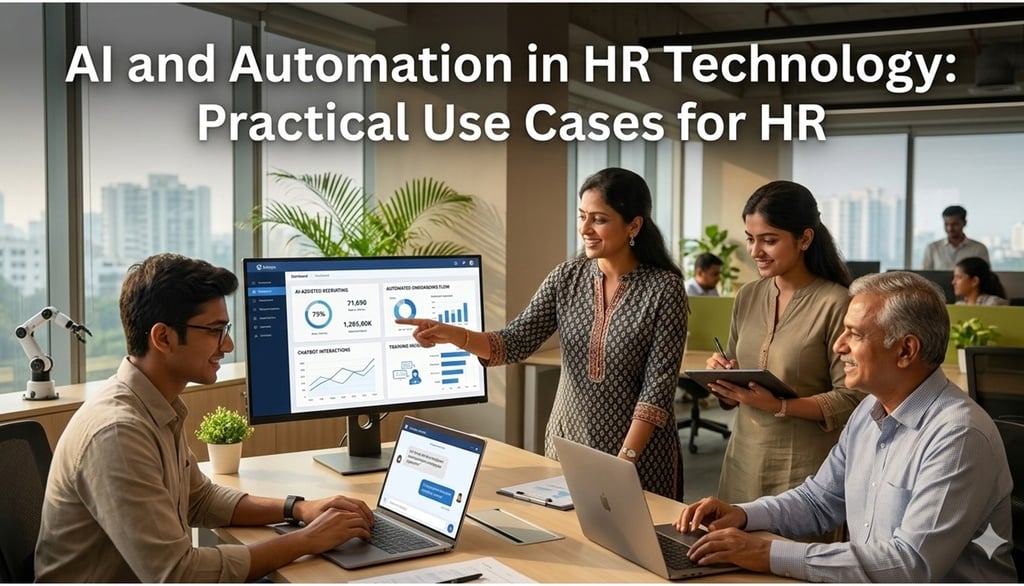
Artificial Intelligence (AI) and automation are increasingly being discussed in HR, often with a mix of excitement and uncertainty. In the Indian organisational context, HR teams are under pressure to manage scale, improve efficiency, and support faster decision-making—while still maintaining fairness and human judgement.
AI and automation in HR should be viewed as enablers, not replacements for HR professionals. When applied thoughtfully, they help streamline routine processes, surface insights from data, and allow HR to focus on strategic and people-centric work. This article explains practical HR use cases for AI and automation, with a grounded, realistic perspective.
Understanding AI and Automation in HR
Automation refers to rule-based systems that handle repetitive tasks such as data entry, approvals, and notifications.
AI goes a step further by identifying patterns, making predictions, and supporting decision-making based on data.
In practice, most HR systems in India currently use a combination of automation and basic AI, rather than advanced or autonomous decision-making models.
Key HR Use Cases for AI and Automation
Recruitment and Hiring
AI-supported tools help HR teams manage high volumes of applications by:
Screening resumes based on predefined criteria
Matching candidate profiles to job requirements
Scheduling interviews automatically
Automation reduces administrative workload, while HR retains control over final hiring decisions.
Employee Onboarding
Automation ensures consistency and timeliness by:
Triggering document collection and approvals
Assigning onboarding tasks and learning modules
Sending reminders to new hires and managers
This improves the new hire experience and reduces delays.
HR Operations and Employee Queries
AI-powered chatbots and automation can:
Respond to common employee queries (leave, policies, payroll dates)
Guide employees to the right HR resources
Reduce dependency on HR for routine clarifications
This is especially useful in large or distributed Indian organisations.
Performance and Learning Support
AI can assist HR by:
Recommending learning based on performance gaps
Identifying skill trends across teams
Highlighting patterns in appraisal outcomes
These insights support better development planning without replacing managerial judgement.
Practical Benefits for Indian Organisations
Scalability: Handles growing employee numbers without proportionate HR expansion
Consistency: Ensures uniform processes across locations
Efficiency: Reduces manual effort and processing time
Data visibility: Enables quicker access to insights for planning
The value lies in incremental improvements, not dramatic transformation.
Risks and Limitations HR Must Be Aware Of
AI and automation also come with risks:
Bias in algorithms due to flawed or incomplete data
Over-reliance on system recommendations
Lack of transparency in automated decisions
Employee mistrust if usage is not communicated clearly
HR must ensure that technology supports fairness, not undermines it.
HR’s Role in Responsible AI Adoption
HR has a critical role in ensuring responsible use:
Defining where automation should and should not be used
Validating AI recommendations with human judgement
Ensuring compliance with data privacy and labour regulations
Communicating clearly with employees about how technology is used
AI should assist HR decision-making, not replace accountability.
Measuring Success of AI and Automation in HR
Success should be evaluated through:
Reduction in processing time and errors
Improvement in employee experience
Adoption and usage rates
Quality of insights supporting HR decisions
Technology success is measured by outcomes and trust, not sophistication.
Conclusion
AI and automation offer meaningful opportunities for Indian HR teams when applied with clarity and restraint. Rather than pursuing advanced tools for their own sake, HR should focus on practical use cases that improve efficiency, consistency, and decision support.
By keeping people, ethics, and organisational context at the centre, HR can ensure AI and automation remain valuable enablers in modern HR practice.
Checklist: AI and Automation in HR Technology
🗹 Identify HR processes suitable for automation based on volume and repetition.
🗹 Clearly define the purpose of AI use in each HR area.
🗹 Ensure data quality before applying AI-based tools.
🗹 Retain human oversight over all critical HR decisions.
🗹 Evaluate tools for transparency and explainability.
🗹 Communicate clearly with employees about AI usage.
🗹 Monitor outcomes for bias, accuracy, and fairness.
🗹 Train HR teams to interpret AI-driven insights responsibly.
🗹 Review legal, ethical, and data privacy implications regularly.
SampleTable: A I and Automation Use Cases in HR
Conclusion--
Effective labour law compliance depends on how well HR operations, payroll, and business processes work together. When compliance is embedded into everyday workflows, organisations reduce risk, improve accuracy, and build sustainable governance systems. HR teams that prioritise integration over isolation are better positioned to manage compliance confidently and consistently.
HireDesk India © 2026 | All Rights Reserved
"Thoughtful guidance for everyday HR"


Quick Links
Topics
Connect
_______________________________________________________________________________________________________________________________________________________________________________________
HireDesk is a free HR knowledge platform focused on practical, India-specific workplace guidance. We help HR professionals, managers, and learners navigate people practices with clarity, responsibility, and real-world relevance.