
AI in Learning and Development: Opportunities and Limitations for HR
HR TECH & ANALYTICS
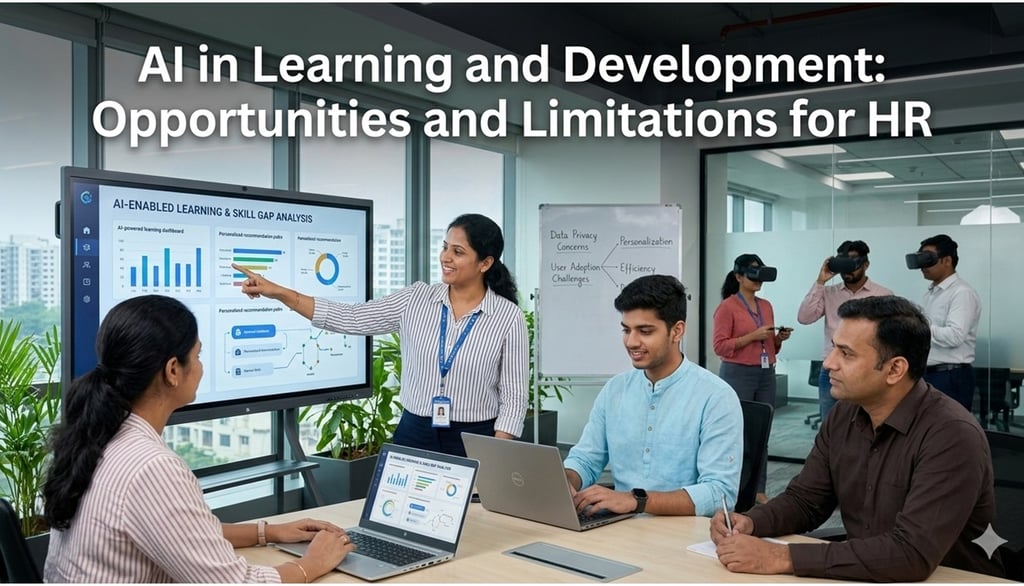
Artificial Intelligence (AI) is increasingly being discussed as a game changer in Learning and Development (L&D). From personalised learning recommendations to automated content creation, AI-enabled tools promise efficiency, scalability, and data-driven decision-making.
However, for Indian organisations, the real value of AI in L&D lies not in adopting advanced features blindly, but in understanding where AI genuinely adds value and where human judgement remains essential. This article explores the practical opportunities and limitations of AI in L&D, with a grounded HR perspective.
What AI Means in the Context of L&D
In L&D, AI typically refers to algorithms and systems that analyse learner data to automate, personalise, or optimise learning experiences. AI is embedded within LMS, LXP, content platforms, and analytics tools rather than functioning as a standalone solution.
Common AI applications in L&D include:
Learning recommendations based on role or skill gaps
Automated assessments and quizzes
Chatbots for learner support
Content tagging and search optimisation
Predictive insights on learning needs
Opportunities of AI in Learning and Development
Personalised Learning Experiences
AI enables learning platforms to suggest content based on an employee’s role, past learning behaviour, performance data, or career aspirations. This moves organisations away from one-size-fits-all training programmes.
Improved Learning Accessibility
AI-powered chatbots and mobile-friendly tools provide instant support, helping employees navigate learning platforms, access content, or clarify queries without HR intervention.
Faster Content Discovery
AI improves how learning content is organised and surfaced. Tagging, search, and recommendations reduce the time learners spend finding relevant material.
Learning Analytics and Insights
AI supports deeper analysis of learning data, helping HR identify:
Skill gaps
Learning adoption patterns
Drop-off points in courses
Readiness for future roles
These insights help HR prioritise interventions rather than relying on assumptions.
AI in the Indian Organisational Context
Indian organisations often face constraints such as:
Large and diverse workforces
Varying digital literacy levels
Budget sensitivity
Legacy systems
In such environments, AI adoption must be incremental and practical. AI should simplify learning and decision-making rather than introduce complexity or alienate learners.
Limitations and Risks of AI in L&D
Overdependence on Algorithms
AI recommendations are only as good as the data they are trained on. Incomplete or biased data can lead to misleading learning suggestions.
Loss of Context and Human Insight
AI cannot fully understand organisational culture, team dynamics, or individual motivation. Managerial and HR judgement remains critical in development decisions.
Data Privacy and Trust Concerns
Learning data often includes performance indicators, career aspirations, and behavioural patterns. Improper handling can erode employee trust.
Uneven Adoption
Employees with limited digital exposure may struggle with AI-driven interfaces, reducing adoption and effectiveness.
HR’s Role in Responsible AI Adoption
HR must act as a custodian rather than a passive user of AI tools. This includes:
Defining clear use cases for AI in L&D
Ensuring transparency in how learning data is used
Validating AI-generated insights with human review
Educating employees and managers on AI-supported learning
AI should support HR decisions, not replace them.
Measuring the Impact of AI in L&D
Success should be assessed through:
Improvement in learning relevance and engagement
Reduction in time spent searching for content
Better alignment between skills and roles
Quality of insights supporting workforce planning
The focus should remain on outcomes, not technological sophistication.
Conclusion
AI offers meaningful opportunities to enhance learning effectiveness, accessibility, and insight generation in L&D. For Indian organisations, the real value lies in thoughtful, responsible adoption aligned with organisational maturity and workforce needs.
When combined with strong HR governance and human judgement, AI can act as a powerful enabler of continuous learning rather than a disruptive force.
Checklist: Using AI in Learning and Development Effectively
🗹 Define specific learning problems before introducing AI tools.
🗹 Start with simple AI features such as recommendations and search.
🗹 Ensure learning data quality before relying on AI insights.
🗹 Maintain transparency on how learner data is used.
🗹 Avoid replacing managerial judgement with automated decisions.
🗹 Support digital adoption through communication and training.
🗹 Monitor learner experience and adoption regularly.
🗹 Validate AI-driven insights with HR and business context.
🗹 Review privacy and access controls periodically.
🗹 Treat AI as an enabler, not a standalone solution.
Sample Table: AI Opportunities and Limitations in L&D
Conclusion--
Effective labour law compliance depends on how well HR operations, payroll, and business processes work together. When compliance is embedded into everyday workflows, organisations reduce risk, improve accuracy, and build sustainable governance systems. HR teams that prioritise integration over isolation are better positioned to manage compliance confidently and consistently.
HireDesk India © 2026 | All Rights Reserved
"Thoughtful guidance for everyday HR"


Quick Links
Topics
Connect
_______________________________________________________________________________________________________________________________________________________________________________________
HireDesk is a free HR knowledge platform focused on practical, India-specific workplace guidance. We help HR professionals, managers, and learners navigate people practices with clarity, responsibility, and real-world relevance.