
Aligning Rewards and Recognition with Company Values in Indian Businesses
EMPLOYEE EXPERIENCE & CULTURE
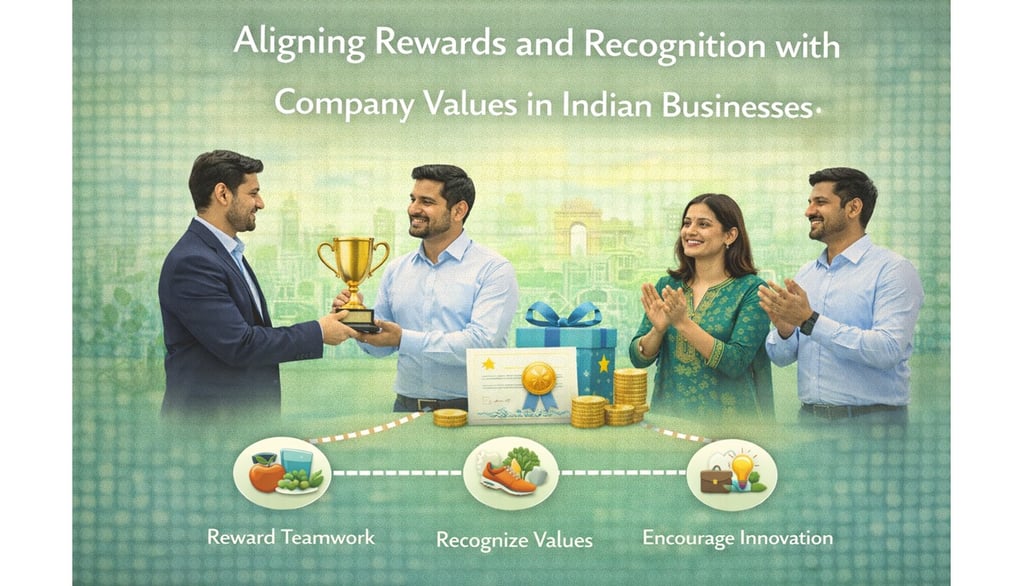
Many Indian organisations proudly display their values on walls, websites, and induction decks. However, employees quickly notice a gap when rewards and recognition are driven only by numbers, targets, or visibility — not by how those results are achieved.
When rewards are misaligned with values, organisations unintentionally reinforce the wrong behaviours. This article explains how HR can align rewards and recognition with stated values so that culture is experienced, not just communicated.
Why Values Often Remain Symbolic
In Indian businesses, values fail to translate into behaviour because:
Rewards focus only on outcomes
Behavioural expectations are not clearly defined
Managers lack guidance on value-based recognition
High performers are excused despite poor conduct
Over time, employees learn that values are optional.
Turning Values into Observable Behaviours
HR must convert abstract values into practical actions.
For example:
Integrity → Following process even under pressure
Collaboration → Sharing information and supporting teams
Respect → Treating all roles with dignity
Customer focus → Responsible decision-making
Recognition should target these observable behaviours.
HR’s Role in Value-Based Rewards
HR’s responsibility is to build structure and discipline.
Key actions include:
Defining value-linked behaviour indicators
Training managers to recognise behaviours
Balancing results and conduct in rewards
Auditing recognition patterns
Correcting misalignment promptly
Values gain meaning when they influence outcomes.
Avoiding Value Dilution in Indian Contexts
Common risks include:
Over-rewarding revenue or delivery at any cost
Ignoring behaviour of influential performers
Token value awards with no credibility
Inconsistent application across teams
Consistency matters more than grand gestures.
Embedding Values Across Reward Mechanisms
Alignment should cut across:
Spot awards
Performance appraisals
Promotions
Incentives and bonuses
Leadership recognition
Employees should see values influencing decisions at every level.
Conclusion
In Indian organisations, values become real only when they affect who gets rewarded, promoted, and trusted. HR’s role is to ensure rewards reinforce the culture the organisation claims to stand for — even when it requires difficult choices.
What you reward repeatedly is what your culture becomes.
HR Checklist: Aligning Rewards with Values
🗹 Define behaviours linked to each value
🗹 Train managers on value-based recognition
🗹 Balance results and conduct in rewards
🗹 Audit recognition and reward patterns
🗹 Correct misalignment early
🗹 Apply standards across hierarchy
🗹 Communicate value-linked decisions clearly
🗹 Review alignment regularly
Values-to-Rewards Alignment Framework
Conclusion--
Effective labour law compliance depends on how well HR operations, payroll, and business processes work together. When compliance is embedded into everyday workflows, organisations reduce risk, improve accuracy, and build sustainable governance systems. HR teams that prioritise integration over isolation are better positioned to manage compliance confidently and consistently.
HireDesk India © 2026 | All Rights Reserved
"Thoughtful guidance for everyday HR"


Quick Links
Topics
Connect
_______________________________________________________________________________________________________________________________________________________________________________________
HireDesk is a free HR knowledge platform focused on practical, India-specific workplace guidance. We help HR professionals, managers, and learners navigate people practices with clarity, responsibility, and real-world relevance.