
Automating Payroll, Leave, and Attendance Systems: Streamlining HR Operations in Indian Organisations
HR TECH & ANALYTICS
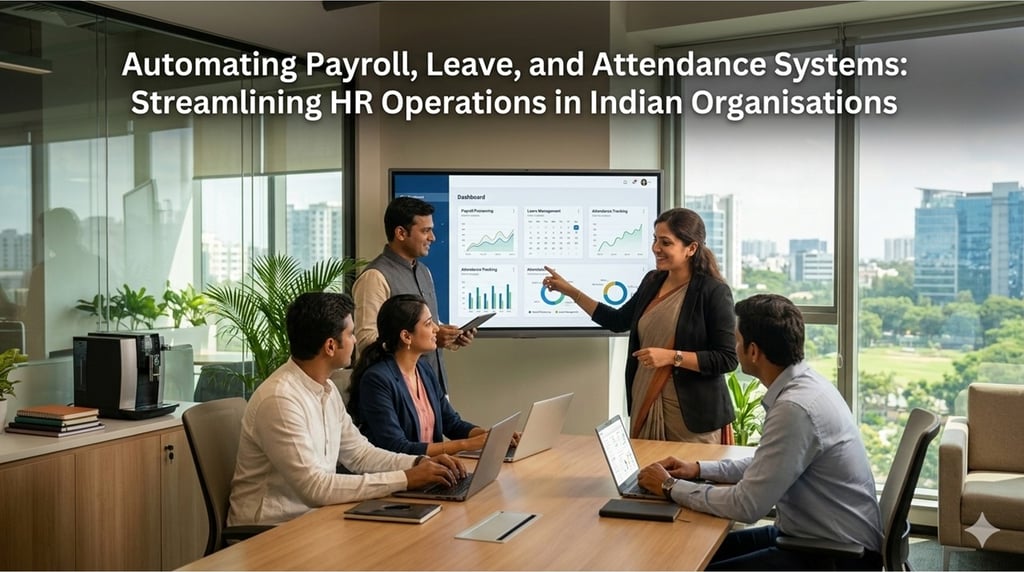
Payroll, leave, and attendance management are core HR operations that directly impact employee satisfaction, compliance, and operational efficiency. Traditionally, these processes in Indian organisations have been manual, prone to errors, and time-consuming.
Automation offers a solution—reducing human error, improving compliance, and freeing HR teams to focus on strategic initiatives. However, successful automation requires careful planning, integration, and adherence to legal requirements.
Benefits of Automating Payroll, Leave, and Attendance
1. Accuracy and Compliance
Minimises errors in salary computation, deductions, and statutory contributions (PF, ESI, TDS)
Ensures adherence to central and state labour laws
Simplifies audit processes
2. Time and Cost Efficiency
Reduces manual processing time
Frees HR for value-added activities like employee engagement
Streamlines approval workflows for leave and attendance
3. Employee Transparency and Satisfaction
Employees can access payslips, leave balances, and attendance records in real time
Reduces queries and complaints
Improves trust in HR operations
4. Data-Driven Decision Making
Provides insights on absenteeism trends, overtime, leave patterns, and payroll costs
Supports workforce planning and budgeting decisions
Automation Considerations for Indian Organisations
Integration with HR Systems
Payroll, leave, and attendance systems should integrate seamlessly with:
HRMS or HRIS
Performance management systems
L&D and learning platforms
Finance and accounting systems
Statutory Compliance
Ensure system handles PF, ESI, professional tax, TDS, gratuity, and other statutory calculations accurately
Incorporate state-specific leave policies where applicable
Accessibility and Employee Self-Service
Provide employee access via web and mobile platforms
Include options for leave applications, approvals, and payslip downloads
Enable managers to track team attendance and leave trends
Security and Data Privacy
Protect sensitive employee data with role-based access
Maintain audit trails for compliance purposes
Ensure cloud-based systems comply with Indian data protection guidelines
Challenges in Payroll and Attendance Automation
Resistance to change from employees or managers accustomed to manual processes
Integration issues with legacy systems
Incorrect or incomplete master data leading to errors
Keeping up with statutory updates and complex policies
These challenges can be mitigated with proper planning, pilot testing, and continuous monitoring.
HR’s Role in Automation Success
HR must act as both a facilitator and guardian of automated systems:
Define requirements and process workflows
Validate payroll and leave policies in the system
Train employees and managers on usage
Monitor system performance and address exceptions
Ensure legal compliance and ethical use of data
Automation is effective only when HR ensures accurate implementation and ongoing governance.
Conclusion
Automating payroll, leave, and attendance systems transforms operational HR processes in Indian organisations. When implemented thoughtfully, automation:
Improves accuracy and compliance
Increases efficiency and employee satisfaction
Enables better workforce insights and decision-making
By combining technology with strong HR oversight, organisations can streamline routine operations and focus on strategic initiatives that drive business outcomes.
Checklist: Automating Payroll, Leave, and Attendance Systems
🗹 Map existing payroll, leave, and attendance processes clearly.
🗹 Define statutory compliance requirements (PF, ESI, TDS, gratuity, state-specific leave).
🗹 Choose systems that integrate with HRIS/HRMS and finance platforms.
🗹 Provide employee self-service access via web and mobile.
🗹 Maintain data privacy, security, and audit trails.
🗹 Validate payroll calculations regularly for accuracy.
🗹 Train HR, managers, and employees on the system.
🗹 Monitor usage and exceptions to improve adoption.
🗹 Update system settings in line with statutory changes.
🗹 Review automation impact on time, cost, and employee satisfaction.
Sample Table: Payroll, Leave, and Attendance Automation Features
Conclusion--
Effective labour law compliance depends on how well HR operations, payroll, and business processes work together. When compliance is embedded into everyday workflows, organisations reduce risk, improve accuracy, and build sustainable governance systems. HR teams that prioritise integration over isolation are better positioned to manage compliance confidently and consistently.
HireDesk India © 2026 | All Rights Reserved
"Thoughtful guidance for everyday HR"


Quick Links
Topics
Connect
_______________________________________________________________________________________________________________________________________________________________________________________
HireDesk is a free HR knowledge platform focused on practical, India-specific workplace guidance. We help HR professionals, managers, and learners navigate people practices with clarity, responsibility, and real-world relevance.