
Background Verification, Reference Checks, and Due Diligence
RECRUITMENT AND HIRING
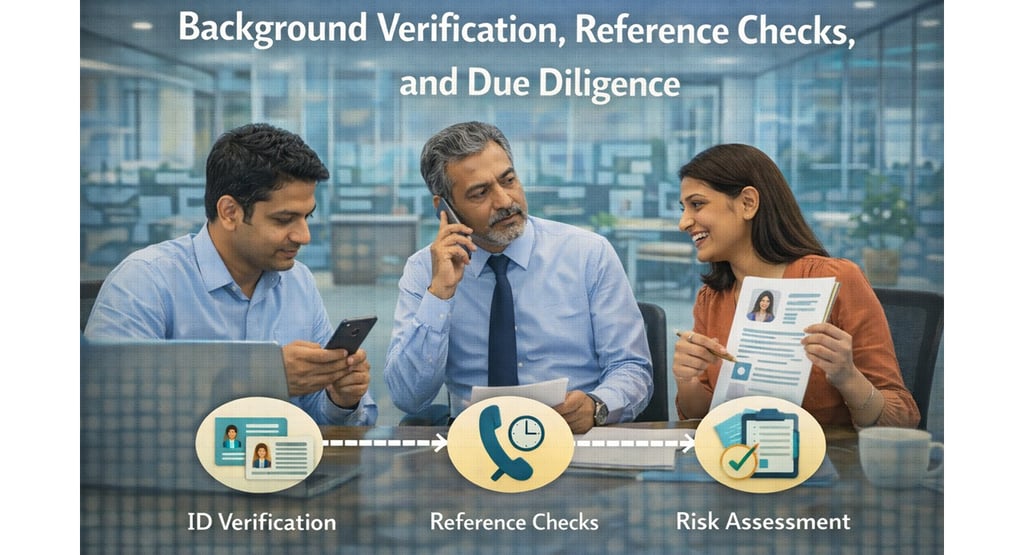
Background verification (BGV), reference checks, and due diligence are critical steps to ensure the integrity, competence, and reliability of hires in Indian organisations. With the rise of resume inflation, undisclosed employment gaps, and varying educational standards, these processes safeguard organisations against operational, financial, and reputational risks.
For HR, BGV is not a mere formality—it is a structured control that reinforces hiring quality, compliance, and trust across the business.
Indian Context and Practical Realities
In India, background verification faces unique challenges:
Resume embellishment is common, especially for mid-level and technical roles
Education and degree verification can be inconsistent across boards and institutions
Employment history may be partially undocumented or informal
Professional and personal references are limited or biased
Legal restrictions under privacy and employment laws need careful navigation
Understanding these realities helps HR design practical and legally compliant verification processes.
Core Components of Verification and Due Diligence
1. Identity and Document Verification
Fundamental to every hire:
Aadhaar, PAN, passport, or voter ID checks
Age, address, and identity confirmation
Verification of statutory documents like PF, ESI, and bank account
This ensures correct payroll, compliance, and audit records.
2. Educational Verification
Education credentials impact eligibility and technical competence:
Verify degrees, diplomas, and certificates with issuing institutions
Check professional certifications as claimed
Use credible third-party vendors for high-volume or senior roles
This reduces the risk of misrepresentation.
3. Employment and Experience Checks
Employment verification validates experience claims:
Confirm previous roles, tenure, and responsibilities
Check reason for leaving and reporting structure
Highlight gaps or inconsistencies
For senior roles, deeper due diligence may include industry reputation and achievements.
4. Reference Checks
References provide qualitative insights beyond documentation:
Speak to supervisors or managers when possible
Ask about work ethic, reliability, attitude, and cultural fit
Maintain structured questionnaires to reduce bias
References complement factual verification with behavioural intelligence.
5. Legal and Regulatory Compliance
HR must comply with Indian laws:
Obtain written consent from candidates for background checks
Respect privacy norms under IT Act and GDPR-like provisions
Avoid discriminatory or invasive questions
Structured consent protects both candidate and employer.
6. Use of Technology and Vendors
Professional verification vendors reduce administrative burden
Digital verification platforms enable faster turnaround
HR should retain ownership, validate vendor accuracy, and track completion
Technology supports efficiency but does not replace judgement.
HR’s Role in Verification and Due Diligence
HR acts as a gatekeeper and process owner:
Define verification standards for each role level
Ensure timely initiation of checks post-offer acceptance
Review and flag discrepancies for hiring managers
Maintain confidential records for audit purposes
Periodically update vendors and processes for reliability
Proactive HR involvement strengthens hiring credibility.
Conclusion
Background verification, reference checks, and due diligence are essential pillars of responsible hiring in India. When executed systematically, they mitigate operational, legal, and reputational risks while reinforcing candidate integrity and organisational trust.
HR’s disciplined management of these processes ensures that hiring decisions are informed, defensible, and sustainable.
🗹 Background Verification & Due Diligence Checklist
🗹 Verify identity and statutory documents before payroll initiation
🗹 Check educational credentials with issuing institutions
🗹 Validate previous employment and experience claims
🗹 Conduct structured reference checks for qualitative insights
🗹 Obtain written consent from candidates for verification
🗹 Track discrepancies and escalate appropriately
🗹 Use vendors and technology for efficiency while retaining oversight
🗹 Maintain confidential records for audit and compliance
Background Verification and Due Diligence Overview
Conclusion--
Effective labour law compliance depends on how well HR operations, payroll, and business processes work together. When compliance is embedded into everyday workflows, organisations reduce risk, improve accuracy, and build sustainable governance systems. HR teams that prioritise integration over isolation are better positioned to manage compliance confidently and consistently.
HireDesk India © 2026 | All Rights Reserved
"Thoughtful guidance for everyday HR"


Quick Links
Topics
Connect
_______________________________________________________________________________________________________________________________________________________________________________________
HireDesk is a free HR knowledge platform focused on practical, India-specific workplace guidance. We help HR professionals, managers, and learners navigate people practices with clarity, responsibility, and real-world relevance.