
Balancing Accountability and Development in Performance Management
PERFORMANCE & DEVELOPMENT
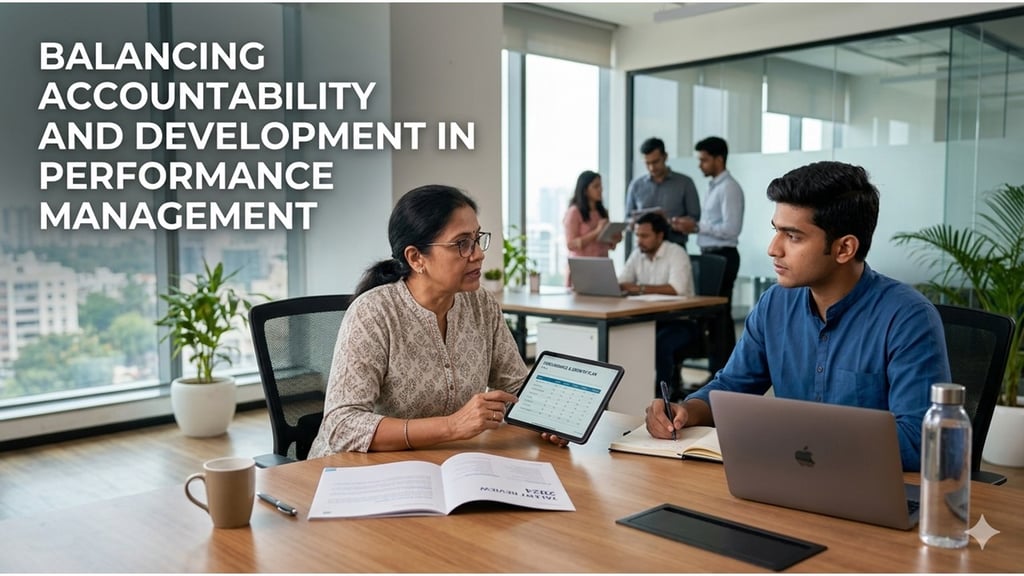
Performance management often fails when it is seen either as a control mechanism or purely as a developmental exercise. Organisations that over-emphasise accountability risk fear-driven compliance, while those that focus only on development may dilute standards.
An effective performance management system balances clear accountability with continuous employee development—ensuring results are achieved while capabilities grow.
Understanding Accountability in Performance Management
Accountability ensures that:
Performance expectations are clearly defined
Employees understand their responsibilities
Outcomes are measured objectively
Consequences—positive or corrective—are applied consistently
Accountability provides structure and fairness, particularly in growing or multi-location Indian organisations.
Understanding Development in Performance Management
Development focuses on:
Skill enhancement and career growth
Capability-building aligned with future roles
Continuous feedback and learning opportunities
Employee engagement and retention
A developmental approach recognises that performance gaps often reflect capability or context, not intent.
Why Balance Is Critical
Without balance:
High accountability, low development → Stress, disengagement, attrition
High development, low accountability → Mediocrity, role ambiguity
Balanced systems encourage employees to take ownership while feeling supported to improve.
Practical Ways to Balance Accountability and Development
1. Clear Goals with Development Conversations
Goals should define what needs to be achieved, while reviews should explore how improvement and growth can happen.
2. Continuous Feedback over Annual Judgement
Regular check-ins reduce surprises and shift focus from evaluation to improvement.
3. Performance Reviews Linked to Learning Plans
Every performance discussion should result in actionable development steps—not just ratings.
4. Differentiated Responses to Performance Gaps
Skill gaps → Training, coaching, mentoring
Effort or attitude issues → Accountability discussions
5. Manager Capability Building
Managers must be trained to hold firm yet supportive conversations.
Sample Table: Balancing Accountability and Development
Role of HR in Maintaining the Balance
HR plays a critical role by:
Designing systems that integrate results and learning
Training managers on balanced performance conversations
Ensuring fairness and consistency across teams
Preventing performance management from becoming punitive
Key Takeaway
Effective performance management is not a choice between accountability and development. It is the integration of both—ensuring employees are responsible for outcomes while being supported to grow and succeed.
Conclusion--
Effective labour law compliance depends on how well HR operations, payroll, and business processes work together. When compliance is embedded into everyday workflows, organisations reduce risk, improve accuracy, and build sustainable governance systems. HR teams that prioritise integration over isolation are better positioned to manage compliance confidently and consistently.
HireDesk India © 2026 | All Rights Reserved
"Thoughtful guidance for everyday HR"


Quick Links
Topics
Connect
_______________________________________________________________________________________________________________________________________________________________________________________
HireDesk is a free HR knowledge platform focused on practical, India-specific workplace guidance. We help HR professionals, managers, and learners navigate people practices with clarity, responsibility, and real-world relevance.