
Behavioural Interviewing: Assessing Fit Beyond Skills
RECRUITMENT AND HIRING
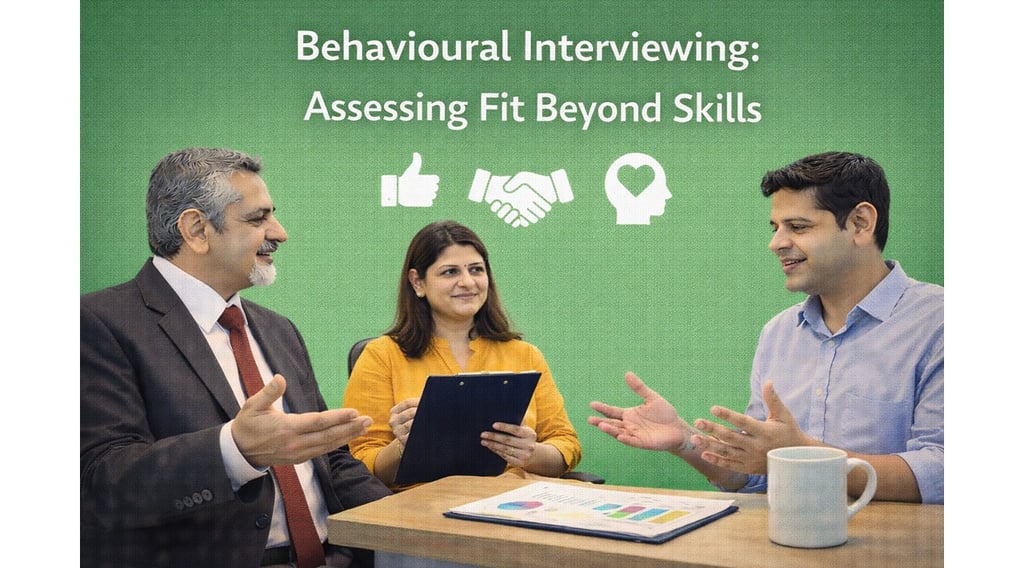
In many Indian organisations, hiring decisions still focus heavily on technical skills and past experience. While these are important, they do not always predict how a candidate will behave, collaborate, or adapt once hired. Behavioural interviewing helps organisations assess attitudes, decision-making style, and cultural fit — factors that strongly influence performance and retention.
For HR teams, behavioural interviewing provides a structured way to look beyond resumes and test real-world behaviours relevant to the role and organisation.
Behavioural Interviewing in the Indian Context
Behavioural interviewing has specific relevance in Indian workplaces:
Diverse work environments: Teams often include varied cultural, regional, and generational backgrounds
Hierarchical settings: Behaviour under authority and ambiguity matters
Customer-facing roles: Behavioural judgement impacts brand and service quality
Growing focus on culture fit: Organisations increasingly value values and adaptability
Used correctly, behavioural interviews complement technical assessments and reduce hiring risk.
Core Principles of Behavioural Interviewing
1. Focus on Past Behaviour
Behavioural interviewing is based on a simple premise: past behaviour is the best predictor of future behaviour.
HR and interviewers should ask candidates to describe:
Specific situations they faced
Actions they took personally
Results achieved and lessons learnt
Generic or hypothetical answers should be probed further.
2. Identify Role-Relevant Behaviours
Behavioural questions must align with job requirements:
Team collaboration and conflict handling
Decision-making and accountability
Customer orientation and problem-solving
Integrity, ethics, and compliance awareness
Avoid asking broad personality questions unrelated to the role.
3. Use Structured Questioning
Consistency is essential for fair assessment:
Prepare a standard set of behavioural questions per role
Ask the same core questions to all candidates
Use probing questions to clarify depth and ownership
Avoid leading or judgemental questions
Structured questioning improves comparability and reduces bias.
4. Assess Evidence, Not Impression
HR must guide interviewers to evaluate evidence:
Look for clarity, ownership, and context in answers
Separate team outcomes from individual contribution
Watch for rehearsed or vague responses
Rate behaviours against defined indicators
This shifts assessment from “liking the candidate” to evaluating fit.
5. Combine with Other Assessments
Behavioural interviewing should not stand alone:
Combine with technical interviews or case discussions
Validate behavioural insights through reference checks where relevant
Align findings with cultural and organisational values
A balanced approach improves overall hiring decisions.
HR’s Practical Perspective
HR’s role is to embed behavioural discipline into interviews:
Define behavioural competencies for each role
Create question banks and assessment guidelines
Train interviewers to probe and document effectively
Ensure behavioural feedback is recorded systematically
Use insights to support final selection decisions
HR stewardship ensures behavioural interviewing adds real value rather than becoming a tick-box exercise.
Conclusion
Behavioural interviewing enables Indian organisations to assess fit beyond skills and experience. By focusing on past behaviour, using structured questions, and evaluating evidence objectively, HR teams can improve hiring quality, reduce early attrition, and build stronger workplace cultures.
When combined with technical and reference assessments, behavioural interviewing becomes a powerful and practical recruitment tool.
🗹 Behavioural Interviewing Checklist
🗹 Define role-specific behavioural competencies
🗹 Prepare structured behavioural interview questions
🗹 Focus on past situations and actions, not hypotheticals
🗹 Probe for clarity, ownership, and outcomes
🗹 Evaluate evidence rather than personal impressions
🗹 Apply consistent questions across candidates
🗹 Document behavioural observations systematically
🗹 Align behavioural insights with organisational values
🗹 Combine behavioural assessment with other selection tools
Behavioural Interviewing Framework
Conclusion--
Effective labour law compliance depends on how well HR operations, payroll, and business processes work together. When compliance is embedded into everyday workflows, organisations reduce risk, improve accuracy, and build sustainable governance systems. HR teams that prioritise integration over isolation are better positioned to manage compliance confidently and consistently.
HireDesk India © 2026 | All Rights Reserved
"Thoughtful guidance for everyday HR"


Quick Links
Topics
Connect
_______________________________________________________________________________________________________________________________________________________________________________________
HireDesk is a free HR knowledge platform focused on practical, India-specific workplace guidance. We help HR professionals, managers, and learners navigate people practices with clarity, responsibility, and real-world relevance.