
Bonus Act Compliance: Eligibility, Calculation, and HR Controls
COMPLIANCE & LABOUR LAWS
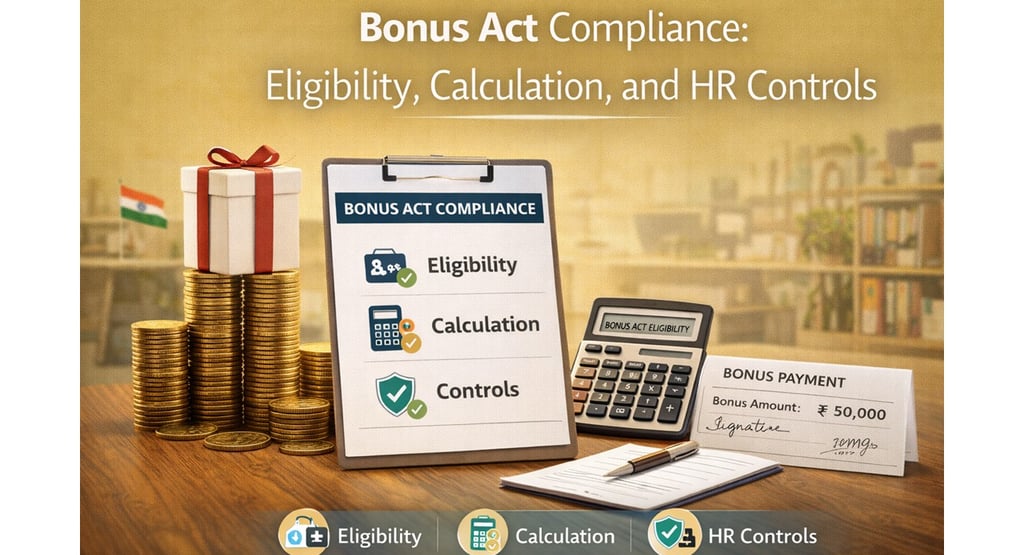
The Payment of Bonus Act, 1965 is one of the most misunderstood yet frequently litigated labour laws in India. Confusion around eligibility thresholds, calculation methods, set-on and set-off, and payment timelines often results in employee disputes and statutory claims.
For HR, Bonus Act compliance is not an annual payroll event—it requires advance planning, accurate data, and disciplined documentation. Errors made during bonus declaration are difficult to correct later.
This article explains who is eligible, how bonus is calculated, and what HR controls are critical for compliance.
Applicability of the Payment of Bonus Act
The Act applies to:
Establishments employing 20 or more employees
Employees drawing wages up to the statutory salary ceiling
Once applicable, the Act continues to apply even if employee strength falls below the threshold.
HR must track coverage at establishment level, not employee-by-employee discretion.
Eligibility for Bonus
Employees are eligible if they:
Have worked for at least 30 working days in the accounting year
Earn wages within the notified salary ceiling
Employees dismissed for fraud, riotous behaviour, or theft are not eligible.
Bonus Calculation: What HR Must Get Right
Minimum and Maximum Bonus
Minimum bonus: 8.33% of wages or ₹100 (₹60 for minors), whichever is higher
Maximum bonus: 20% of wages
Bonus must be paid even in loss-making years (subject to eligibility).
Salary for Bonus Calculation
Bonus is calculated on:
Basic wages + DA (subject to statutory limits)
HR must avoid using CTC or gross salary figures incorrectly.
Set-On and Set-Off
Where allocable surplus exceeds limits:
Excess is carried forward as set-on
Shortfall is adjusted as set-off
HR must maintain clear year-wise surplus records.
Payment Timelines and Mode
Bonus must be paid:
Within 8 months from the close of the accounting year
Earlier, if mandated by settlements or awards
Delays without approved extensions are non-compliant.
HR Execution: Key Control Areas
HR teams should:
Validate employee eligibility lists carefully
Lock calculation logic before processing
Obtain management approval on bonus percentage
Communicate bonus rationale transparently
Maintain working papers and registers
Bonus disputes often arise from poor communication, not just calculation errors.
Conclusion
Bonus Act compliance requires HR to balance legal precision with employee expectations. Clear eligibility determination, correct calculation, timely payment, and strong documentation are essential to avoid disputes and penalties.
When managed proactively, bonus processing becomes a predictable statutory exercise, not a yearly risk.
HR Compliance Action Checklist: Payment of Bonus Act
🗹 Confirm applicability based on employee strength
🗹 Identify eligible employees within wage ceiling
🗹 Calculate bonus on prescribed wage components
🗹 Apply minimum and maximum bonus limits correctly
🗹 Track set-on and set-off accurately
🗹 Obtain formal approval for bonus declaration
🗹 Pay bonus within statutory timelines
🗹 Issue bonus statements to employees
🗹 Maintain bonus registers and records
🗹 Prepare documentation for inspections and disputes
Payment of Bonus Act: HR Compliance Overview
Conclusion--
Effective labour law compliance depends on how well HR operations, payroll, and business processes work together. When compliance is embedded into everyday workflows, organisations reduce risk, improve accuracy, and build sustainable governance systems. HR teams that prioritise integration over isolation are better positioned to manage compliance confidently and consistently.
HireDesk India © 2026 | All Rights Reserved
"Thoughtful guidance for everyday HR"


Quick Links
Topics
Connect
_______________________________________________________________________________________________________________________________________________________________________________________
HireDesk is a free HR knowledge platform focused on practical, India-specific workplace guidance. We help HR professionals, managers, and learners navigate people practices with clarity, responsibility, and real-world relevance.