
Building an HR Function from Scratch: A Practical Guide for Indian SMEs
SME HR OPERATIONS
Introduction--
Once a candidate accepts an offer, the period between acceptance and joining becomes a critical phase in the recruitment lifecycle. This pre-joining window influences whether a candidate actually joins, how prepared they feel on Day One, and how quickly they settle into the organisation. For HR, effective pre-joining engagement and onboarding planning are essential to convert offers into confident, committed employees.
This article outlines practical approaches HR teams can adopt to manage pre-joining engagement and establish strong onboarding foundations—without overcomplicating the process.
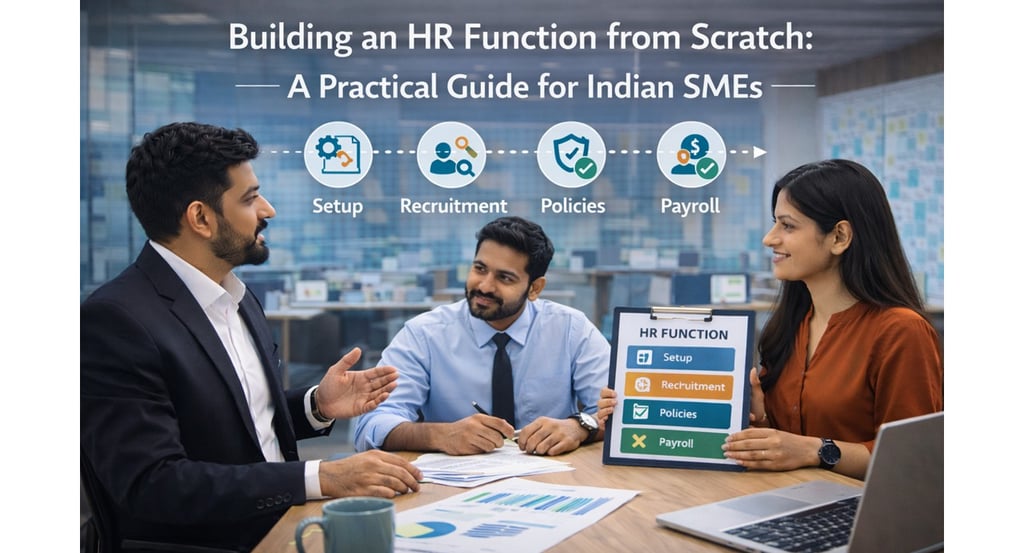
For many Indian SMEs, HR starts informally — sometimes just a founder managing payroll and leaves. As the business grows, ad hoc people management can lead to compliance risks, disengaged employees, and operational inefficiencies.
Building a structured HR function early can save time, ensure compliance with Indian labour laws, and create a foundation for growth. This guide helps HR practitioners and SME leaders understand what HR must do from day one, even with limited resources.
1. Assessing HR Needs in Your SME
Not every SME needs a full-fledged HR department immediately. Start by asking:
Size and complexity of the workforce (10–50 employees vs 50–200+)
Regulatory obligations (PF, ESI, Shops & Establishment Act)
Critical HR gaps (payroll, leaves, recruitment, compliance)
A pragmatic approach is to define a minimum HR function that covers:
Payroll and statutory compliance
Attendance, leave, and employee records
Recruitment, onboarding, and exit
Basic employee policies and handbook
This helps avoid over-investing in HR before the organisation is ready.
2. Structuring Your SME HR Function
Even with one HR professional or part-time HR, clarity of roles is critical. Typical SME HR responsibilities include:
Even aEven a single HR generalist can manage these initially, using simple processes and spreadsheets or affordable HR software.
3. Prioritising HR Activities
Start with foundational HR tasks first — these prevent legal penalties and operational confusion. For example:
Maintain accurate employee records and contracts
Register with PF, ESI, and other applicable laws
Implement payroll on time, correctly, and consistently
Draft core HR policies (leave, attendance, code of conduct)
Next, focus on employee experience and engagement — onboarding, communication, and performance basics. Finally, introduce structured HR programs like performance management, training, and career growth.
4. HR Process Design in Resource-Constrained SMEs
SMEs often cannot implement complex processes. Keep HR operations:
Simple: avoid multiple approval layers
Documented: basic SOPs for key HR processes
Automated where possible: payroll software, leave tracking, online forms
Scalable: processes should grow with headcount without constant redesign
This approach balances compliance, efficiency, and agility, which is critical in Indian SME contexts.
5. HR Metrics and Governance
Even in small teams, tracking a few metrics helps measure HR effectiveness:
Payroll accuracy rate
Employee attrition rate
Average time-to-hire
Leave utilisation
Statutory compliance adherence
Use simple spreadsheets or basic HR tools. The goal is visibility, not over-analysis.
Conclusion
Building an HR function from scratch in Indian SMEs is about prioritising the essentials, simplifying processes, and staying compliant. A small, structured HR setup ensures smooth day-to-day operations, protects the business legally, and supports long-term growth.
Starting small and scaling HR operations gradually is better than creating complex systems prematurely.
Checklist: Key Steps for SME HR Setup
🗹 Assess workforce size, regulatory needs, and critical HR gaps
🗹 Identify core HR functions and allocate responsibilities
🗹 Register with PF, ESI, and other statutory authorities
🗹 Implement accurate payroll and timely salary processing
🗹 Maintain attendance, leave, and HR documentation systematically
🗹 Draft essential HR policies and an employee handbook
🗹 Design simple, scalable HR processes suitable for SMEs
🗹 Introduce onboarding, induction, and basic training programs
🗹 Track essential HR metrics to monitor compliance and efficiency
🗹 Enable managers to support HR in small teams
🗹 Plan gradual HR scaling aligned with business growth
SME HR Function Breakdown
Conclusion--
Effective labour law compliance depends on how well HR operations, payroll, and business processes work together. When compliance is embedded into everyday workflows, organisations reduce risk, improve accuracy, and build sustainable governance systems. HR teams that prioritise integration over isolation are better positioned to manage compliance confidently and consistently.
HireDesk India © 2026 | All Rights Reserved
"Thoughtful guidance for everyday HR"


Quick Links
Topics
Connect
_______________________________________________________________________________________________________________________________________________________________________________________
HireDesk is a free HR knowledge platform focused on practical, India-specific workplace guidance. We help HR professionals, managers, and learners navigate people practices with clarity, responsibility, and real-world relevance.