
Building HR Analytics Capability in HR Teams
HR TECH & ANALYTICS
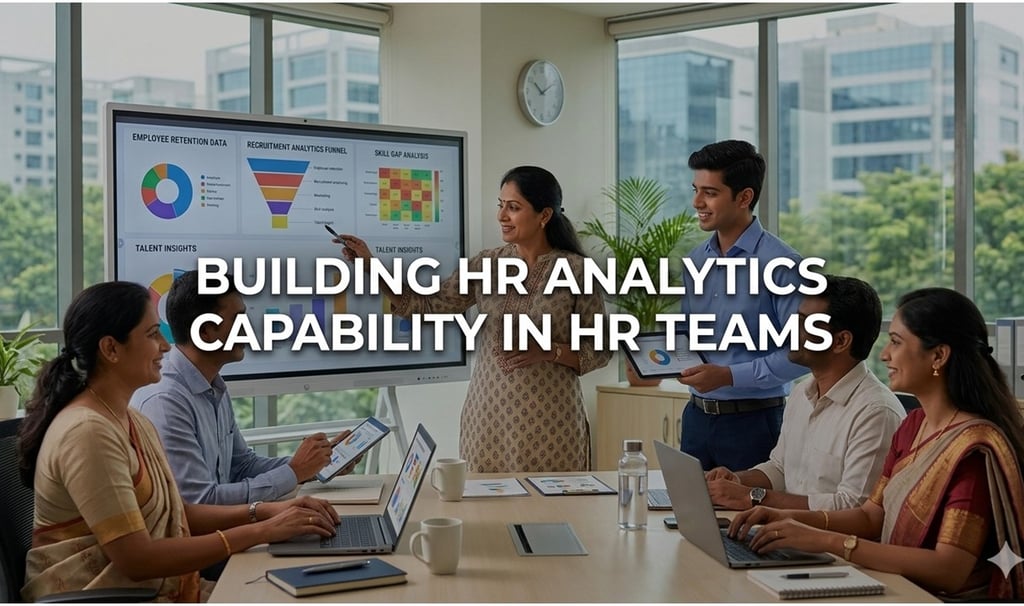
As organisations increasingly rely on data for decision-making, HR teams are expected to move beyond transactional reporting to providing meaningful workforce insights. However, the effectiveness of HR analytics depends not on tools alone, but on the capability of HR professionals to understand, interpret, and apply data.
In the Indian context, building HR analytics capability is a gradual journey that requires skill development, mindset change, and practical exposure rather than advanced statistical expertise.
What Does HR Analytics Capability Mean?
HR analytics capability refers to the ability of HR teams to:
Understand HR data and metrics
Analyse trends and patterns
Translate data into actionable insights
Support business and people decisions
It is less about complex models and more about asking the right questions and using data responsibly.
Why HR Teams Need Analytics Capability
Shift in HR Expectations
Business leaders increasingly expect HR to:
Explain attrition and productivity trends
Support workforce planning decisions
Measure the impact of HR initiatives
Provide evidence-based recommendations
Without analytics capability, HR risks being seen as reactive rather than strategic.
Better Decision-Making
Analytics helps HR:
Identify root causes, not just symptoms
Prioritise interventions
Track outcomes and effectiveness
Common Barriers to HR Analytics Capability
Limited comfort with numbers and data
Over-dependence on IT or external vendors
Poor data quality and fragmented systems
Focus on dashboards without interpretation
Lack of time due to operational workload
These barriers are common and can be addressed with structured effort.
Building Blocks of HR Analytics Capability
1. Data Literacy in HR Teams
HR professionals should be comfortable with:
Basic metrics and ratios
Trends and comparisons
Interpreting charts and tables
This forms the foundation for meaningful analysis.
2. Understanding Business Context
Analytics becomes useful only when HR understands:
Business priorities
Workforce challenges
Industry and organisational realities
Context transforms numbers into insights.
3. Analytical Thinking and Questioning
HR teams should move from “what happened” to:
Why did it happen?
What does it mean?
What should we do next?
4. Practical Tool Exposure
Capability grows through:
Using HRIS reports
Working with spreadsheets
Participating in analytics discussions
Advanced tools can be introduced gradually.
HR’s Role in Developing Analytics Capability
HR leadership should:
Encourage curiosity and learning
Provide training and exposure
Create safe environments to experiment with data
Recognise analytics-driven contributions
Capability building is a long-term investment, not a one-time initiative.
Measuring Progress in HR Analytics Capability
Indicators include:
Quality of insights shared with leadership
Use of data in HR decision-making
Reduction in ad-hoc data requests
Improved confidence in HR reports
Conclusion
Building HR analytics capability is essential for HR teams to remain relevant and impactful. In Indian organisations, the focus should be on practical skills, business understanding, and ethical data use, rather than technical sophistication.
When HR teams develop confidence in working with data, analytics becomes a natural part of everyday HR decision-making rather than a specialised function.
Checklist: Building HR Analytics Capability in HR Teams
🗹 Build basic data literacy across HR roles.
🗹 Improve understanding of HR metrics and workforce trends.
🗹 Strengthen business context awareness within HR teams.
🗹 Encourage analytical questioning beyond surface-level reports.
🗹 Provide hands-on exposure to HR systems and reports.
🗹 Improve data quality and reliability as a foundation.
🗹 Balance analytics with human judgement and experience.
🗹 Create learning opportunities through real HR problems.
🗹 Recognise and reward analytics-driven HR contributions.
🗹 Develop capability gradually, aligned with organisational maturity.
Sample Table: HR Analytics Capability Development Areas
Conclusion--
Effective labour law compliance depends on how well HR operations, payroll, and business processes work together. When compliance is embedded into everyday workflows, organisations reduce risk, improve accuracy, and build sustainable governance systems. HR teams that prioritise integration over isolation are better positioned to manage compliance confidently and consistently.
HireDesk India © 2026 | All Rights Reserved
"Thoughtful guidance for everyday HR"


Quick Links
Topics
Connect
_______________________________________________________________________________________________________________________________________________________________________________________
HireDesk is a free HR knowledge platform focused on practical, India-specific workplace guidance. We help HR professionals, managers, and learners navigate people practices with clarity, responsibility, and real-world relevance.