
Central vs State Labour Laws: How HR Should Manage Variations
COMPLIANCE & LABOUR LAWS
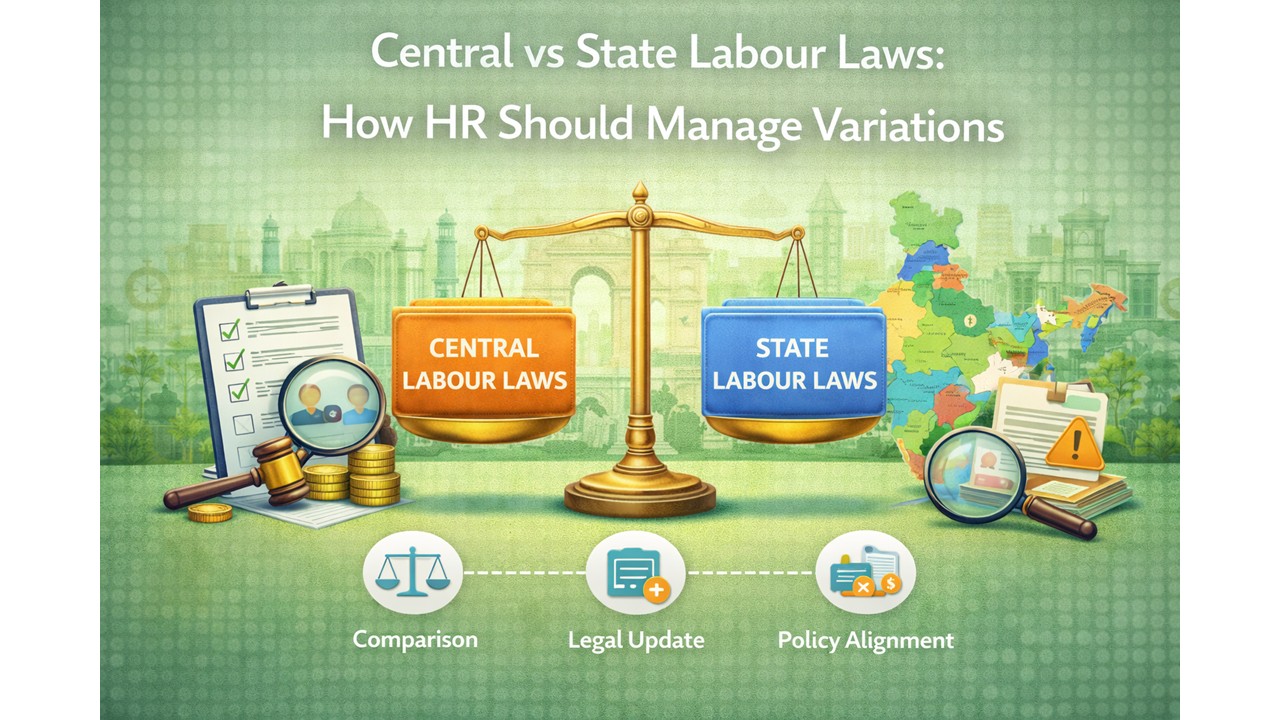
One of the most practical challenges for HR in India is managing differences between central and state labour laws. While central laws provide the broad legal framework, state governments have significant powers to frame rules, amend provisions, and enforce compliance differently.
For organisations operating in multiple states, this creates complexity in areas such as working hours, leave, minimum wages, welfare funds, and registers. HR’s role is not to interpret law like a lawyer, but to ensure correct application at the workplace level.
This article explains how central and state labour laws interact and how HR can manage variations without creating operational confusion.
Understanding the Central–State Structure
1. Role of Central Labour Laws
Central labour laws:
Apply across India
Lay down minimum standards and principles
Cover areas such as wages, social security, industrial relations, and safety
Examples include the Payment of Wages Act, EPF Act, ESIC Act, and Industrial Disputes Act.
These laws create a baseline, not the final rulebook.
2. Role of State Labour Laws
State governments:
Frame rules under central acts
Enact state-specific laws (e.g., Shops & Establishments Acts, Labour Welfare Fund Acts)
Prescribe registration, returns, inspections, and penalties
In many cases, state provisions are more detailed or stricter than central ones. HR must always follow the provision that is more beneficial to the employee.
3. Where Variations Commonly Occur
HR teams typically face variations in:
Working hours and spread-over limits
Leave entitlements and carry-forward rules
Minimum wage rates and skill classifications
Labour Welfare Fund applicability and contributions
Registers, formats, and filing timelines
Assuming uniformity across locations is one of the most common compliance mistakes.
HR’s Practical Approach to Managing Variations
1. Location-Based Compliance Mapping
HR should map:
Each office, branch, or factory to its applicable state laws
Employee categories (workmen, staff, contract labour)
Thresholds based on headcount and activity
This mapping must be documented and reviewed annually.
2. Standardisation with Local Flexibility
While policies can be centrally designed, HR must:
Allow state-specific annexures for leave, holidays, and working hours
Configure payroll and attendance systems to reflect local rules
Avoid “one-size-fits-all” templates for statutory compliance
This balance reduces risk without overcomplicating processes.
3. Monitoring Amendments and Notifications
State labour departments frequently issue:
Minimum wage revisions
Rule amendments
Portal changes and filing instructions
HR should assign clear ownership for tracking updates and implementing changes promptly.
4. Inspection and Audit Readiness
Labour inspections are state-driven. HR must ensure:
Correct registers and forms as per state formats
Local language requirements, where applicable
Familiarity with state inspectorate practices
Preparation at the location level matters more than central documentation.
Conclusion
Managing central and state labour law variations is less about legal interpretation and more about HR discipline and structure. Organisations that invest in location-wise clarity, documented processes, and periodic reviews face fewer surprises during audits and inspections.
For HR, success lies in knowing where flexibility ends and compliance begins — and applying the right rule, in the right place, at the right time.
HR Action Checklist: Managing Central and State Law Variations
🗹 Identify applicable central and state labour laws for each location
🗹 Document state-wise variations affecting working hours, leave, and wages
🗹 Create state-specific annexures to HR policies where required
🗹 Configure payroll and attendance systems for local compliance
🗹 Track state notifications, amendments, and minimum wage revisions
🗹 Assign ownership for compliance at each location
🗹 Maintain registers and returns in prescribed state formats
🗹 Prepare location teams for state-level inspections
🗹 Review multi-state compliance annually and close gaps
Central vs State Labour Laws: Practical HR Comparison
Conclusion--
Effective labour law compliance depends on how well HR operations, payroll, and business processes work together. When compliance is embedded into everyday workflows, organisations reduce risk, improve accuracy, and build sustainable governance systems. HR teams that prioritise integration over isolation are better positioned to manage compliance confidently and consistently.
HireDesk India © 2026 | All Rights Reserved
"Thoughtful guidance for everyday HR"


Quick Links
Topics
Connect
_______________________________________________________________________________________________________________________________________________________________________________________
HireDesk is a free HR knowledge platform focused on practical, India-specific workplace guidance. We help HR professionals, managers, and learners navigate people practices with clarity, responsibility, and real-world relevance.