
Central vs State Labour Laws: What HR Must Know
COMPLIANCE & LABOUR LAWS
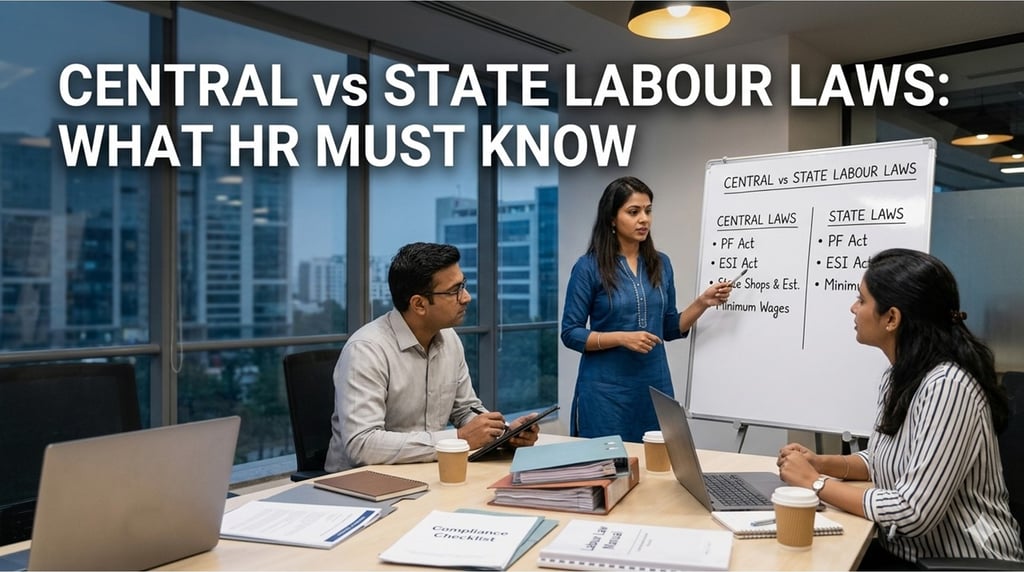
One of the most common sources of confusion in labour law compliance is the distinction between central and state labour laws. While central laws establish broad principles, state governments frame rules that determine how those laws are implemented in practice. For HR professionals, understanding this distinction is essential to managing compliance accurately across locations.
This article explains how central and state labour laws interact, why state-specific rules matter, and what HR teams must practically track to avoid compliance gaps.
Understanding the Structure of Labour Laws in India
Indian labour legislation generally follows a two-tier structure:
Central laws passed by Parliament
State rules framed by individual state governments under those laws
While the central law provides the framework, state rules define operational aspects such as registrations, returns, forms, registers, and procedural requirements.
HR compliance depends on understanding both layers.
Social security legislations such as the Employees’ Provident Fund (PF) and Employees’ State Insurance (ESIC) are central laws that apply uniformly across India. However, HR teams may still encounter state-level procedural differences related to registrations, inspections, and interactions with local authorities. While contribution structures are governed centrally, operational compliance often requires awareness of state-specific processes and enforcement practices.
Why State Rules Matter More Than HR Often Realises
Many organisations assume that compliance with the central law automatically ensures compliance everywhere. This assumption is risky.
State rules can differ in:
Registration processes and timelines
Forms and formats of statutory registers
Filing frequencies and authorities
Local amendments and exemptions
HR teams must therefore treat state rules as equally important as the parent law.
Multi-State Operations: Key HR Challenges
Organisations operating across multiple states face additional compliance complexity.
Common challenges include:
Different registers required in different states
Varying leave, working hour, and holiday rules
Multiple labour department portals and procedures
Inconsistent inspection practices
A single central policy may need state-level operational adjustments.
How HR Can Track Central and State Compliance Effectively
HR does not need to memorise every rule, but it must establish reliable tracking mechanisms.
Practical approaches include:
Maintaining a state-wise compliance checklist
Mapping applicable laws by location
Tracking state notifications and amendments
Standardising documentation with state-specific annexures
Clarity improves when compliance responsibilities are structured, not improvised.
Common Mistakes HR Should Avoid
HR teams often face compliance issues due to:
Applying one-state rules across all locations
Ignoring state-level notifications
Delayed updates after operational expansion
Overlooking contractor-related state compliance
Awareness and periodic review significantly reduce these risks.
Central vs State Compliance Checklist for HR
Use this checklist to manage location-based compliance effectively:
Applicability & Mapping
☐ Applicable central laws identified
☐ State rules mapped for each location
☐ Thresholds reviewed state-wise
Documentation & Filing
☐ State-specific registers maintained
☐ Filing formats and portals validated
☐ Records stored and retrievable by location
Review & Coordination
☐ State compliance reviewed periodically
☐ External inputs validated internally
☐ Expansion or relocation assessed for compliance impact
Conclusion
Understanding the distinction between central and state labour laws is fundamental to effective compliance management. HR teams that track applicability carefully and respect state-level variations are better positioned to prevent errors and respond confidently during inspections. A structured, location-aware approach enables HR to manage compliance with clarity and consistency.
Conclusion--
Effective labour law compliance depends on how well HR operations, payroll, and business processes work together. When compliance is embedded into everyday workflows, organisations reduce risk, improve accuracy, and build sustainable governance systems. HR teams that prioritise integration over isolation are better positioned to manage compliance confidently and consistently.
HireDesk India © 2026 | All Rights Reserved
"Thoughtful guidance for everyday HR"


Quick Links
Topics
Connect
_______________________________________________________________________________________________________________________________________________________________________________________
HireDesk is a free HR knowledge platform focused on practical, India-specific workplace guidance. We help HR professionals, managers, and learners navigate people practices with clarity, responsibility, and real-world relevance.