
Child Labour, Young Workers and Apprentices: Legal Boundaries for Factory HR
INDUSTRIAL RELATIONS & FACTORY HR
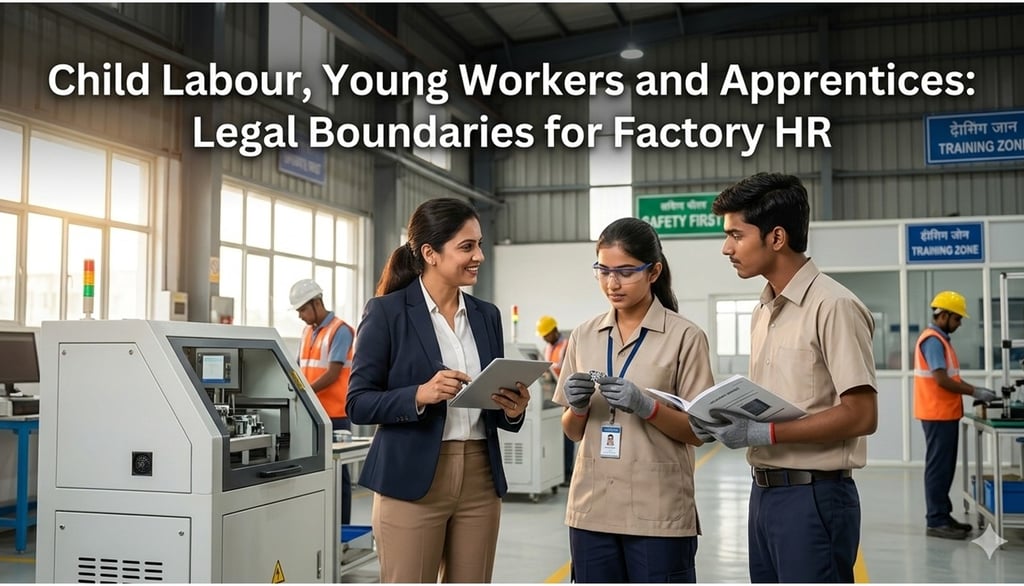
Factories in India operate under strict legal boundaries when it comes to employing children, adolescents, and apprentices. Violations in this area attract zero tolerance from regulators, and even unintentional lapses can result in prosecution, licence suspension, and reputational damage.
Factory HR teams must clearly understand who can be employed, under what conditions, and with what safeguards. This is not an area where operational convenience or labour shortages can override statutory discipline.
Prohibition of Child Labour in Factories
Indian law completely prohibits employment of children in factories.
A child is defined as a person:
Below 14 years of age
Key implications for HR:
No engagement, even as helpers, trainees, or relatives
No exceptions for family-owned factories
Liability rests with the occupier and management
HR must ensure age verification is robust and documented.
Employment of Adolescents (Young Workers)
An adolescent is a person:
14 years or above but below 18 years
Adolescents may be employed only if:
A valid Certificate of Fitness is issued by a certifying surgeon
Working hours are within permitted limits
No night work or hazardous operations are assigned
Without certification, employment is illegal even if the worker is above 14.
Working Conditions for Adolescents
Factory HR must ensure:
Restricted working hours
No overtime
No night shifts
No hazardous processes
Clear supervision and safety training
Adolescents must be treated as a protected category, not as regular workers.
Apprentices and Trainees: Legal Distinction
Apprentices are governed primarily by:
Apprentices Act, 1961
Key compliance principles:
Training, not employment
Stipend, not wages
Defined training curriculum
Fixed training period
HR must avoid misclassifying regular workers as apprentices to reduce wage or compliance burden.
Common Compliance Risks for Factory HR
Typical violations include:
Inadequate age proof
Missing fitness certificates
Apprentices doing regular production work
Adolescents working overtime
Contractors supplying underage workers
Most violations surface during inspections or accident investigations.
HR’s Preventive Responsibilities
Effective HR practices include:
Strict age verification at entry
Medical certification tracking
Separate records for adolescents and apprentices
Contractor compliance audits
Supervisor awareness training
Prevention is far easier than defence after a violation.
Conclusion
Employment of children, adolescents, and apprentices is a high-risk compliance area in Indian factories. The law draws clear boundaries, and enforcement authorities expect absolute adherence.
Factory HR teams must combine documentation discipline with strong gatekeeping controls. A single lapse can undo years of compliance credibility and expose the organisation to severe legal consequences.
🗹 Factory HR Checklist: Young Workers & Apprentices
🗹 Verify age proof before engagement
🗹 Prohibit employment below 14 years
🗹 Obtain fitness certificates for adolescents
🗹 Restrict hours and prohibit night work
🗹 Prevent hazardous task allocation
🗹 Follow Apprentices Act provisions strictly
🗹 Audit contractor-supplied manpower
🗹 Maintain separate statutory records
Child, Adolescent and Apprentice Compliance – Key HR Responsibility Matrix
Conclusion--
Effective labour law compliance depends on how well HR operations, payroll, and business processes work together. When compliance is embedded into everyday workflows, organisations reduce risk, improve accuracy, and build sustainable governance systems. HR teams that prioritise integration over isolation are better positioned to manage compliance confidently and consistently.
HireDesk India © 2026 | All Rights Reserved
"Thoughtful guidance for everyday HR"


Quick Links
Topics
Connect
_______________________________________________________________________________________________________________________________________________________________________________________
HireDesk is a free HR knowledge platform focused on practical, India-specific workplace guidance. We help HR professionals, managers, and learners navigate people practices with clarity, responsibility, and real-world relevance.