
Choosing HR Tools Without Over-Engineering: A Practical Guide for HR Teams
HR TECH & ANALYTICS
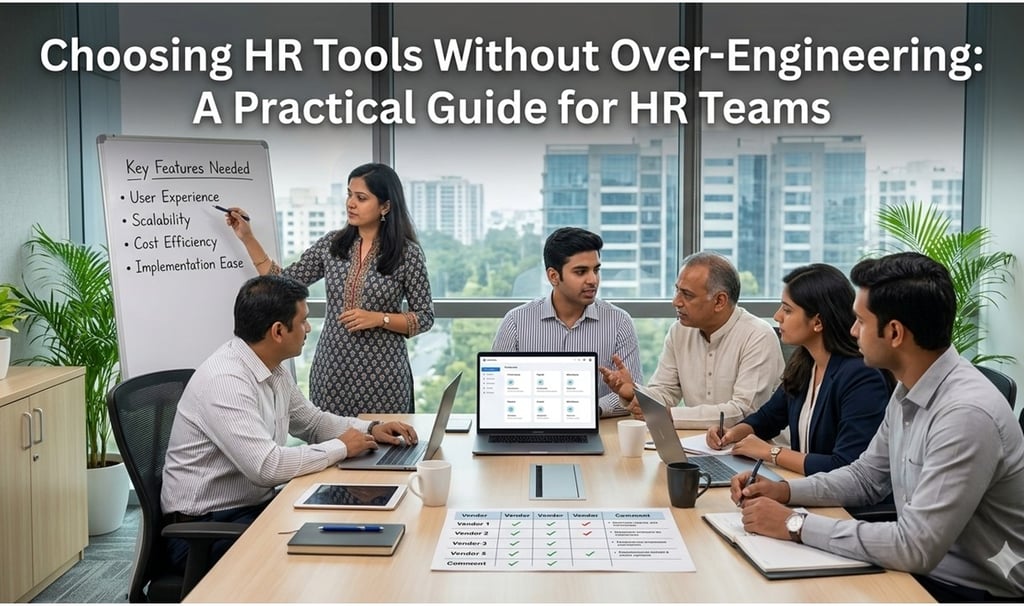
With the rapid growth of HR technology, Indian organisations today are spoilt for choice when selecting HR tools. From feature-rich HR suites to specialised platforms, vendors often promise end-to-end transformation. However, many organisations struggle after implementation because the chosen tools are too complex, underutilised, or poorly aligned with actual HR needs.
Over-engineering HR tools leads to low adoption, wasted investment, and operational frustration. This article explains how HR teams can choose fit-for-purpose HR tools without unnecessary complexity.
What Does Over-Engineering Mean in HR Technology?
Over-engineering occurs when HR tools are selected or designed with:
Features that are not required by the organisation
Advanced analytics or automation without data readiness
Heavy customisation for simple processes
Complex workflows that users struggle to follow
The result is a system that looks impressive but delivers limited real value.
Why Over-Engineering Is Common in Indian Organisations
Several factors contribute to over-engineering:
Desire to “future-proof” systems prematurely
Vendor-driven feature demonstrations influencing decisions
Lack of clear process mapping before tool selection
Pressure from leadership to adopt the “latest” technology
Insufficient understanding of user maturity and readiness
HR tools should evolve with organisational maturity, not run ahead of it.
Principles for Choosing the Right HR Tools
1. Start with Process, Not Technology
HR should clearly define:
Current process gaps
Pain points for HR, managers, and employees
Compliance and reporting requirements
Technology should support these needs—not dictate them.
2. Focus on Usability and Adoption
A simpler tool with high adoption delivers more value than a complex system used by a few.
Consider:
Ease of navigation
Minimal training requirements
Mobile and self-service usability
3. Prioritise Core Functionality
Identify must-have vs nice-to-have features. Core HR needs such as payroll accuracy, compliance, and basic analytics should take priority over advanced modules.
4. Choose Scalable, Modular Systems
Select tools that allow gradual expansion rather than full-suite implementation upfront. Modular systems reduce risk and improve adoption.
5. Evaluate Integration Needs Carefully
Integration is important, but unnecessary integrations increase complexity. Focus on systems that genuinely need to exchange data.
HR’s Role in Preventing Over-Engineering
HR must act as the custodian of practicality by:
Translating business needs into clear requirements
Challenging unnecessary complexity during vendor discussions
Involving end users in evaluation and testing
Limiting customisation unless legally or operationally required
Monitoring post-implementation usage and outcomes
HR credibility improves when tools selected actually work for the organisation.
Common Warning Signs of Over-Engineered HR Tools
Low user adoption after implementation
Manual work continuing alongside the system
Excessive reliance on vendor support
Complex workflows for simple approvals
Dashboards that are rarely used or understood
Early identification allows corrective action before costs escalate.
Conclusion
Choosing HR tools without over-engineering requires clarity, discipline, and a phased mindset. Indian organisations benefit most when HR tools are simple, usable, and aligned with actual processes and maturity levels.
By focusing on practicality over sophistication, HR teams can ensure that technology remains an enabler of efficiency and decision-making, not an operational burden.
Checklist: Choosing HR Tools Without Over-Engineering
🗹 Clearly document current HR processes and pain points.
🗹 Define must-have features before evaluating vendors.
🗹 Involve HR users, managers, and employees in tool evaluation.
🗹 Prioritise usability and ease of adoption over feature volume.
🗹 Avoid heavy customisation unless legally or operationally required.
🗹 Choose modular tools that support phased implementation.
🗹 Assess integration needs realistically and selectively.
🗹 Plan for data readiness before adopting advanced analytics.
🗹 Set clear success metrics for adoption and efficiency.
🗹 Review tool usage periodically and simplify where required.
Sample Table: Right-Sizing HR Technology Choices
Conclusion--
Effective labour law compliance depends on how well HR operations, payroll, and business processes work together. When compliance is embedded into everyday workflows, organisations reduce risk, improve accuracy, and build sustainable governance systems. HR teams that prioritise integration over isolation are better positioned to manage compliance confidently and consistently.
HireDesk India © 2026 | All Rights Reserved
"Thoughtful guidance for everyday HR"


Quick Links
Topics
Connect
_______________________________________________________________________________________________________________________________________________________________________________________
HireDesk is a free HR knowledge platform focused on practical, India-specific workplace guidance. We help HR professionals, managers, and learners navigate people practices with clarity, responsibility, and real-world relevance.