
Common Employee Experience and Culture Mistakes Indian HR Teams Should Avoid
EMPLOYEE EXPERIENCE & CULTURE
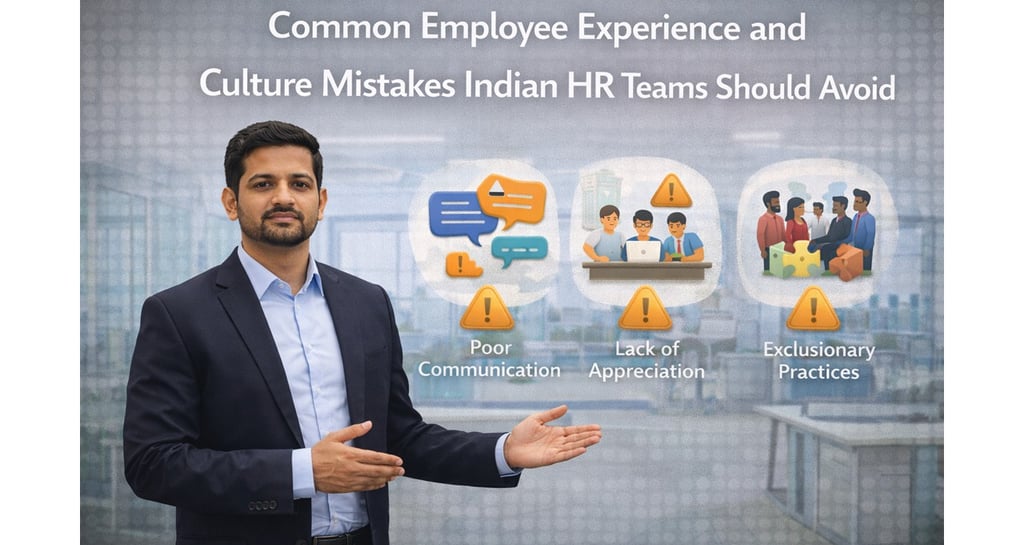
Many Indian HR teams invest time and intent into improving employee experience and culture. However, good intent does not always translate into good outcomes. Certain recurring mistakes weaken trust, dilute culture, and reduce the impact of HR efforts.
This article highlights common employee experience and culture mistakes seen across Indian organisations — and how HR can avoid them through practical judgement and discipline.
Mistake 1: Treating Culture as an HR Initiative
Culture is often launched as an HR programme rather than a leadership responsibility. When HR owns culture in isolation, line managers disengage and employees see it as a “HR thing”.
Culture improves only when leaders and managers live it daily.
Mistake 2: Copying Global or Startup Culture Models
Many organisations copy practices from global firms or fast-growing startups without considering Indian realities such as hierarchy, scale, workforce diversity, and regulatory environment.
Context matters more than trends.
Mistake 3: Over-Reliance on Surveys and Scores
Frequent surveys without visible action lead to survey fatigue and cynicism. Employees stop giving honest feedback when nothing changes.
Measurement without follow-through damages credibility.
Mistake 4: Confusing Perks with Experience
Free snacks, events, and wellness apps cannot compensate for poor manager behaviour, unclear roles, or unfair decisions.
Experience is shaped more by daily interactions than benefits.
Mistake 5: Ignoring Manager Capability Gaps
Many culture initiatives fail because managers are not equipped to handle feedback, coaching, or people issues. HR often assumes managers will “figure it out”.
Without manager enablement, culture will remain inconsistent.
Mistake 6: Avoiding Difficult Conversations
HR teams sometimes avoid addressing toxic behaviour, favouritism, or unfair practices to maintain surface harmony.
Unaddressed issues quietly erode trust.
Mistake 7: Over-Communicating Vision, Under-Communicating Reality
Leadership messaging often highlights aspiration but avoids acknowledging constraints, trade-offs, or challenges.
Employees value honesty over optimism.
HR’s Role in Avoiding These Mistakes
HR must:
Apply judgement, not just frameworks
Push back when culture messaging is unrealistic
Focus on consistency over innovation
Enable managers continuously
Balance employee voice with business realities
Strong culture comes from steady, disciplined actions.
Conclusion
Employee experience and culture improve when HR avoids shortcuts and symbolic actions. Indian organisations do not need perfect cultures — they need honest, fair, and consistently applied ones.
HR’s credibility depends not on ambition, but on execution.
HR Checklist: Avoiding Common Culture Mistakes
🗹 Treat culture as a leadership responsibility, not an HR project
🗹 Adapt practices to Indian organisational realities
🗹 Act visibly on employee feedback
🗹 Focus on daily behaviours over perks
🗹 Invest in manager capability building
🗹 Address toxic behaviours early
🗹 Communicate honestly about challenges
🗹 Review culture practices regularly
Common Culture Mistakes and Better HR Responses
Conclusion--
Effective labour law compliance depends on how well HR operations, payroll, and business processes work together. When compliance is embedded into everyday workflows, organisations reduce risk, improve accuracy, and build sustainable governance systems. HR teams that prioritise integration over isolation are better positioned to manage compliance confidently and consistently.
HireDesk India © 2026 | All Rights Reserved
"Thoughtful guidance for everyday HR"


Quick Links
Topics
Connect
_______________________________________________________________________________________________________________________________________________________________________________________
HireDesk is a free HR knowledge platform focused on practical, India-specific workplace guidance. We help HR professionals, managers, and learners navigate people practices with clarity, responsibility, and real-world relevance.