
Common Labour Law Compliance Mistakes Made by Organisations
COMPLIANCE & LABOUR LAWS
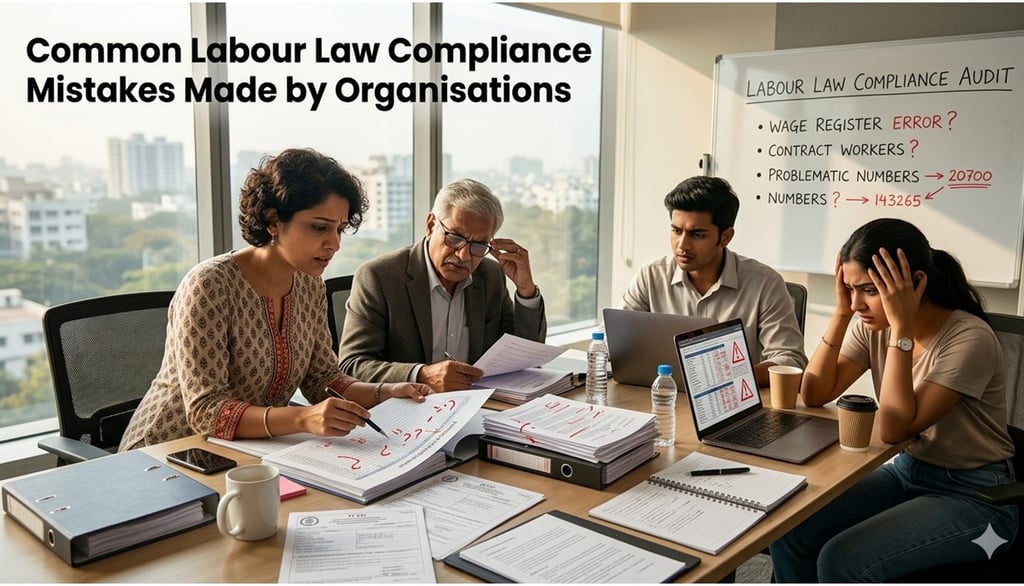

Labour law non-compliance in Indian organisations is often the result of misunderstandings, process gaps, or assumptions—rather than deliberate intent. Many compliance issues surface only during inspections, audits, or disputes, by which time corrective action becomes reactive and stressful. For HR teams, recognising common compliance mistakes early is key to reducing risk and maintaining organisational credibility.
This article highlights frequent labour law compliance mistakes seen across organisations and explains how HR teams can proactively avoid them through structured awareness and process discipline.
Assuming One-Time Compliance Is Sufficient
One of the most common mistakes organisations make is treating compliance as a one-time setup activity. Laws, rules, and interpretations evolve over time, and processes that were compliant earlier may no longer be sufficient.
Typical issues include:
Not updating policies after legal amendments
Continuing old payroll or attendance practices
Assuming registration alone ensures compliance
Compliance requires periodic review, not static implementation.
Misunderstanding Applicability Thresholds
Applicability of labour laws depends on factors such as employee count, location, and nature of operations. Errors often occur when organisations:
Track headcount incorrectly
Ignore contract or temporary workers
Apply thresholds uniformly across locations
HR must regularly reassess applicability as the organisation grows, restructures, or expands geographically.
Incomplete or Inconsistent Documentation
Documentation gaps are among the most visible compliance risks. Even when practices are aligned, poor record-keeping can expose organisations during inspections.
Common documentation issues include:
Missing or outdated statutory registers
Inconsistent attendance and wage records
Inadequate employee acknowledgements for policies
Poor storage and retrieval of compliance documents
Accurate documentation is as critical as compliant processes.
Over-Reliance on External Consultants
While consultants and advisors play an important role, complete dependence without internal understanding can be risky.
This often results in:
HR teams being unaware of underlying compliance logic
Delays when consultants are unavailable
Inability to respond confidently during inspections
HR does not need to become legal experts—but must retain working knowledge and ownership of compliance processes.
Lack of Coordination Between HR, Payroll, and Operations
Compliance failures frequently arise due to fragmented ownership across teams.
Examples include:
Payroll processed without HR compliance inputs
Operations changing shift patterns without legal review
Contractors engaged without compliance validation
Cross-functional alignment is essential to prevent compliance gaps.
Treating Compliance as an Administrative Burden
When compliance is viewed purely as paperwork, it often gets deprioritised until a problem arises. This mindset increases long-term risk.
Effective HR teams integrate compliance into:
Routine HR operations
Process design and reviews
Training and awareness initiatives
Compliance works best when embedded—not isolated.
Labour Law Compliance Mistake-Prevention Checklist for HR
Use this checklist to proactively identify and reduce compliance risks:
Applicability & Awareness
☐ Applicability thresholds reviewed periodically
☐ Headcount calculations include all worker categories
☐ Legal updates tracked through credible sources
Documentation & Processes
☐ Statutory registers maintained and updated
☐ Policies reviewed for legal alignment
☐ Payroll and attendance systems audited periodically
Ownership & Coordination
☐ Clear compliance ownership defined within HR
☐ Regular coordination with payroll and operations
☐ External advisors engaged with internal oversight
Conclusion
Most labour law compliance mistakes stem from oversight rather than intent. By recognising common risk areas and adopting a structured, preventive approach, HR teams can reduce exposure and operate with greater confidence. Proactive compliance management strengthens organisational governance and reinforces HR’s credibility as a responsible function.
Conclusion--
Effective labour law compliance depends on how well HR operations, payroll, and business processes work together. When compliance is embedded into everyday workflows, organisations reduce risk, improve accuracy, and build sustainable governance systems. HR teams that prioritise integration over isolation are better positioned to manage compliance confidently and consistently.
HireDesk India © 2026 | All Rights Reserved
"Thoughtful guidance for everyday HR"


Quick Links
Topics
Connect
_______________________________________________________________________________________________________________________________________________________________________________________
HireDesk is a free HR knowledge platform focused on practical, India-specific workplace guidance. We help HR professionals, managers, and learners navigate people practices with clarity, responsibility, and real-world relevance.