
Competency Mapping and Its Role in Performance Management
PERFORMANCE & DEVELOPMENT
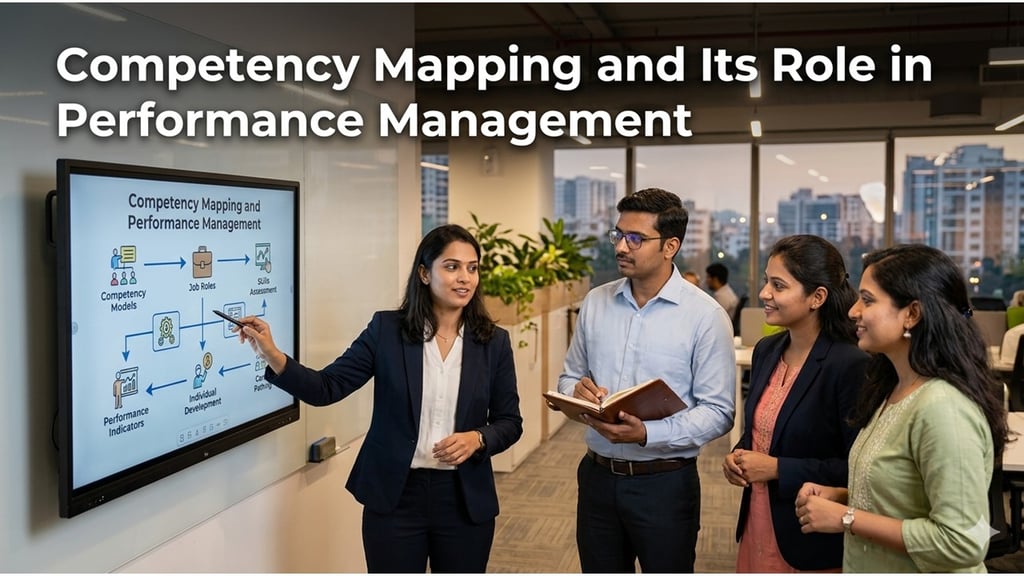
Competencies define the skills, knowledge, and behaviours required for success in a role. When integrated with performance management, competency mapping provides clarity, consistency, and actionable insights for employee development and organisational growth.
This article explains how Indian organisations can use competency frameworks to align performance expectations, guide development, and support talent decisions.
Why Competency Mapping Matters
Competency mapping helps:
Set clear performance expectations beyond task completion
Identify skill gaps and development needs
Guide career progression and succession planning
Enhance fairness and consistency in evaluations
Without defined competencies, performance reviews often rely on subjective judgement, which reduces credibility.
Key Steps in Competency Mapping
1. Identify Role-Specific Competencies
List technical, behavioural, and leadership competencies for each role
Include both current and future capability requirements
2. Define Proficiency Levels
For each competency, define levels such as Basic, Intermediate, Advanced, Expert
Provides clarity on expectations and measurable benchmarks
3. Integrate with Performance Reviews
Include competencies in appraisal forms
Evaluate employees on both outcomes and demonstrated behaviours
4. Use Competencies for Development Planning
Link gaps to learning programs, mentoring, or stretch assignments
Align competency growth with career progression
5. Review and Update Regularly
Competency frameworks should evolve with changing business needs and roles
Ensure alignment with organisational strategy
Sample View: Competency Mapping Framework
Checklist: Effective Competency Mapping
☐ Competencies are defined for each role and level
☐ Proficiency levels are clear and measurable
☐ Competencies are integrated into performance reviews
☐ Gaps are linked to development initiatives
☐ Framework is reviewed periodically for relevance
☐ Managers are trained to assess competencies fairly
Role of HR
HR ensures that competency mapping:
Aligns with business objectives and role expectations
Supports consistent performance evaluation and career planning
Guides targeted learning and development initiatives
Enhances fairness and objectivity in talent decisions
HR acts as a strategic enabler, embedding competencies into performance management and workforce planning.
Key Takeaway
Competency mapping strengthens performance management by linking behaviours and skills to expected outcomes, supporting development, recognition, and career progression. It creates transparency, consistency, and clarity for employees and managers alike.
Conclusion--
Effective labour law compliance depends on how well HR operations, payroll, and business processes work together. When compliance is embedded into everyday workflows, organisations reduce risk, improve accuracy, and build sustainable governance systems. HR teams that prioritise integration over isolation are better positioned to manage compliance confidently and consistently.
HireDesk India © 2026 | All Rights Reserved
"Thoughtful guidance for everyday HR"


Quick Links
Topics
Connect
_______________________________________________________________________________________________________________________________________________________________________________________
HireDesk is a free HR knowledge platform focused on practical, India-specific workplace guidance. We help HR professionals, managers, and learners navigate people practices with clarity, responsibility, and real-world relevance.