
Conducting Effective Interviews in Resource-Constrained SMEs
SME HR OPERATIONS
Introduction--
Once a candidate accepts an offer, the period between acceptance and joining becomes a critical phase in the recruitment lifecycle. This pre-joining window influences whether a candidate actually joins, how prepared they feel on Day One, and how quickly they settle into the organisation. For HR, effective pre-joining engagement and onboarding planning are essential to convert offers into confident, committed employees.
This article outlines practical approaches HR teams can adopt to manage pre-joining engagement and establish strong onboarding foundations—without overcomplicating the process.
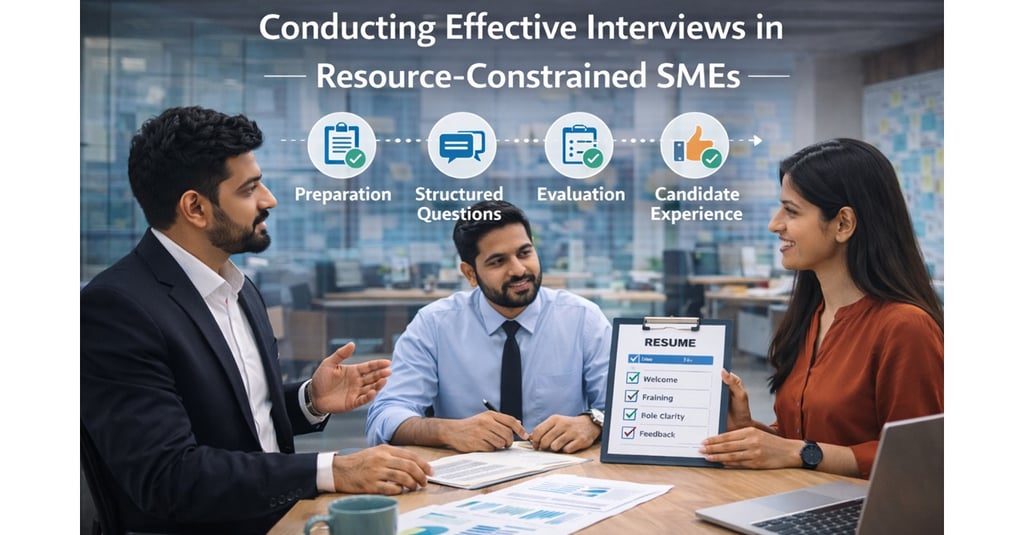
In Indian SMEs, interviews are often conducted informally — sometimes squeezed between daily operational priorities. While speed is important, unstructured interviews increase the risk of poor hiring decisions, which SMEs can least afford.
Effective interviewing in SMEs is about asking the right questions, involving the right people, and making timely decisions, without adding cost or complexity. This article outlines practical interview practices suited for resource-constrained Indian SMEs.
Challenges SMEs Face During Interviews
SME hiring typically involves:
Limited interviewer availability
No dedicated recruitment panel
Pressure to close positions quickly
Inconsistent interview standards
Recognising these challenges helps HR design a focused and efficient interview process.
Preparing for Interviews: The HR Role
Before interviews begin, HR should ensure:
Job roles and expectations are clearly documented
Interview criteria are aligned with role priorities
Compensation range is finalised
Interviewers understand their evaluation role
Preparation reduces subjective decisions and repeated interview rounds.
Structuring Interviews Without Over-Engineering
A simple, effective SME interview structure includes:
Role and experience discussion
Skill and problem-solving assessment
Behavioural and culture-fit questions
One or two interview rounds are usually sufficient for most SME roles.
Asking the Right Questions
SMEs should focus on:
Practical, role-related questions
Situational examples from past experience
Adaptability and learning ability
Willingness to work in a growing organisation
Avoid overly theoretical or corporate-style questions.
Involving Managers Without Delays
Line managers play a critical role in interviews. HR should:
Schedule interviews in advance
Share evaluation criteria beforehand
Limit panel size
Drive quick feedback and decisions
Delayed feedback often leads to candidate dropouts.
HR’s Role in Interview Governance
HR ensures:
Consistent interview experience
Fair evaluation and documentation
Timely communication with candidates
Offer terms are clear and aligned
This protects both the organisation and candidate experience.
Conclusion
Effective interviews in resource-constrained SMEs rely on clarity, structure, and speed, not elaborate processes. A simple, well-prepared interview framework helps SMEs make better hiring decisions while conserving time and resources.
Checklist: Effective Interviewing for SMEs
🗹 Finalise job requirements and evaluation criteria
🗹 Limit interview rounds to what is truly necessary
🗹 Use structured, role-relevant questions
🗹 Involve line managers early in the process
🗹 Avoid theoretical or generic assessments
🗹 Capture interview feedback consistently
🗹 Communicate decisions promptly to candidates
🗹 Ensure offer terms are clear and documented
Simple Interview Structure for SMEs
Conclusion--
Effective labour law compliance depends on how well HR operations, payroll, and business processes work together. When compliance is embedded into everyday workflows, organisations reduce risk, improve accuracy, and build sustainable governance systems. HR teams that prioritise integration over isolation are better positioned to manage compliance confidently and consistently.
HireDesk India © 2026 | All Rights Reserved
"Thoughtful guidance for everyday HR"


Quick Links
Topics
Connect
_______________________________________________________________________________________________________________________________________________________________________________________
HireDesk is a free HR knowledge platform focused on practical, India-specific workplace guidance. We help HR professionals, managers, and learners navigate people practices with clarity, responsibility, and real-world relevance.