
Contract Labour Safety and Welfare in Factories: HR Compliance Responsibilities
INDUSTRIAL RELATIONS & FACTORY HR
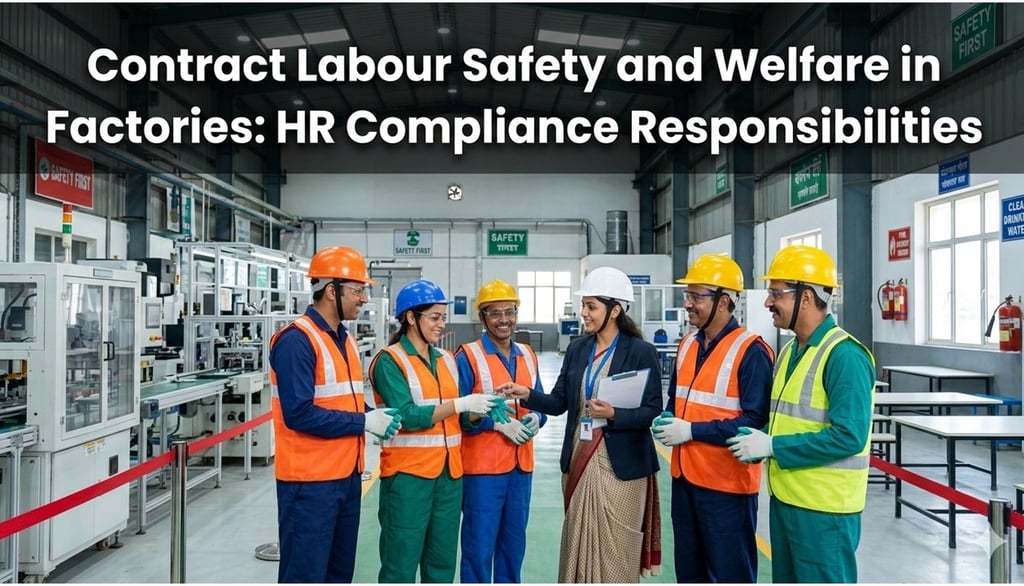
Contract labour forms a significant portion of the workforce in Indian factories. While outsourcing offers flexibility, it also introduces serious compliance and safety risks if not managed carefully. Accidents involving contract workers often attract the highest scrutiny from labour authorities, regardless of contractual arrangements.
For Factory HR teams, the responsibility does not end with engaging a licensed contractor. Principal employers remain legally accountable for safety, welfare, and working conditions of contract labour within the factory premises.
This article explains how HR must manage contract labour safety and welfare from a practical and compliance-focused perspective.
Legal Framework Governing Contract Labour
Key laws governing contract labour include:
Contract Labour (Regulation and Abolition) Act, 1970
Factories Act, 1948
State Factory Rules
Occupational Safety, Health and Working Conditions Code, 2020
These laws clearly establish that safety and welfare obligations rest with both the contractor and the principal employer.
Safety Responsibilities Towards Contract Labour
HR must ensure contract workers:
Receive safety induction before starting work
Are provided appropriate PPE
Are trained for task-specific hazards
Participate in safety drills and toolbox talks
Work under supervised and authorised conditions
Lack of safety training for contract workers is a common compliance failure.
Welfare Facilities for Contract Workers
Welfare provisions must not discriminate between regular and contract workers. HR must ensure access to:
Drinking water
Sanitation facilities
Canteens (where applicable)
First-aid and medical care
Rest rooms and shelters
Even if contractors are responsible on paper, the principal employer is accountable during inspections.
HR’s Role in Contractor Governance
Effective contract labour management requires:
Verifying contractor licences and registrations
Including safety and welfare clauses in contracts
Conducting periodic audits of contractors
Maintaining statutory records and returns
Coordinating corrective actions for non-compliance
HR must act as the compliance gatekeeper.
Common Compliance Gaps
Typical gaps observed include:
Inadequate safety induction
Poor PPE quality or usage
Lack of medical fitness certification
Incomplete contractor documentation
Exclusion of contract workers from welfare facilities
Such gaps expose factories to legal and reputational risk.
Conclusion
Contract labour safety and welfare is a shared responsibility, but HR plays a decisive role in enforcement and coordination. Strong systems, clear accountability, and regular monitoring help prevent accidents and ensure compliance.
Factories that integrate contract workers into safety and welfare systems build safer, more stable operations.
🗹 Factory HR Checklist: Contract Labour Safety & Welfare
🗹 Verify contractor licence and registrations
🗹 Conduct safety induction for all contract workers
🗹 Ensure PPE availability and usage
🗹 Provide access to welfare facilities
🗹 Include contract workers in safety drills
🗹 Monitor contractor compliance regularly
🗹 Maintain statutory records and returns
🗹 Address safety violations promptly
Contract Labour Safety & Welfare – HR Reference Table
Conclusion--
Effective labour law compliance depends on how well HR operations, payroll, and business processes work together. When compliance is embedded into everyday workflows, organisations reduce risk, improve accuracy, and build sustainable governance systems. HR teams that prioritise integration over isolation are better positioned to manage compliance confidently and consistently.
HireDesk India © 2026 | All Rights Reserved
"Thoughtful guidance for everyday HR"


Quick Links
Topics
Connect
_______________________________________________________________________________________________________________________________________________________________________________________
HireDesk is a free HR knowledge platform focused on practical, India-specific workplace guidance. We help HR professionals, managers, and learners navigate people practices with clarity, responsibility, and real-world relevance.