
Contract Staffing vs Full-Time Hiring: HR Decision Framework for SMEs
SME HR OPERATIONS
Introduction--
Once a candidate accepts an offer, the period between acceptance and joining becomes a critical phase in the recruitment lifecycle. This pre-joining window influences whether a candidate actually joins, how prepared they feel on Day One, and how quickly they settle into the organisation. For HR, effective pre-joining engagement and onboarding planning are essential to convert offers into confident, committed employees.
This article outlines practical approaches HR teams can adopt to manage pre-joining engagement and establish strong onboarding foundations—without overcomplicating the process.
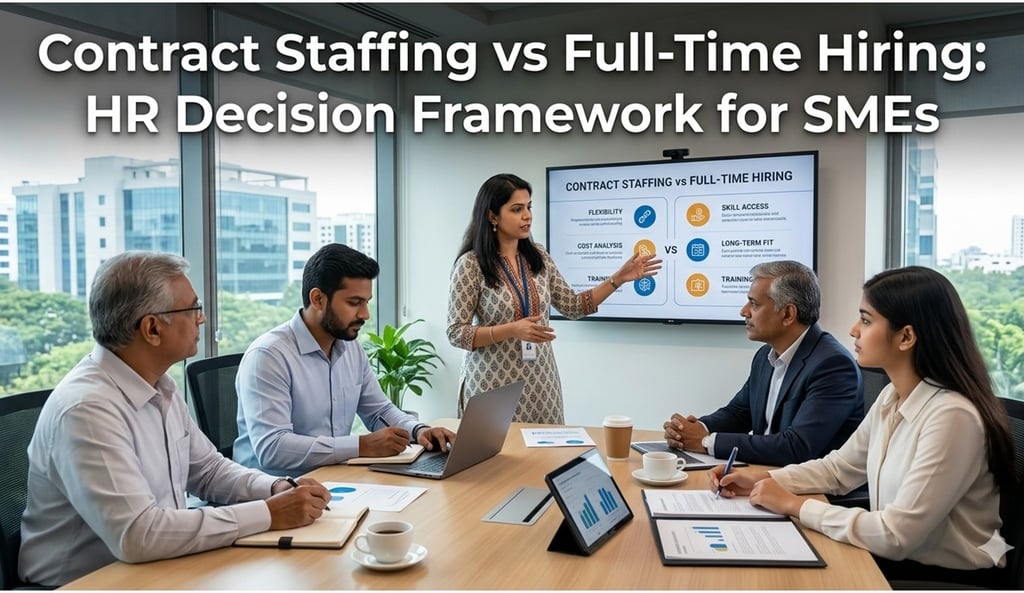
Indian SMEs frequently face a core people decision: should we hire full-time employees or use contract staffing? The answer is rarely binary. Cost pressure, demand variability, compliance exposure, and control over work all influence this choice.
Many SMEs make this decision informally — based on urgency or cost alone — and then face issues around productivity, compliance, or workforce stability. This article provides a practical HR decision framework to help SMEs choose the right hiring model for the right roles.
Understanding the Two Models in an SME Context
Full-time hiring typically offers stability, ownership, and deeper capability building.
Contract staffing offers flexibility, speed, and cost variability.
Both models are valid — when applied thoughtfully.
When Contract Staffing Makes Sense for SMEs
Contract staffing is usually appropriate when:
Work demand is seasonal or project-based
Skills are transactional or routine
Speed of deployment matters
Headcount flexibility is required
Budget predictability is important
However, SMEs must remember that contract labour still carries statutory responsibility, even when sourced through vendors.
When Full-Time Hiring Is the Better Choice
Full-time hiring works better when:
Roles require continuity and ownership
Employees handle customers, data, or core processes
Skills need long-term development
Decision-making authority is involved
Cultural alignment is important
Overuse of contract staffing in such roles weakens accountability.
Compliance and Risk Considerations
From an HR and legal standpoint, SMEs must evaluate:
Applicability of Contract Labour (Regulation & Abolition) Act
Principal employer obligations
PF, ESI, minimum wages, and bonus compliance
Risk of contract labour being treated as disguised employment
Cost savings disappear quickly when compliance is weak.
Cost Is Not Just Salary
SMEs should assess total cost, not just monthly payout.
Consider:
Recruitment and onboarding cost
Training time
Supervision effort
Attrition and replacement cost
Compliance and audit exposure
The cheapest option upfront is not always the most economical long-term.
HR’s Role in the Decision
HR should not just execute leadership decisions — HR must frame the decision.
This includes:
Clarifying role nature and duration
Evaluating compliance implications
Advising on vendor quality
Reviewing workforce mix periodically
HR’s judgement here directly impacts business risk.
Conclusion
For SMEs, the right mix of contract and full-time hiring is a strategic choice, not an administrative one. When HR applies a clear decision framework — balancing flexibility, control, and compliance — SMEs gain both agility and stability.
There is no universal answer, only informed choices.
Checklist: Choosing Between Contract and Full-Time Hiring in SMEs
🗹 Assess whether the role is core or support
🗹 Evaluate duration and predictability of work
🗹 Consider skill criticality and ownership needs
🗹 Review statutory and compliance implications
🗹 Analyse total cost, not just monthly payout
🗹 Verify contractor and vendor compliance standards
🗹 Define supervision and accountability clearly
🗹 Review workforce mix annually
Contract Staffing vs Full-Time Hiring – SME Decision Guide
Conclusion--
Effective labour law compliance depends on how well HR operations, payroll, and business processes work together. When compliance is embedded into everyday workflows, organisations reduce risk, improve accuracy, and build sustainable governance systems. HR teams that prioritise integration over isolation are better positioned to manage compliance confidently and consistently.
HireDesk India © 2026 | All Rights Reserved
"Thoughtful guidance for everyday HR"


Quick Links
Topics
Connect
_______________________________________________________________________________________________________________________________________________________________________________________
HireDesk is a free HR knowledge platform focused on practical, India-specific workplace guidance. We help HR professionals, managers, and learners navigate people practices with clarity, responsibility, and real-world relevance.