
Culture in Family-Owned and Promoter-Led Organisations: What HR Must Understand
Family-owned and promoter-led organisations form a large part of the Indian corporate landscape. Their cultures are often deeply personal, relationship-driven, and shaped by legacy rather than documented systems. For HR, working in such environments requires sensitivity, judgement, and practical realism.
EMPLOYEE EXPERIENCE & CULTURE
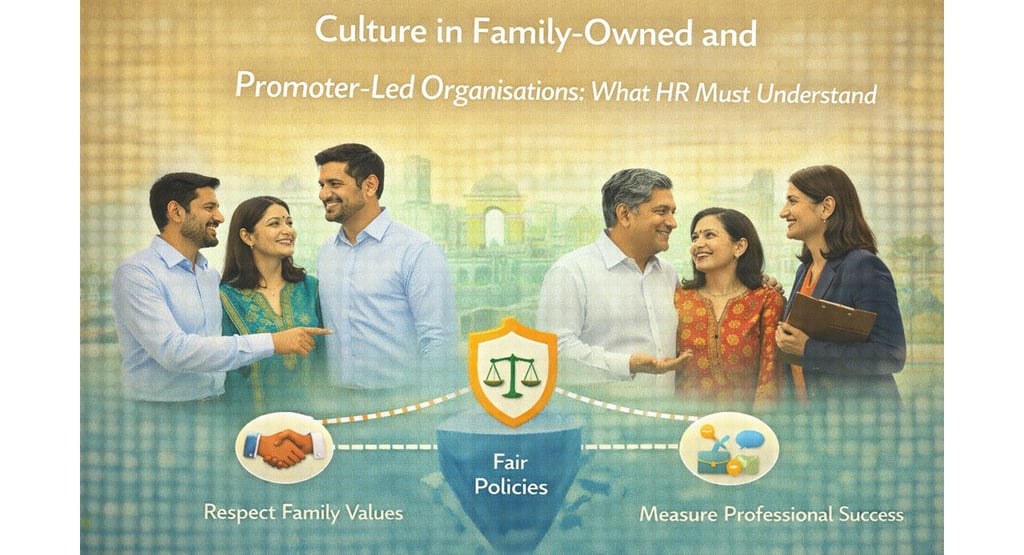
Family-owned and promoter-led organisations form a large part of the Indian corporate landscape. Their cultures are often deeply personal, relationship-driven, and shaped by legacy rather than documented systems.
For HR, working in such environments requires sensitivity, judgement, and practical realism. This article explains how HR can operate effectively within promoter-led cultures while upholding fairness and professionalism.
Understanding the Cultural Context
In promoter-led organisations, culture is influenced by:
Family values and long-standing relationships
Informal authority structures
Personal loyalty and trust
Unwritten rules that guide behaviour
Employees often adapt to these cues faster than to formal policies.
Common HR Challenges in Promoter-Led Setups
HR teams frequently face challenges such as:
Exceptions for family members or trusted associates
Ambiguity in decision-making authority
Resistance to formal processes
Difficulty addressing perceived favouritism
Ignoring these realities weakens HR credibility.
Where HR Adds the Most Value
HR’s impact lies in:
Bringing consistency without confrontation
Creating guardrails rather than rigid rules
Documenting practices gradually
Acting as a neutral interpreter between promoters and employees
Progress is often incremental, not transformational.
Managing Fairness Without Undermining Trust
In such organisations, fairness is built by:
Transparent criteria for decisions
Consistent communication
Clear escalation paths
Quiet course-correction rather than public enforcement
HR must balance respect for legacy with the need for professionalism.
Professionalising Culture at a Sustainable Pace
Successful HR leaders:
Introduce systems aligned with business needs
Gain promoter buy-in before rolling out changes
Focus on critical people processes first
Use data and examples rather than ideology
Cultural evolution works best when it respects organisational roots.
Conclusion
Culture in family-owned and promoter-led organisations is nuanced and deeply contextual. HR effectiveness depends not on enforcing textbook models, but on applying judgement with patience and credibility.
When HR works with promoters — not against them — culture becomes both stable and fair.
HR Checklist: Working Effectively in Promoter-Led Cultures
🗹 Understand informal authority structures clearly
🗹 Identify non-negotiable fairness principles
🗹 Introduce HR processes gradually and thoughtfully
🗹 Handle exceptions with transparency
🗹 Build promoter trust through business alignment
🗹 Document practices without rigidity
🗹 Address favouritism concerns discreetly
🗹 Train managers on consistent people practices
🗹 Protect employee dignity in all decisions
Cultural Characteristics and HR Approach
Conclusion--
Effective labour law compliance depends on how well HR operations, payroll, and business processes work together. When compliance is embedded into everyday workflows, organisations reduce risk, improve accuracy, and build sustainable governance systems. HR teams that prioritise integration over isolation are better positioned to manage compliance confidently and consistently.
HireDesk India © 2026 | All Rights Reserved
"Thoughtful guidance for everyday HR"


Quick Links
Topics
Connect
_______________________________________________________________________________________________________________________________________________________________________________________
HireDesk is a free HR knowledge platform focused on practical, India-specific workplace guidance. We help HR professionals, managers, and learners navigate people practices with clarity, responsibility, and real-world relevance.