
Defining Roles and Job Descriptions for Indian Workplaces
RECRUITMENT AND HIRING

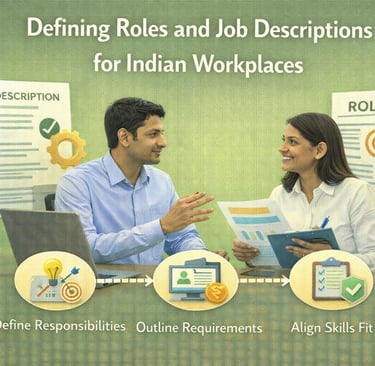
Clear role definition is one of the most underestimated aspects of recruitment in Indian organisations. Many hiring issues — wrong hires, early attrition, performance confusion, and compensation disputes — can be traced back to poorly defined roles and vague job descriptions.
In practice, job descriptions in India are often copied from older documents, downloaded from the internet, or written in broad, generic language. This creates misalignment between business expectations, candidate understanding, and actual work on the ground. Well-defined roles and realistic job descriptions help HR and managers attract suitable candidates and set clear expectations from day one.
Role Definition in the Indian Organisational Context
Indian workplaces operate with layered reporting structures, evolving responsibilities, and frequent role overlap, especially in SMEs and growing organisations. As a result:
Roles expand informally without documentation
Titles may not reflect actual responsibility
Employees are expected to handle multiple functions
Job descriptions are rarely updated
Role definition must therefore reflect actual work realities rather than ideal or aspirational descriptions.
Core Components of Effective Role Definition
Clarifying the Purpose of the Role
Every role should have a clearly stated purpose. HR should work with managers to articulate why the role exists and what problem it is meant to solve.
A clear role purpose helps:
Filter unsuitable candidates early
Align expectations during interviews
Guide performance evaluation post-joining
Defining Key Responsibilities and Outcomes
Instead of listing generic activities, job descriptions should focus on outcomes and accountability. In the Indian context, this helps reduce ambiguity around “additional responsibilities” that often arise later.
Responsibilities should:
Reflect day-to-day work realities
Indicate priority areas
Distinguish core duties from support tasks
Identifying Required and Trainable Skills
Over-specification is a common issue in Indian hiring. Job descriptions often demand extensive experience, multiple skills, and certifications that are not strictly required.
HR should help managers distinguish between:
Essential skills required at joining
Skills that can be developed through training
Nice-to-have qualifications
This improves candidate quality and reduces unnecessary hiring delays.
Aligning Role Level, Title, and Compensation
Role titles and levels must align with responsibility and compensation. Misalignment leads to dissatisfaction and attrition.
HR should ensure:
Titles reflect market norms and internal parity
Role scope matches compensation bands
Growth expectations are clearly communicated
This is particularly important in India, where titles carry strong perceived value.
Documenting Reporting Relationships and Authority
Clear reporting lines reduce confusion and workplace conflict. Job descriptions should state:
Reporting manager
Team interactions
Decision-making authority
This clarity supports smoother onboarding and day-to-day functioning.
HR’s Role and Practical Perspective
HR plays a critical role in ensuring role clarity across the organisation. This includes:
Reviewing and standardising job description formats
Challenging unrealistic or inflated role requirements
Ensuring consistency across similar roles
Updating job descriptions when roles evolve
Using JDs as a live reference, not a static document
In Indian organisations, HR judgement is essential to balance flexibility with structure.
Conclusion
Clear role definition and well-written job descriptions form the foundation of effective recruitment and performance management. In the Indian workplace, where roles often evolve rapidly, realistic and updated job descriptions help align expectations and reduce conflict.
By focusing on role purpose, accountability, skill clarity, and alignment with compensation, HR teams can significantly improve hiring outcomes and employee satisfaction.
🗹 Role Definition & Job Description Checklist
🗹 Clearly state the purpose of the role
🗹 Define key responsibilities and expected outcomes
🗹 Reflect actual day-to-day work requirements
🗹 Separate essential skills from trainable skills
🗹 Avoid unrealistic experience and qualification demands
🗹 Align role level, title, and compensation
🗹 Specify reporting relationships and authority
🗹 Use consistent JD formats across the organisation
🗹 Review and update job descriptions periodically
Core Elements of a Job Description
Conclusion--
Effective labour law compliance depends on how well HR operations, payroll, and business processes work together. When compliance is embedded into everyday workflows, organisations reduce risk, improve accuracy, and build sustainable governance systems. HR teams that prioritise integration over isolation are better positioned to manage compliance confidently and consistently.
HireDesk India © 2026 | All Rights Reserved
"Thoughtful guidance for everyday HR"


Quick Links
Topics
Connect
_______________________________________________________________________________________________________________________________________________________________________________________
HireDesk is a free HR knowledge platform focused on practical, India-specific workplace guidance. We help HR professionals, managers, and learners navigate people practices with clarity, responsibility, and real-world relevance.