
Designing Competency Frameworks for Employee Growth
PERFORMANCE & DEVELOPMENT
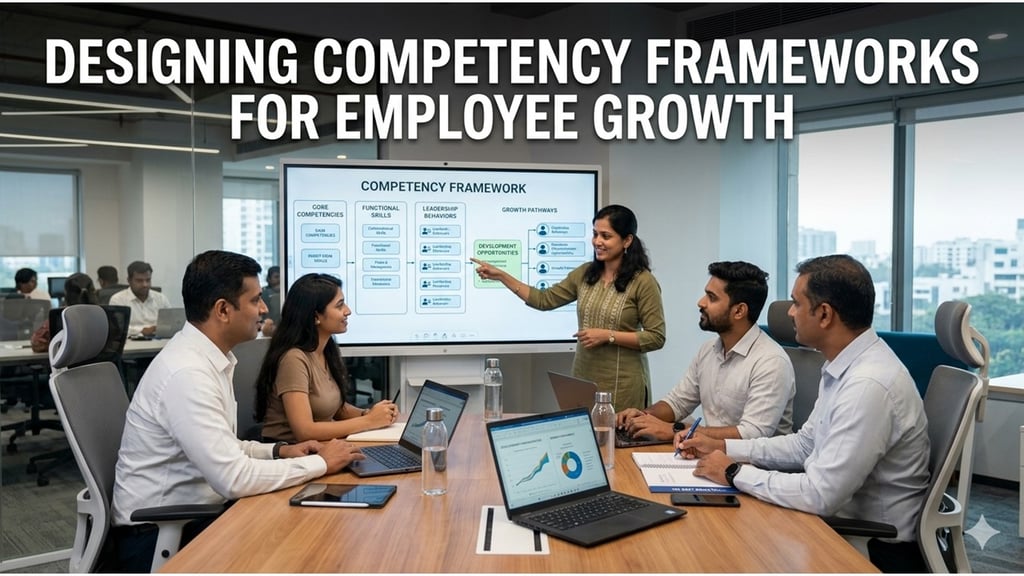
Competency frameworks are structured sets of skills, behaviours, and attributes that employees need to perform effectively in their roles and grow in their careers. In Indian organisations, well-designed competency frameworks help align employee capabilities with business goals, guide learning and development, and provide clear paths for career progression.
A competency framework acts as a bridge between performance management and employee development, enabling HR and managers to identify gaps, plan interventions, and measure outcomes consistently across the organisation.
What Is a Competency Framework?
A competency framework defines the knowledge, skills, behaviours, and attitudes expected from employees at different levels and roles. It serves as a blueprint for:
Recruitment and selection
Learning and development programs
Performance management
Career planning and succession management
By providing a clear standard, it ensures role clarity, supports fair evaluations, and strengthens organisational capability.
Key Components of a Competency Framework
Core Competencies
Skills and behaviours required across all roles, such as communication, problem-solving, and collaboration.Role-Specific Competencies
Technical skills, functional knowledge, and behaviour patterns specific to a particular role or department.Leadership Competencies
Attributes required for managerial or leadership positions, including strategic thinking, decision-making, and team development.Behavioural Indicators
Observable actions or behaviours that demonstrate a competency in practice, providing clarity on expectations.Proficiency Levels
Defines the expected level of competency for each role, typically ranging from basic to expert.
Light Checklist: Building a Competency Framework
☐ Core competencies are identified and communicated clearly
☐ Role-specific competencies are mapped for every position
☐ Behavioural indicators are defined for each competency
☐ Proficiency levels are aligned with career progression
☐ Framework is linked with recruitment, learning, and performance systems
☐ Employees are trained and made aware of expectations
☐ Framework is reviewed periodically to ensure relevance
☐ Managers are equipped to assess and coach employees on competencies
Sample Table: Competency Framework Overview
Best Practices for Indian Organisations
Link to Performance Management: Competencies should inform evaluations and development plans.
Align with Business Strategy: Ensure competencies support current and future organisational needs.
Regular Review: Update the framework periodically to reflect changing skills requirements.
Employee Involvement: Engage employees to increase understanding and buy-in.
Manager Enablement: Train managers to assess competencies accurately and provide developmental feedback.
Closing Note
A well-designed competency framework guides employee growth, enhances performance, and supports succession planning. It enables Indian organisations to clearly define expectations, develop talent strategically, and ensure fair and transparent career progression. When effectively implemented, it strengthens organisational capability while fostering a motivated, skilled, and engaged workforce.
Conclusion--
Effective labour law compliance depends on how well HR operations, payroll, and business processes work together. When compliance is embedded into everyday workflows, organisations reduce risk, improve accuracy, and build sustainable governance systems. HR teams that prioritise integration over isolation are better positioned to manage compliance confidently and consistently.
HireDesk India © 2026 | All Rights Reserved
"Thoughtful guidance for everyday HR"


Quick Links
Topics
Connect
_______________________________________________________________________________________________________________________________________________________________________________________
HireDesk is a free HR knowledge platform focused on practical, India-specific workplace guidance. We help HR professionals, managers, and learners navigate people practices with clarity, responsibility, and real-world relevance.