
Designing Employee Journeys: Mapping Key Moments from Offer to Exit
EMPLOYEE EXPERIENCE & CULTURE
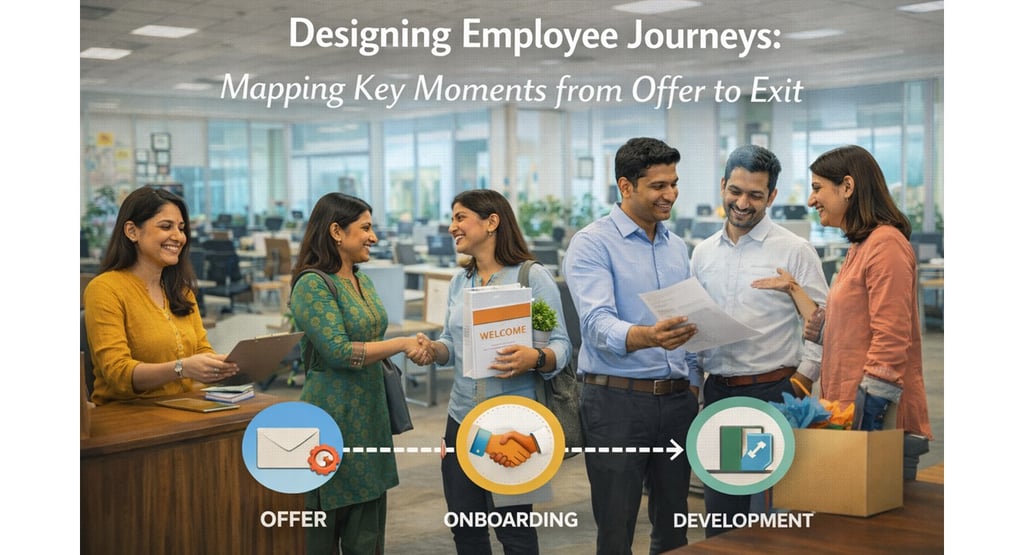
Employees do not experience organisations as isolated HR processes. They experience work as a journey — a series of moments that begin with the offer letter and end with exit and settlement. In many Indian organisations, these moments are handled in silos, leading to inconsistency and confusion.
Designing employee journeys helps HR view the employee experience end to end. This article explains how Indian HR teams can map key employee journey stages, identify experience gaps, and improve consistency without adding unnecessary complexity.
What Is an Employee Journey?
An employee journey is the sequence of interactions an employee has with the organisation across their lifecycle. Each stage shapes perception, trust, and engagement.
In Indian workplaces, journeys are influenced by:
Manager behaviour at each stage
Informal practices alongside formal processes
Variations across functions, locations, and grades
A well-designed journey ensures clarity and fairness, even when flexibility is required.
Why Mapping Employee Journeys Matters
Mapping journeys helps HR:
Identify high-impact moments that shape trust
Reduce contradictions between policies and practice
Improve coordination between HR, managers, and leadership
Anticipate issues before they become grievances
For Indian organisations, journey mapping is a practical tool — not a design exercise.
Key Stages in the Employee Journey
While journeys vary by role and context, most Indian organisations share common stages:
Offer and joining communication
Onboarding and initial role clarity
Daily work, supervision, and feedback
Performance reviews and career discussions
Transitions, role changes, or growth phases
Grievances, conflicts, or discipline (when they arise)
Exit, notice period, and final settlement
Each stage carries cultural signals.
How HR Should Map Employee Journeys
A practical approach includes:
Listing major employee lifecycle stages
Documenting expected experience at each stage
Identifying common pain points and exceptions
Aligning manager responsibilities at each stage
Journey maps should be simple and usable, not theoretical diagrams.
Using Employee Journeys to Improve Culture
When HR uses journey mapping effectively:
Managers understand their role at each stage
Inconsistencies become visible and addressable
Employee experience becomes predictable
Cultural risks reduce over time
The focus remains on reliability, not perfection.
Conclusion
Designing employee journeys helps HR move from fragmented processes to a coherent employee experience. In Indian organisations, where diversity of roles and maturity levels is high, journey mapping brings clarity and discipline.
By focusing on key moments from offer to exit, HR can improve trust, consistency, and cultural stability across the organisation.
HR Checklist: Mapping Employee Journeys Effectively
🗹 Identify key lifecycle stages relevant to your organisation
🗹 Define expected employee experience at each stage
🗹 Map manager responsibilities across the journey
🗹 Identify recurring pain points and exceptions
🗹 Simplify journey documentation for easy reference
🗹 Align HR processes across functions and locations
🗹 Use journey insights to improve consistency
🗹 Review journeys periodically as the organisation evolves
🗹 Avoid over-designing journeys beyond organisational maturity
Employee Journey Stages and HR Focus Areas
Conclusion--
Effective labour law compliance depends on how well HR operations, payroll, and business processes work together. When compliance is embedded into everyday workflows, organisations reduce risk, improve accuracy, and build sustainable governance systems. HR teams that prioritise integration over isolation are better positioned to manage compliance confidently and consistently.
HireDesk India © 2026 | All Rights Reserved
"Thoughtful guidance for everyday HR"


Quick Links
Topics
Connect
_______________________________________________________________________________________________________________________________________________________________________________________
HireDesk is a free HR knowledge platform focused on practical, India-specific workplace guidance. We help HR professionals, managers, and learners navigate people practices with clarity, responsibility, and real-world relevance.