
Designing Fair and Effective Performance Improvement Plans (PIPs)
PERFORMANCE & DEVELOPMENT
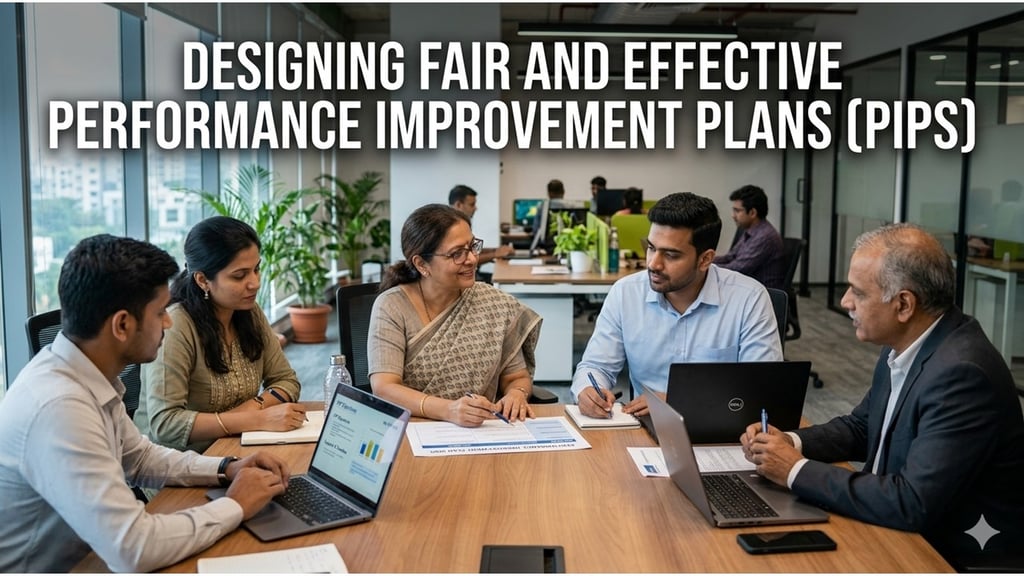
Performance Improvement Plans (PIPs) are often misunderstood as disciplinary tools. In well-designed performance management systems, however, PIPs serve a structured, fair, and documented mechanism to help employees meet defined performance expectations.
This article focuses on how PIPs should be designed and governed as part of the overall performance framework—distinct from how managers run PIPs on a day-to-day basis.
Purpose of a Framework-Driven PIP
A well-designed PIP framework helps organisations:
Address sustained performance gaps objectively
Maintain consistency across teams and roles
Protect both employee dignity and organisational interests
Reduce subjectivity and ad-hoc decision-making
The goal is performance correction with fairness, not punishment.
When a PIP Is Structurally Appropriate
A PIP should be considered only when:
Performance expectations were clearly communicated earlier
Adequate time and support were already provided
The gap is measurable and role-related
Informal feedback has not led to improvement
PIPs should not be used to manage:
Cultural misfit
Behavioural misconduct
Sudden role changes without training
Core Design Principles of a Fair PIP Framework
1. Clarity of Expectations
Performance standards must be specific, measurable, and role-relevant.
2. Consistency Across Roles
Similar performance gaps should trigger similar responses, irrespective of team or manager.
3. Defined Timeframes
PIP durations should be standardised by role type, not decided arbitrarily.
4. Support and Enablement
The framework must specify what support the organisation will provide.
5. Documented Outcomes
Possible outcomes—successful closure, extension, or separation—should be clearly stated upfront.
Sample View: PIP Framework Structure
Checklist: HR Review Before Initiating a PIP
☐ Performance standards were documented earlier
☐ Employee received regular feedback before PIP
☐ Performance gaps are measurable, not subjective
☐ PIP duration aligns with policy norms
☐ Support measures are clearly defined
☐ Possible outcomes are documented and approved
Role of HR in PIP Governance
HR’s role is not to manage the employee, but to:
Ensure the PIP aligns with policy and principles
Maintain documentation discipline
Prevent misuse or inconsistency
Support managers with structured guidance
A weak framework increases legal, cultural, and trust risks.
Relationship Between PIPs and Development Plans
PIPs are corrective, while development plans are progressive.
However, a good framework ensures:
Skill gaps feed into learning plans
Successful PIPs transition into development goals
Employees do not remain in “correction mode” indefinitely
Key Takeaway
A PIP is effective only when it is designed as a fair, structured system, not as a last-minute reaction to poor performance. Clear frameworks protect employees, managers, and organisations alike.
Conclusion--
Effective labour law compliance depends on how well HR operations, payroll, and business processes work together. When compliance is embedded into everyday workflows, organisations reduce risk, improve accuracy, and build sustainable governance systems. HR teams that prioritise integration over isolation are better positioned to manage compliance confidently and consistently.
HireDesk India © 2026 | All Rights Reserved
"Thoughtful guidance for everyday HR"


Quick Links
Topics
Connect
_______________________________________________________________________________________________________________________________________________________________________________________
HireDesk is a free HR knowledge platform focused on practical, India-specific workplace guidance. We help HR professionals, managers, and learners navigate people practices with clarity, responsibility, and real-world relevance.