
Designing Salary Structures for SME Employees: HR Considerations
SME HR OPERATIONS
Introduction--
Once a candidate accepts an offer, the period between acceptance and joining becomes a critical phase in the recruitment lifecycle. This pre-joining window influences whether a candidate actually joins, how prepared they feel on Day One, and how quickly they settle into the organisation. For HR, effective pre-joining engagement and onboarding planning are essential to convert offers into confident, committed employees.
This article outlines practical approaches HR teams can adopt to manage pre-joining engagement and establish strong onboarding foundations—without overcomplicating the process.

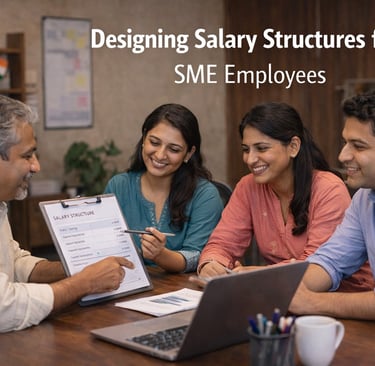
For many Indian SMEs, salary structures evolve informally — negotiated offers, ad-hoc increments, and inconsistent components across employees. While this may work initially, it soon creates internal inequity, payroll confusion, and compliance risk.
A well-designed salary structure does not mean high cost or complex break-ups. For SMEs, the objective is clarity, compliance, and sustainability. This article explains how HR can design practical salary structures that suit Indian SMEs while remaining legally compliant and easy to administer.
Why Salary Structure Design Matters in SMEs
Salary structures impact more than just payroll numbers. They affect:
Employee perception of fairness
Compliance with wage and social security laws
Cost predictability for the business
Ease of payroll processing and audits
Poorly designed structures often lead to disputes during exits or inspections.
Key Principles for SME Salary Structures
While designing salary structures, SMEs should keep the following principles in mind:
Keep components limited and easy to understand
Ensure minimum wage compliance
Balance fixed and variable elements
Avoid aggressive cost-splitting purely to reduce statutory contributions
Maintain consistency across similar roles
Complexity does not create savings — discipline does.
Common Salary Components in Indian SMEs
Most SME salary structures include:
Basic Salary – foundation for statutory calculations
Allowances – HRA, conveyance, special allowance
Variable Pay – performance-linked, where applicable
Statutory Deductions – EPF, ESI, Professional Tax
Each component should have a clear purpose and calculation logic.
Statutory and Compliance Considerations
HR must ensure that salary structures align with:
Minimum Wages Act (state and skill category-wise)
EPF wage definitions and contribution rules
ESI coverage and wage limits
Gratuity calculation norms
Artificial splitting of wages to reduce compliance exposure increases legal risk.
Balancing Cost Control and Employee Expectations
SMEs operate under tight budgets, but salary transparency builds trust. HR should:
Explain salary break-ups clearly at the time of offer
Avoid frequent changes to structure
Review market benchmarks periodically
Ensure increments are applied consistently
Clarity reduces dissatisfaction even when budgets are limited.
HR’s Role in Salary Governance
HR acts as the custodian of salary structures, responsible for:
Standardising structures by role or level
Coordinating with payroll and finance
Reviewing statutory impact before changes
Maintaining documentation for audits
Salary decisions should not be left entirely to negotiation.
Conclusion
Designing salary structures for SME employees is about simplicity, fairness, and compliance. By using clear components, respecting statutory requirements, and maintaining internal consistency, Indian SMEs can manage compensation effectively without over-engineering or legal exposure.
Checklist: Designing Effective Salary Structures in SMEs
🗹 Define standard salary components clearly
🗹 Ensure minimum wage compliance for all roles
🗹 Align salary structure with EPF, ESI, and gratuity rules
🗹 Keep the number of components manageable
🗹 Maintain consistency across similar roles
🗹 Explain salary break-ups transparently to employees
🗹 Review structures periodically for compliance
🗹 Document approvals and revisions properly
Typical Salary Structure Components for SMEs
Conclusion--
Effective labour law compliance depends on how well HR operations, payroll, and business processes work together. When compliance is embedded into everyday workflows, organisations reduce risk, improve accuracy, and build sustainable governance systems. HR teams that prioritise integration over isolation are better positioned to manage compliance confidently and consistently.
HireDesk India © 2026 | All Rights Reserved
"Thoughtful guidance for everyday HR"


Quick Links
Topics
Connect
_______________________________________________________________________________________________________________________________________________________________________________________
HireDesk is a free HR knowledge platform focused on practical, India-specific workplace guidance. We help HR professionals, managers, and learners navigate people practices with clarity, responsibility, and real-world relevance.