
Digitisation of Factory HR Records: Legal Do’s and Don’ts
INDUSTRIAL RELATIONS & FACTORY HR
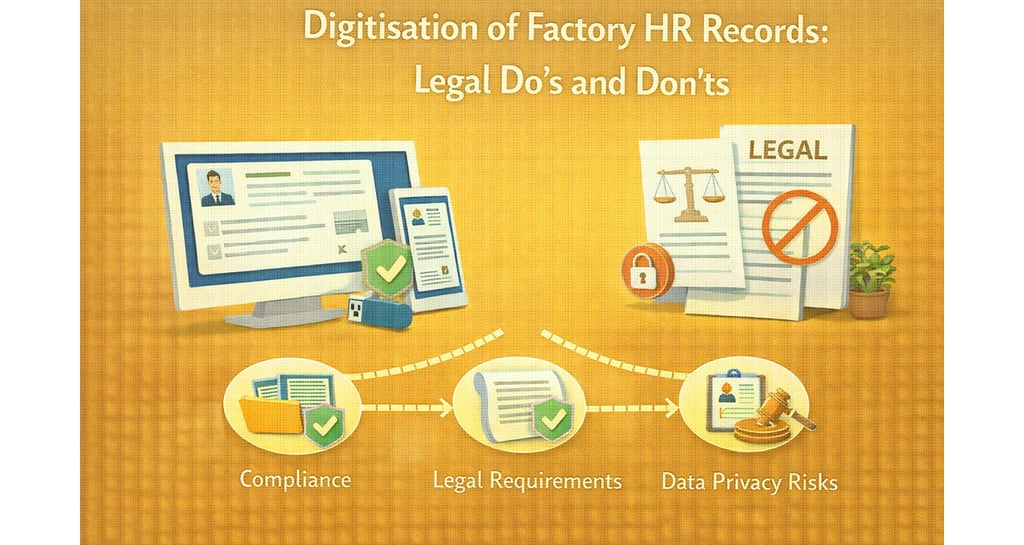
Factory HR teams across India are steadily moving from manual registers to digital systems for attendance, wages, statutory records, and employee files. Digitisation improves efficiency, reduces errors, and supports real-time reporting. However, digitisation does not dilute statutory obligations.
Labour authorities continue to expect accuracy, authenticity, and accessibility of records—whether maintained physically or electronically. Improper digitisation can expose factories to inspection objections, evidentiary challenges, and legal disputes.
This article explains what factory HR can digitise, the legal safeguards to follow, and the common mistakes to avoid.
Why Digitisation Needs Legal Caution
Unlike corporate HR records, factory HR documentation often carries statutory evidentiary value. During inspections, disputes, or court proceedings, HR must be able to:
Produce records immediately
Prove authenticity and non-tampering
Demonstrate consistency with statutory formats
Digitisation without governance can weaken compliance rather than strengthen it.
What Factory HR Can Digitise Safely
Many HR records are now commonly accepted in digital form, provided they are reliable and retrievable.
Typically digitised records include:
Attendance and shift records
Wage and payslip records
Leave management data
EPF and ESIC records and returns
Employee personal files
However, HR must remain aligned with state-specific rules and inspection practices.
Legal Do’s for Digitising Factory HR Records
1. Ensure Statutory Acceptance
HR must confirm whether:
State rules permit electronic registers
Inspecting authorities accept digital formats
Printouts can be produced on demand
Where ambiguity exists, maintain parallel physical records.
2. Preserve Original Formats and Fields
Digitised registers should:
Mirror statutory register formats
Capture all mandatory fields
Retain historical data without overwriting
Any deviation can invite inspection objections.
3. Maintain Audit Trails and Access Controls
HR systems must:
Record who created, modified, or accessed records
Prevent unauthorised changes
Maintain time-stamped entries
Audit trails are critical during disputes and enquiries.
4. Enable On-Demand Retrieval
During inspections, HR must:
Retrieve records immediately
Generate readable printouts
Provide explanations where required
Delayed access is often treated as non-maintenance.
Legal Don’ts HR Must Avoid
1. Do Not Assume Digital Equals Compliant
Digitisation alone does not satisfy statutory requirements. Data accuracy and completeness remain mandatory.
2. Avoid Retrospective Data Entry
Backdated or bulk uploads can raise suspicion during inspections. HR should ensure real-time or daily updates.
3. Do Not Rely Solely on Vendors
HR remains accountable even if systems are outsourced. Vendor failure does not excuse non-compliance.
4. Avoid Data Loss or Poor Backups
Loss of digital records is treated on par with non-maintenance. HR must ensure robust backup and recovery mechanisms.
HR’s Role in Governing Digitisation
Factory HR must:
Define digitisation policies and SOPs
Train HR staff and supervisors
Conduct periodic data accuracy audits
Coordinate with IT on security and backups
Stay updated on evolving legal interpretations
Digitisation must be a controlled transformation, not an ad-hoc shift.
Conclusion
Digitisation of factory HR records offers efficiency and transparency, but only when governed by legal awareness and process discipline. Indian factory HR teams must balance technology adoption with statutory expectations and inspection realities.
When implemented correctly, digitisation strengthens compliance, improves governance, and enhances operational control. When done casually, it can expose factories to unnecessary legal risk.
HR Checklist: Digitisation Do’s and Don’ts
🗹 Verify statutory acceptance of electronic registers
🗹 Preserve statutory formats and mandatory data fields
🗹 Maintain audit trails and access controls
🗹 Update records in real time or daily
🗹 Ensure instant retrieval during inspections
🗹 Maintain physical backups where legally required
🗹 Audit digital data accuracy periodically
🗹 Train HR teams on digital compliance standards
🗹 Secure data with backups and recovery plans
Physical vs Digital HR Records: Practical Comparison
Conclusion--
Effective labour law compliance depends on how well HR operations, payroll, and business processes work together. When compliance is embedded into everyday workflows, organisations reduce risk, improve accuracy, and build sustainable governance systems. HR teams that prioritise integration over isolation are better positioned to manage compliance confidently and consistently.
HireDesk India © 2026 | All Rights Reserved
"Thoughtful guidance for everyday HR"


Quick Links
Topics
Connect
_______________________________________________________________________________________________________________________________________________________________________________________
HireDesk is a free HR knowledge platform focused on practical, India-specific workplace guidance. We help HR professionals, managers, and learners navigate people practices with clarity, responsibility, and real-world relevance.