
Display Notices and Abstracts: What HR Must Display at the Workplace
COMPLIANCE & LABOUR LAWS

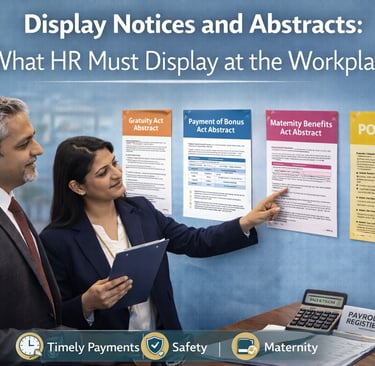
Display of statutory notices and abstracts is one of the simplest yet most frequently violated labour law requirements in India. During inspections, labour officers often begin by checking what is displayed at the workplace, even before examining registers or records.
For HR, this is a high-visibility compliance area. Missing, outdated, or incorrectly displayed notices can attract penalties—even if the organisation is otherwise compliant.
This article explains what notices and abstracts HR must display, why they matter, and how HR should manage this requirement across locations.
Legal Basis for Display Requirements
Display obligations arise from multiple laws, including:
Factories Act, 1948
State Shops and Establishments Acts
Minimum Wages Act
Payment of Wages Act
Contract Labour (R&A) Act
State-specific rules and notifications
Each law specifies what must be displayed, where, and in which language.
What Are Notices and Abstracts?
Statutory Abstracts
Abstracts are:
Summaries of key provisions of a labour law
Prescribed formats issued by authorities
Intended for employee awareness
HR must use the exact format notified, not self-drafted summaries.
Notices
Notices typically include:
Working hours and shift timings
Weekly holidays
Wage periods and pay dates
Name and address of inspectors
These notices reflect actual practice, not just policy intent.
Location and Language Requirements
Most laws require that notices:
Be displayed at prominent and accessible locations
Be readable and protected from damage
Be displayed in English and the local language
Failure on language compliance is a common inspection observation.
Digital Display: Is It Enough?
Some states allow:
Electronic display of notices
Intranet-based communication
However, unless explicitly permitted, physical display is still mandatory. HR should avoid assuming that digital-only display is sufficient.
HR Execution: How to Stay Compliant
HR should:
Maintain a location-wise display checklist
Standardise laminated notice sets
Update displays immediately after legal changes
Audit displays during internal compliance reviews
Displays must match current law and current practice.
Conclusion
Display notices and abstracts may appear minor, but they are inspection-critical. For HR, disciplined upkeep of statutory displays reflects compliance maturity and reduces unnecessary regulatory friction.
Treat workplace displays as living compliance assets, not one-time formalities.
HR Compliance Action Checklist: Statutory Displays
🗹 Identify applicable laws for each establishment
🗹 Obtain prescribed abstracts in notified formats
🗹 Display working hours, holidays, and wage notices
🗹 Ensure English and local language versions are displayed
🗹 Place notices at prominent and accessible locations
🗹 Replace damaged or outdated displays immediately
🗹 Track state amendments affecting display content
🗹 Audit displays during internal compliance checks
🗹 Maintain evidence of compliance for inspections
Common Statutory Notices and Abstracts: HR Reference
Conclusion--
Effective labour law compliance depends on how well HR operations, payroll, and business processes work together. When compliance is embedded into everyday workflows, organisations reduce risk, improve accuracy, and build sustainable governance systems. HR teams that prioritise integration over isolation are better positioned to manage compliance confidently and consistently.
HireDesk India © 2026 | All Rights Reserved
"Thoughtful guidance for everyday HR"


Quick Links
Topics
Connect
_______________________________________________________________________________________________________________________________________________________________________________________
HireDesk is a free HR knowledge platform focused on practical, India-specific workplace guidance. We help HR professionals, managers, and learners navigate people practices with clarity, responsibility, and real-world relevance.