
Domestic Enquiries and Disciplinary Action: Legal Process for HR
COMPLIANCE & LABOUR LAWS
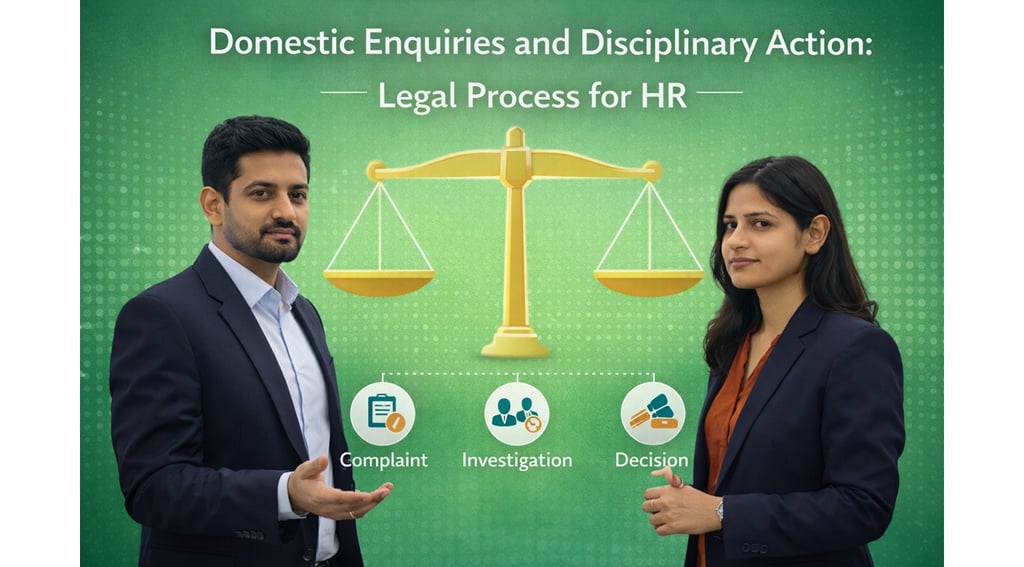
Domestic enquiries form the legal backbone of disciplinary action in Indian organisations. Any punishment imposed without following a proper enquiry process is vulnerable to being set aside by labour authorities or courts—regardless of the employee’s misconduct.
For HR, domestic enquiries are not about proving guilt aggressively. They are about following due process, natural justice, and documentation discipline. Most adverse rulings against employers arise from procedural lapses, not weak facts.
This article explains the legally sound approach HR should follow while conducting domestic enquiries and disciplinary action.
When Is a Domestic Enquiry Required?
A domestic enquiry is required when:
Misconduct is alleged against an employee
The proposed punishment may affect employment (suspension, dismissal, demotion, wage cut, etc.)
Minor corrective actions may not require a full enquiry, but any punitive action must be backed by due process.
HR must assess seriousness before acting.
Principles of Natural Justice HR Must Follow
Every domestic enquiry must satisfy:
Audi alteram partem – the employee must be heard
Nemo judex in causa sua – the enquiry officer must be impartial
Ignoring these principles invalidates the entire disciplinary action, even if misconduct is proven later.
Step-by-Step Domestic Enquiry Process
1. Issue of Charge Sheet
HR must:
Clearly state charges
Mention relevant standing orders or service rules
Provide reasonable time to respond
Vague or poorly drafted charge sheets are a common compliance failure.
2. Appointment of Enquiry Officer
The enquiry officer must:
Be unbiased
Not be a witness or complainant
Understand enquiry procedures
HR’s role is to ensure procedural fairness, not influence outcomes.
3. Conduct of Enquiry
During the enquiry:
Employee must get opportunity to defend
Evidence and witnesses must be recorded
Proceedings must be documented
Shortcuts here almost always weaken the employer’s case.
4. Enquiry Report and Findings
The enquiry officer must submit:
Findings based on evidence
Reasoned conclusions
HR should review the report for process correctness, not rewrite findings.
5. Disciplinary Action
Before imposing punishment:
Issue show-cause notice on proposed punishment
Consider employee’s representation
Punishment must be proportionate to misconduct.
Common HR Mistakes in Disciplinary Matters
Frequent errors include:
Predetermined decisions
Delayed enquiries
Mixing investigation and enquiry stages
Poor documentation
These mistakes often lead to reinstatement orders with back wages.
Conclusion
Domestic enquiries are not administrative formalities—they are legal processes with strict expectations. HR teams that respect timelines, neutrality, documentation, and natural justice can enforce discipline confidently and lawfully.
A fair enquiry protects both the organisation and the integrity of HR decision-making.
HR Compliance Action Checklist: Domestic Enquiries
🗹 Identify cases requiring formal enquiry
🗹 Draft clear and specific charge sheets
🗹 Appoint unbiased enquiry officers
🗹 Follow principles of natural justice
🗹 Allow fair opportunity for defence
🗹 Record enquiry proceedings properly
🗹 Review enquiry reports for procedural validity
🗹 Issue show-cause notice before punishment
🗹 Impose proportionate disciplinary action
🗹 Preserve enquiry records securely
Domestic Enquiry Process: HR Legal Framework
Conclusion--
Effective labour law compliance depends on how well HR operations, payroll, and business processes work together. When compliance is embedded into everyday workflows, organisations reduce risk, improve accuracy, and build sustainable governance systems. HR teams that prioritise integration over isolation are better positioned to manage compliance confidently and consistently.
HireDesk India © 2026 | All Rights Reserved
"Thoughtful guidance for everyday HR"


Quick Links
Topics
Connect
_______________________________________________________________________________________________________________________________________________________________________________________
HireDesk is a free HR knowledge platform focused on practical, India-specific workplace guidance. We help HR professionals, managers, and learners navigate people practices with clarity, responsibility, and real-world relevance.