
Domestic Enquiry Process: Step-by-Step Guide for Factory HR
INDUSTRIAL RELATIONS & FACTORY HR
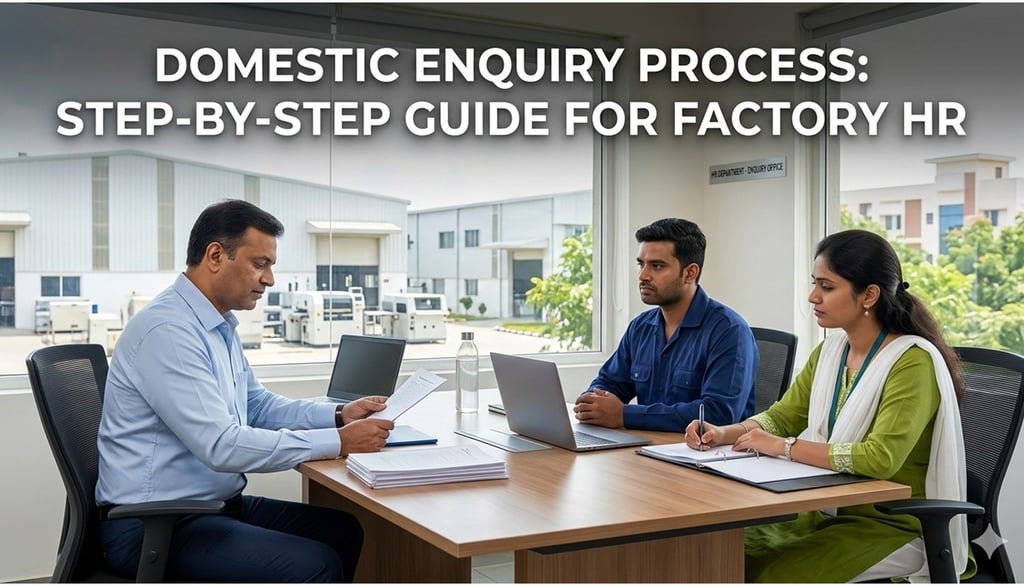
In Indian factories, a domestic enquiry is the most critical safeguard between disciplinary intent and legal sustainability. Even genuine cases of misconduct fail in labour courts when the enquiry process is flawed, rushed, or biased.
For Factory HR teams, a domestic enquiry is not a legal ritual—it is a structured fact-finding process rooted in Standing Orders and principles of natural justice. This article provides a clear, step-by-step guide to conducting domestic enquiries correctly in Indian factory settings.
What Is a Domestic Enquiry
A domestic enquiry is an internal investigation conducted by the employer to determine whether charges of misconduct against a workman are proved.
It ensures that:
Facts are established objectively
The employee gets a fair opportunity to defend
Management decisions are based on evidence
A properly conducted enquiry protects the organisation even if punishment is challenged later.
When Is a Domestic Enquiry Required
A domestic enquiry is required when:
Misconduct is alleged under Standing Orders
Management proposes major punishment (suspension, dismissal, discharge)
Facts are disputed or denial is raised
Minor misconducts with admitted guilt may not require a full enquiry, but HR must exercise caution.
Step-by-Step Domestic Enquiry Process
Step 1: Preliminary Assessment by HR
Before issuing any charge-sheet, HR must:
Verify whether the act qualifies as misconduct
Check Standing Orders definitions
Review available evidence
Decide whether enquiry is necessary
Premature decisions or assumptions weaken the case.
Step 2: Issue of Charge-Sheet
The charge-sheet is the foundation of the enquiry.
HR Must Ensure
Charges are clear, specific, and factual
Date, time, place, and nature of misconduct are mentioned
Relevant Standing Order clauses are cited
Reasonable time is given for explanation
Vague or omnibus charges are a common reason for enquiry failure.
Step 3: Consideration of Employee Explanation
After receiving the explanation:
HR must objectively assess the reply
If explanation is satisfactory, enquiry may be dropped
If not, enquiry must be initiated formally
Predetermined enquiries are viewed unfavourably by courts.
Step 4: Appointment of Enquiry Officer
The Enquiry Officer must be neutral and unbiased.
Key HR Considerations
Should not be complainant or witness
Should not have personal hostility
Should understand enquiry procedures
External enquiry officers may be used in sensitive cases
Bias at this stage invalidates the entire process.
Step 5: Conduct of Enquiry Proceedings
This is the core of the domestic enquiry.
HR Must Ensure
Notice of enquiry is issued
Employee is allowed representation as per Standing Orders
Management presents evidence and witnesses
Employee is allowed cross-examination
Employee can produce defence witnesses
Proceedings must be recorded accurately.
Step 6: Enquiry Report
After completion, the Enquiry Officer submits a reasoned report.
Report Should Contain
Issues framed
Evidence considered
Findings on each charge
Clear conclusion on guilt or otherwise
HR should not influence findings.
Step 7: Show Cause Notice on Punishment
If charges are proved:
HR issues show cause notice on proposed punishment
Employee is allowed to respond
Past record may be considered at this stage
Punishment cannot be automatic.
Step 8: Final Decision and Order
The disciplinary authority must:
Apply independent judgement
Ensure proportionality
Issue a speaking order
Communicate decision clearly
Mechanical approval of enquiry findings is discouraged.
Common Mistakes Factory HR Must Avoid
Punishing before enquiry completion
Appointing biased enquiry officers
Denying cross-examination
Poor documentation
Treating enquiry as a formality
These errors often result in reinstatement orders.
Role of HR in Domestic Enquiries
HR is the process owner, not the judge.
HR must:
Guide managers
Ensure compliance with Standing Orders
Maintain documentation
Safeguard fairness
Balance discipline and justice
Strong HR oversight ensures credibility.
Conclusion
A domestic enquiry is the backbone of disciplinary fairness in Indian factories. When conducted properly, it protects management decisions, withstands legal scrutiny, and reinforces workplace discipline.
Factory HR teams must treat domestic enquiries as structured governance processes, not administrative hurdles.
🗹 Domestic Enquiry – HR Action Checklist
🗹 Verify misconduct under Standing Orders
🗹 Issue clear and specific charge-sheet
🗹 Allow reasonable time for explanation
🗹 Appoint unbiased enquiry officer
🗹 Ensure fair enquiry proceedings
🗹 Permit cross-examination and defence
🗹 Obtain reasoned enquiry report
🗹 Issue proportionate and reasoned punishment
Domestic Enquiry Process – HR Reference Table
Conclusion--
Effective labour law compliance depends on how well HR operations, payroll, and business processes work together. When compliance is embedded into everyday workflows, organisations reduce risk, improve accuracy, and build sustainable governance systems. HR teams that prioritise integration over isolation are better positioned to manage compliance confidently and consistently.
HireDesk India © 2026 | All Rights Reserved
"Thoughtful guidance for everyday HR"


Quick Links
Topics
Connect
_______________________________________________________________________________________________________________________________________________________________________________________
HireDesk is a free HR knowledge platform focused on practical, India-specific workplace guidance. We help HR professionals, managers, and learners navigate people practices with clarity, responsibility, and real-world relevance.