
Employee Experience in Indian Workplaces: HR’s Role from Onboarding to Engagement
EMPLOYEE EXPERIENCE & CULTURE
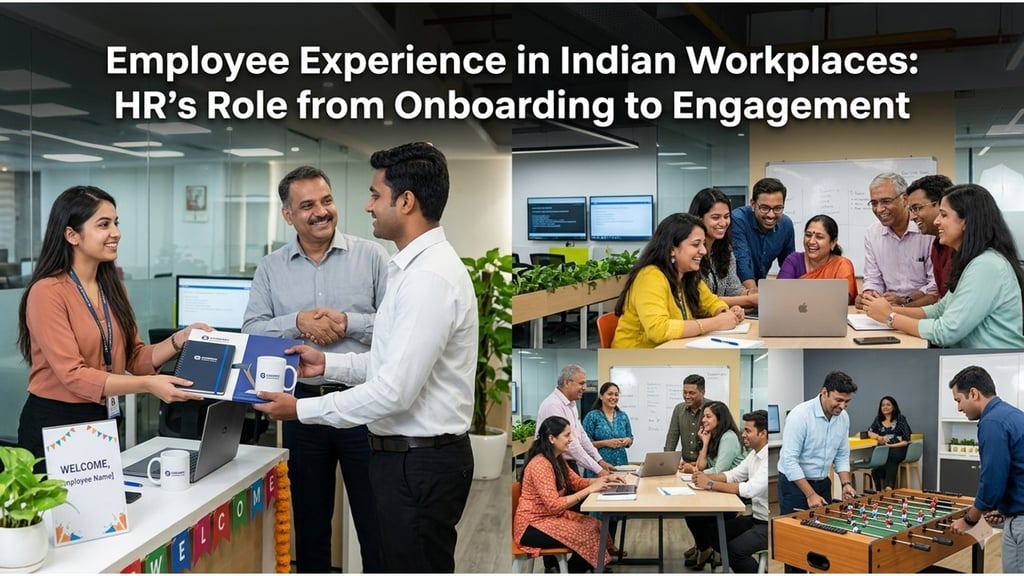
Employee experience (EX) is shaped not by isolated initiatives, but by the sum of everyday HR decisions, policies, and interactions employees encounter throughout their time in an organisation. In Indian workplaces, where diversity of workforce expectations, organisational maturity, and regulatory context coexist, HR plays a central role in shaping experiences that are consistent, fair, and sustainable.
This article explains what employee experience means in practice, how it differs from engagement alone, and where HR’s responsibilities truly lie.
What Is Employee Experience?
Employee experience refers to how employees perceive and experience their workplace across the full lifecycle—right from recruitment and onboarding to daily work, development, and eventual exit.
It is influenced by:
Workplace culture and leadership behaviour
HR policies and people practices
Manager-employee interactions
Physical, digital, and social work environments
Unlike one-time engagement programs, EX is continuous and cumulative.
Employee Experience vs Employee Engagement
While often used interchangeably, the two are distinct:
Employee experience is the broader journey and environment
Employee engagement is an outcome—how employees feel and respond
Strong engagement is difficult to sustain without a thoughtfully designed employee experience.
HR’s Core Responsibilities in Shaping Experience
HR influences employee experience through:
1. Policy Design and Consistency
Clear, fair, and well-communicated policies reduce ambiguity and build trust.
2. Manager Enablement
People managers are the daily face of HR practices. HR must equip them with tools, clarity, and accountability.
3. Lifecycle Touchpoints
Recruitment, onboarding, performance discussions, learning access, and exits all shape perceptions.
4. Listening and Feedback Mechanisms
Surveys, pulse checks, and open feedback loops help HR identify experience gaps early.
Indian Workplace Context: Practical Realities
In Indian organisations, employee experience is often shaped by:
Mixed workforce demographics and expectations
Rapid growth or operational pressures
Compliance-driven HR processes
Manager capability variance
HR’s role is not to create “perfect” experiences, but workable, credible, and inclusive ones.
Common Pitfalls in EX Initiatives
Treating engagement activities as substitutes for core HR hygiene
Launching initiatives without manager buy-in
Ignoring frontline and operational employee realities
Measuring sentiment without acting on insights
Employee Experience Orientation Checklist for HR
☐ Map key employee lifecycle touchpoints
☐ Review policy clarity and consistency
☐ Assess manager capability gaps
☐ Establish feedback and follow-up loops
☐ Align experience initiatives with organisational context
Conclusion
Employee experience is not owned by programs—it is shaped by everyday HR and leadership behaviour. When HR focuses on clarity, fairness, and practical execution, positive experience follows naturally.
Conclusion--
Effective labour law compliance depends on how well HR operations, payroll, and business processes work together. When compliance is embedded into everyday workflows, organisations reduce risk, improve accuracy, and build sustainable governance systems. HR teams that prioritise integration over isolation are better positioned to manage compliance confidently and consistently.
Related Articles
HireDesk India © 2026 | All Rights Reserved
"Thoughtful guidance for everyday HR"


Quick Links
Topics
Connect
_______________________________________________________________________________________________________________________________________________________________________________________
HireDesk is a free HR knowledge platform focused on practical, India-specific workplace guidance. We help HR professionals, managers, and learners navigate people practices with clarity, responsibility, and real-world relevance.