
Employee Separation and Full & Final Settlement in Factories: HR Compliance Guide
INDUSTRIAL RELATIONS & FACTORY HR
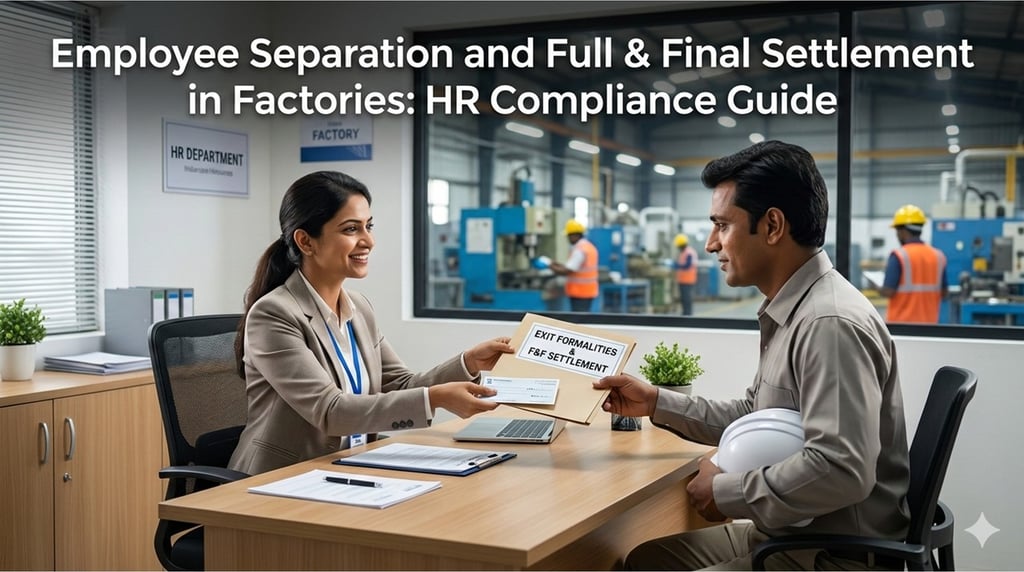

Employee separation is a routine but sensitive process in Indian factories. Whether due to resignation, retirement, termination, VRS, or abandonment of service, improper handling of separation and Full & Final (F&F) settlement often leads to disputes, complaints to labour authorities, and damaged industrial relations.
For Factory HR teams, separation is not just an administrative closure. It is a legal, financial, and relationship-sensitive process that must balance compliance, fairness, and discipline.
This article explains how HR must manage employee separation and F&F settlement in factories in a legally sound and practical manner.
Types of Employee Separation in Factories
Common forms of separation include:
Resignation by employee
Superannuation or retirement
Termination for misconduct or poor performance
Retrenchment or layoff
Voluntary Retirement Scheme (VRS)
Death or permanent disablement
Each type has different legal and settlement implications, which HR must clearly understand.
Legal Framework Governing Separation and Settlement
Key laws impacting separation and F&F include:
Industrial Disputes Act, 1947
Industrial Relations Code, 2020
Factories Act, 1948
Payment of Wages Act, 1936
Payment of Gratuity Act, 1972
Applicable Standing Orders and service rules
Delayed or incorrect settlement is treated as a serious violation, even if separation is otherwise valid.
Full & Final Settlement Components
A typical F&F settlement may include:
Earned wages up to last working day
Leave encashment
Gratuity (where applicable)
Bonus or incentive (as per policy)
Overtime dues
Deductions for statutory or authorised recoveries
HR must ensure clarity, accuracy, and documentation for every component.
HR Process for Managing Separation
A structured separation process should include:
Written request or order for separation
Verification of notice period compliance
Clearance from departments
Computation and approval of settlement
Timely payment and documentation
Issuance of experience and service certificates
Informal exits or verbal settlements create long-term legal exposure.
Time Limits and Payment Discipline
As per law:
Wages must be paid within prescribed timelines
Gratuity must be paid within statutory limits
Delay attracts penalties and interest
HR must track deadlines rigorously, especially in involuntary separations.
Common HR Mistakes in Separation Handling
Frequent issues include:
Delayed F&F payments
Withholding dues as leverage
Incorrect gratuity calculations
Poor documentation of exit reasons
Inconsistent treatment across employees
Such mistakes often result in avoidable litigation.
Conclusion
Employee separation and F&F settlement are critical moments that reflect the organisation’s governance and fairness. HR’s role is to ensure compliance, accuracy, and dignity throughout the exit process.
Factories that handle separations professionally reduce disputes, protect reputation, and maintain industrial harmony.
🗹 Factory HR Checklist: Separation & Full & Final Settlement
🗹 Identify correct separation category
🗹 Follow Standing Orders and service rules
🗹 Compute all dues accurately
🗹 Adhere to statutory payment timelines
🗹 Obtain clearances systematically
🗹 Document deductions and recoveries
🗹 Issue service and experience certificates
🗹 Maintain complete exit records
Employee Separation & F&F Settlement – HR Reference Table
Conclusion--
Effective labour law compliance depends on how well HR operations, payroll, and business processes work together. When compliance is embedded into everyday workflows, organisations reduce risk, improve accuracy, and build sustainable governance systems. HR teams that prioritise integration over isolation are better positioned to manage compliance confidently and consistently.
HireDesk India © 2026 | All Rights Reserved
"Thoughtful guidance for everyday HR"


Quick Links
Topics
Connect
_______________________________________________________________________________________________________________________________________________________________________________________
HireDesk is a free HR knowledge platform focused on practical, India-specific workplace guidance. We help HR professionals, managers, and learners navigate people practices with clarity, responsibility, and real-world relevance.