
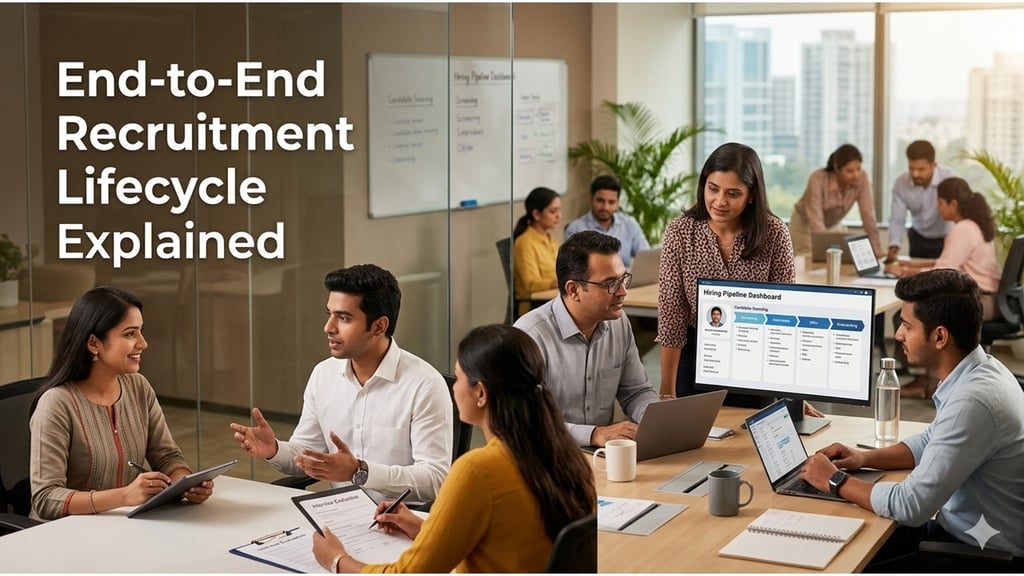
End-to-End Recruitment Lifecycle Explained
Recruitment is a foundational HR responsibility that directly influences workforce quality, productivity, and organisational culture. In Indian organisations, HR teams often manage recruitment alongside compliance, operations, and people management—making clarity and structure essential.
RECRUITMENT AND HIRING
This article explains the end-to-end recruitment lifecycle, from workforce planning and sourcing to selection, onboarding, and early-stage integration, with a practical focus on how HR can manage each stage effectively.
What Is the Recruitment Lifecycle?
The recruitment lifecycle covers all stages from identifying a vacancy to onboarding a new employee.
A structured lifecycle helps organisations:
Reduce hiring errors
Improve candidate experience
Ensure compliance
About this article
This article outlines the recruitment lifecycle as a connected set of HR responsibilities, from role definition to final hiring decisions. Each stage highlights the need for structure, consistency, and alignment with organisational needs. While this guide provides a high-level framework, individual stages are explored in more detail through focused practical articles. Readers may use this overview as a starting point before diving deeper into each stage.
Key Stages in the Recruitment Lifecycle
1. Manpower Requirement Identification
Business justification
Role clarity
Budget approval
2. Job Description Preparation
Clear job descriptions define:
Role purpose
Key responsibilities
Required skills
Well-written JDs improve hiring quality.
3. Sourcing Candidates
Common sourcing channels include:
Job portals
Employee referrals
Recruitment agencies
Internal postings
HR must balance speed and quality.
4. Screening and Shortlisting
Initial screening involves:
Resume review
Eligibility checks
Shortlisting criteria
Consistency is critical at this stage.
5. Interview and Evaluation
Structured interviews
Role-based assessment
Objective evaluation
Unstructured interviews often lead to biased decisions.
6. Offer and Pre-Joining
Offer letter issuance
Compensation alignment
Document collection
This stage requires close HR attention.
7. Onboarding
Recruitment does not end at joining. Effective onboarding:
Improves retention
Sets expectations
Builds early engagement
Common Recruitment Challenges
Hiring under pressure
Poor role clarity
Candidate drop-outs
Inconsistent evaluation
Process discipline reduces these issues.
This article is part of HireDesk’s Recruitment & Hiring knowledge resources.
Conclusion
Recruitment is not a single activity but a connected lifecycle. HR teams that approach hiring systematically achieve better outcomes and stronger organisational alignment.
Related Articles
HireDesk India © 2026 | All Rights Reserved
"Thoughtful guidance for everyday HR"


Quick Links
Topics
Connect
_______________________________________________________________________________________________________________________________________________________________________________________
HireDesk is a free HR knowledge platform focused on practical, India-specific workplace guidance. We help HR professionals, managers, and learners navigate people practices with clarity, responsibility, and real-world relevance.