
Factories Act Compliance: HR and Admin Responsibilities
COMPLIANCE & LABOUR LAWS

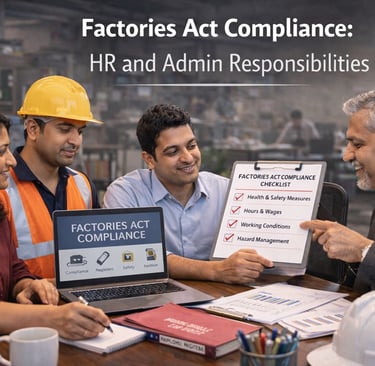
The Factories Act, 1948 remains one of the most operationally intensive labour laws in India. Unlike many “paper-heavy” statutes, this law directly governs how a factory runs every single day — working hours, safety, health, welfare, registers, notices, inspections, and worker facilities.
While senior management may see compliance as an “admin issue”, in practice it is HR and Admin teams who carry the day-to-day burden of Factories Act compliance. Any gap — missing registers, delayed returns, unsafe practices, or non-display of notices — can immediately attract inspections, show-cause notices, or prosecution.
This article explains what HR and Admin are actually responsible for under the Factories Act, and how to manage compliance practically in Indian factory environments.
1. Who Is Covered Under the Factories Act?
A premise is covered if:
10 or more workers are employed with power, or
20 or more workers are employed without power
Once covered, compliance applies irrespective of job role — permanent, temporary, trainee, or contract workers working inside the factory premises.
HR must remember: Coverage is based on actual headcount, not payroll classification.
2. Core Areas of HR & Admin Responsibility
Factories Act compliance can be grouped into six operational buckets:
a) Working Hours and Shifts
HR is responsible for ensuring that:
Weekly working hours do not exceed 48 hours
Daily working hours do not exceed 9 hours
Spread-over limits (including breaks) are followed
Overtime is calculated and paid correctly
Weekly offs and compensatory offs are tracked
Shift rosters, attendance records, and overtime approvals must align strictly with the Act.
b) Health, Safety, and Welfare Provisions
While safety officers and EHS teams handle execution, HR/Admin remains legally accountable for ensuring:
Cleanliness and sanitation
Drinking water arrangements
Washing, seating, canteen, and rest room facilities
First-aid boxes and medical facilities
Appointment of Safety Officer / Welfare Officer where applicable
Inspectors often question HR on availability, not just policy.
c) Registers, Records, and Forms
Factories Act compliance is documentation-heavy. HR/Admin must maintain:
Attendance and wage registers
Overtime registers
Leave with wages registers
Accident registers
Muster rolls and worker details
Annual returns and periodic filings
Incomplete or back-dated registers are one of the most common inspection observations.
d) Display Notices and Abstracts
HR/Admin must ensure that:
Statutory abstracts of the Factories Act are displayed
Working hours, shift timings, and holidays are notified
Inspector contact details are displayed
Safety instructions and emergency procedures are visible
These must be displayed at conspicuous locations, not kept in files.
e) Handling Inspections and Notices
During inspections, HR/Admin is expected to:
Coordinate with Factory Inspector
Produce registers and records immediately
Facilitate site walkthroughs
Receive inspection notes or notices
Coordinate timely replies and corrective actions
Poor inspection handling often escalates minor issues into formal violations.
f) Coordination with Contractors
Even when contract labour is deployed:
Principal employer obligations under the Factories Act continue
Working hours, safety, welfare, and medical facilities apply equally
HR must ensure contractors follow factory rules
“Contractor default” is not accepted as a defence by inspectors.
3. Practical Challenges Faced by HR Teams
Common real-world issues include:
Multiple shifts running beyond permitted hours
Inconsistent attendance and overtime records
Safety compliance treated as “production issue”
Old factories operating with outdated layouts
Poor coordination between HR, Admin, and EHS teams
HR’s role is often that of a compliance integrator, aligning operations with legal limits.
4. HR Risk Areas Under the Factories Act
HR must be particularly careful about:
Excessive overtime without approvals
Non-appointment of mandatory officers
Missing or outdated registers
Non-submission of annual returns
Repeat inspection observations
Penalties under the Act can include fines, prosecution of occupier and manager, and factory closure directions in extreme cases.
🗹 HR & Admin Self-Check: Factories Act Readiness
🗹 Is the factory coverage threshold correctly assessed and documented?
🗹 Are shift timings, overtime, and weekly offs legally compliant?
🗹 Are all statutory registers updated in real time?
🗹 Are health, safety, and welfare facilities actually available on the shop floor?
🗹 Are statutory notices and abstracts clearly displayed?
🗹 Is there a clear inspection-handling protocol for HR/Admin?
Conclusion
Factories Act compliance is not a once-a-year filing exercise — it is daily operational discipline. HR and Admin teams sit at the centre of this discipline, balancing production pressures with legal boundaries.
Factories that stay inspection-ready are usually not the ones with the thickest manuals, but the ones where HR processes match shop-floor reality.
For Indian HR professionals, mastering the Factories Act is less about legal theory and more about consistent execution.
Reference Table: Key HR & Admin Responsibilities Under the Factories Act
Conclusion--
Effective labour law compliance depends on how well HR operations, payroll, and business processes work together. When compliance is embedded into everyday workflows, organisations reduce risk, improve accuracy, and build sustainable governance systems. HR teams that prioritise integration over isolation are better positioned to manage compliance confidently and consistently.
HireDesk India © 2026 | All Rights Reserved
"Thoughtful guidance for everyday HR"


Quick Links
Topics
Connect
_______________________________________________________________________________________________________________________________________________________________________________________
HireDesk is a free HR knowledge platform focused on practical, India-specific workplace guidance. We help HR professionals, managers, and learners navigate people practices with clarity, responsibility, and real-world relevance.