
Factories Act Compliance: Key HR Responsibilities in India
INDUSTRIAL RELATIONS & FACTORY HR
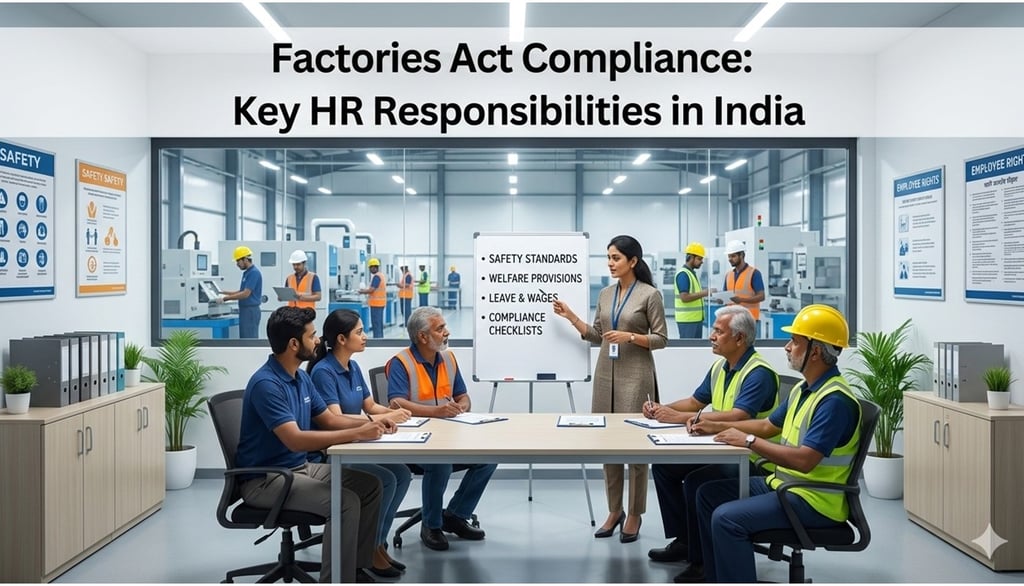
The Factories Act, 1948 remains the backbone of labour regulation for manufacturing units in India. Despite the emergence of new labour codes, the practical realities of factory operations—shifts, safety, welfare, working hours, and inspections—continue to be governed largely by the Factories Act and state factory rules.
For Factory HR teams, compliance is not a paperwork exercise alone. It directly impacts worker safety, production continuity, legal risk, and industrial relations. Weak compliance often becomes the root cause of disputes, accidents, penalties, and even factory shutdowns.
This article explains what the Factories Act expects, and how HR must operationalise compliance on the shop floor.
Applicability of the Factories Act
The Factories Act applies to manufacturing units where:
10 or more workers are employed with power, or
20 or more workers are employed without power
Once applicable, compliance is mandatory irrespective of:
Employment type (permanent, contract, trainee)
Union presence
Size of production output
HR must clearly establish applicability at the unit level and ensure registrations and renewals are always current.
Core Compliance Areas Under the Factories Act
Factory HR responsibilities broadly fall under five compliance pillars:
1. Working Hours and Leave Management
HR must ensure:
Daily and weekly working hour limits
Weekly holidays and compensatory offs
Overtime calculation and payment
Earned leave accrual, usage, and registers
Any deviation without approval exposes the factory to penalties and disputes.
2. Health and Safety Compliance
Safety is not optional under the Act.
HR must coordinate with safety officers to ensure:
Safe machinery and guarding
PPE issuance and enforcement
Periodic health check-ups
Accident reporting and investigation
Safety training and mock drills
Most prosecutions under the Act arise from safety lapses.
3. Welfare Facilities
Factories must provide statutory welfare facilities based on workforce strength, such as:
Clean drinking water
Sanitary facilities
Canteen
Rest rooms and crèches (where applicable)
First-aid and medical facilities
HR is responsible for upkeep, vendor management, and inspections readiness.
4. Employment Conditions and Records
HR must maintain:
Muster rolls and attendance records
Wage and overtime registers
Leave registers
Notice boards with statutory displays
Identity cards and employment details
Incomplete or inconsistent records are treated as non-compliance even if practices are correct.
5. Inspections and Government Interface
HR is the primary liaison during:
Factory inspections
Show-cause notices
Accident inquiries
Licensing renewals
A prepared, transparent approach reduces friction and long-term scrutiny.
Role of Factory HR in Ensuring Compliance
Unlike corporate HR, Factory HR must work on the shop floor, not from policy manuals.
Effective compliance requires HR to:
Translate legal provisions into SOPs
Train supervisors and line managers
Conduct internal audits
Track state-specific rule changes
Maintain discipline without fear-based enforcement
Compliance succeeds only when HR, operations, and safety teams function together.
Common Compliance Gaps in Indian Factories
Some recurring issues HR must watch out for:
Excess overtime without approvals
Poor contractor compliance alignment
Incomplete statutory registers
Delayed accident reporting
Neglected welfare facilities
Weak documentation during inspections
Most of these are preventable with structured HR processes.
Conclusion
Factories Act compliance is a continuous operational responsibility, not a one-time statutory task. For Indian factories, strong compliance protects workers, safeguards management, and supports stable industrial relations.
Factory HR teams play a central role in balancing productivity with statutory discipline. When compliance is embedded into daily operations, it reduces disputes, inspections become smoother, and the factory gains long-term credibility with authorities and employees alike.
🗹 Factory HR Compliance Checklist under the Factories Act
🗹 Confirm applicability and licence validity
🗹 Track working hours, overtime, and weekly offs
🗹 Ensure safety training and PPE compliance
🗹 Maintain welfare facilities as per thresholds
🗹 Keep statutory registers updated and accurate
🗹 Conduct internal compliance audits
🗹 Coordinate with safety officers and operations
🗹 Prepare proactively for inspections
Factories Act – Key HR Responsibility Matrix
Conclusion--
Effective labour law compliance depends on how well HR operations, payroll, and business processes work together. When compliance is embedded into everyday workflows, organisations reduce risk, improve accuracy, and build sustainable governance systems. HR teams that prioritise integration over isolation are better positioned to manage compliance confidently and consistently.
HireDesk India © 2026 | All Rights Reserved
"Thoughtful guidance for everyday HR"


Quick Links
Topics
Connect
_______________________________________________________________________________________________________________________________________________________________________________________
HireDesk is a free HR knowledge platform focused on practical, India-specific workplace guidance. We help HR professionals, managers, and learners navigate people practices with clarity, responsibility, and real-world relevance.