
Factory HR Documentation and Registers: What to Maintain and Why
INDUSTRIAL RELATIONS & FACTORY HR
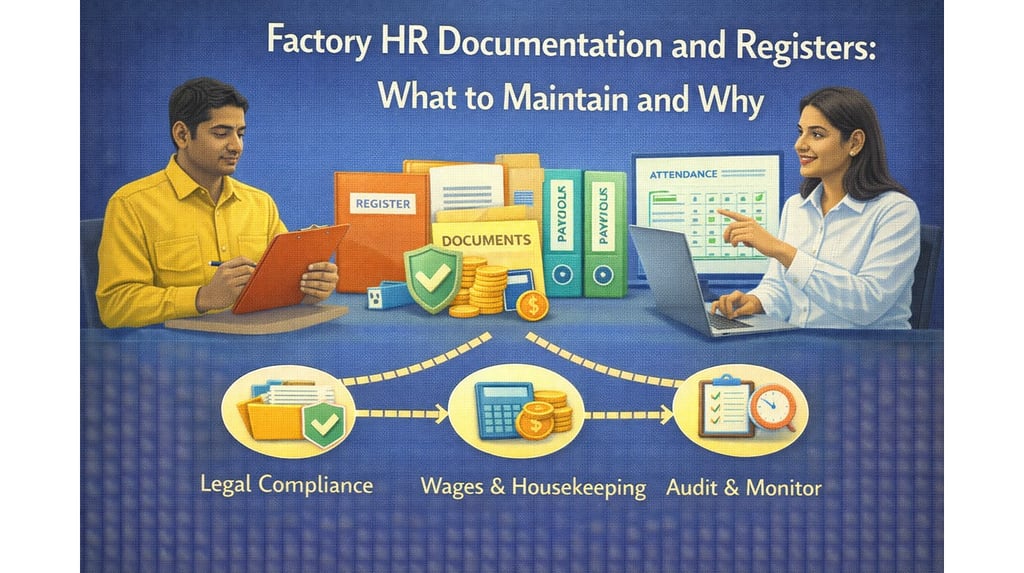
In Indian factories, HR documentation is not a paperwork exercise—it is a legal safeguard and an operational backbone. Labour inspections, union disputes, accidents, wage claims, or disciplinary actions often hinge on one simple question: Are your records complete, accurate, and up to date?
Factory HR teams operate in a heavily regulated environment under the Factories Act, Industrial Relations Code, wage laws, social security laws, and state-specific rules. Proper maintenance of statutory registers and records protects the organisation from penalties, builds credibility with labour authorities, and supports fair employee management.
This article explains what documentation factory HR must maintain, why it matters, and how HR should manage it practically.
Why HR Documentation Is Critical in Factories
Unlike corporate offices, factories face frequent inspections, higher union presence, and stricter compliance expectations. Documentation serves multiple purposes:
Demonstrates legal compliance during inspections
Acts as evidence during disputes or enquiries
Ensures transparency in wages, attendance, and service conditions
Supports safety, welfare, and social security obligations
Missing or inconsistent registers can lead to fines, prosecution, back-wage claims, or adverse orders—even if actual practices are fair.
Core Categories of Factory HR Documentation
1. Employment and Service Records
These records establish the employer–employee relationship and service conditions.
Typical documents include:
Appointment letters and service contracts
Employee personal files (KYC, qualifications, nominations)
Certified standing orders or service rules
Transfer, promotion, and increment records
These documents are often examined during disputes related to termination, suspension, or service benefits.
2. Attendance, Working Hours, and Leave Registers
Factories must strictly record working hours to ensure compliance with overtime, weekly off, and shift regulations.
HR must maintain:
Muster rolls / attendance registers
Shift schedules and overtime registers
Leave registers (earned leave, sick leave, casual leave)
Attendance records are frequently cross-checked with wage payments during inspections.
3. Wages and Payment Records
Wage documentation is one of the most scrutinised areas in factory inspections.
Key records include:
Wage registers (basic, DA, allowances, deductions)
Overtime wage calculations
Payslips and proof of wage payment
Minimum wage compliance records
Any mismatch between attendance, overtime, and wage registers can invite penalties.
4. Statutory Social Security Records
HR must maintain accurate documentation for all statutory contributions.
This includes:
EPF and ESIC registration and contribution records
Challans, returns, and member-wise details
Nomination forms and declarations
Inspectors often verify whether contributions match actual wages and headcount.
5. Safety, Health, and Welfare Registers
Under the Factories Act, safety documentation is mandatory and non-negotiable.
Common registers include:
Accident and dangerous occurrence registers
Health check-up records
Safety committee minutes
Welfare amenities records (canteen, crèche, drinking water)
These records are critical during accidents or safety audits.
6. Industrial Relations and Disciplinary Records
IR-related documentation supports fair process and legal defensibility.
HR should maintain:
Grievance registers
Disciplinary case files
Domestic enquiry proceedings
Settlement agreements and MoUs
Incomplete documentation can invalidate otherwise fair disciplinary actions.
HR’s Practical Role in Managing Documentation
Factory HR is not just a record keeper. HR must ensure:
Registers are updated in real time, not retrospectively
Physical and digital records are consistent
Records are preserved for the legally prescribed period
Confidentiality and access controls are maintained
Contractors’ records are also reviewed regularly
Documentation discipline reflects the maturity of factory HR governance.
Conclusion
Factory HR documentation is a compliance shield, dispute defence, and governance tool. In the Indian factory environment, where inspections and IR issues are common, accurate registers protect both management and workers.
HR teams that treat documentation as a living system—not a last-minute inspection response—are better positioned to ensure compliance, trust, and operational stability. Strong documentation practices ultimately reduce disputes, penalties, and organisational risk.
HR Checklist: Factory Documentation Discipline
🗹 Maintain all statutory registers as per central and state rules
🗹 Ensure attendance, wage, and overtime data are internally consistent
🗹 Update registers daily or shift-wise, not retrospectively
🗹 Preserve records for the legally required duration
🗹 Audit contractor registers regularly as principal employer
🗹 Keep disciplinary and enquiry records complete and chronological
🗹 Train HR staff on register formats and inspection readiness
🗹 Digitise records where possible, without losing statutory accuracy
🗹 Control access to sensitive employee and IR documents
Key Factory HR Registers and Their Purpose
Conclusion--
Effective labour law compliance depends on how well HR operations, payroll, and business processes work together. When compliance is embedded into everyday workflows, organisations reduce risk, improve accuracy, and build sustainable governance systems. HR teams that prioritise integration over isolation are better positioned to manage compliance confidently and consistently.
HireDesk India © 2026 | All Rights Reserved
"Thoughtful guidance for everyday HR"


Quick Links
Topics
Connect
_______________________________________________________________________________________________________________________________________________________________________________________
HireDesk is a free HR knowledge platform focused on practical, India-specific workplace guidance. We help HR professionals, managers, and learners navigate people practices with clarity, responsibility, and real-world relevance.