
Fire Safety and Emergency Preparedness in Factories: HR Compliance Guide
INDUSTRIAL RELATIONS & FACTORY HR
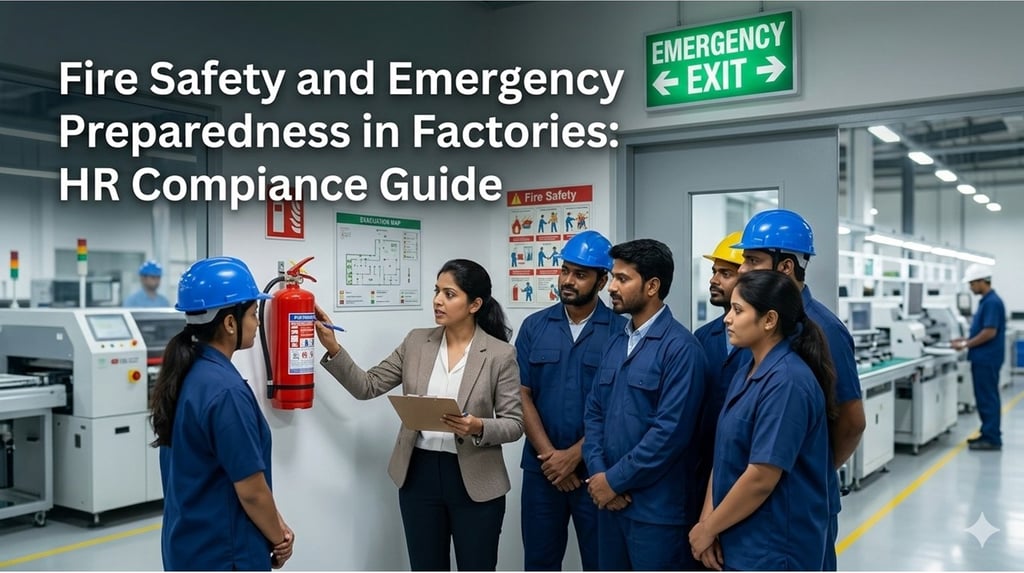
Fire incidents and workplace emergencies in factories pose serious risks to life, assets, and business continuity. In India, factory fires often result not only from technical failures but also from poor preparedness, lack of training, and weak enforcement of safety systems.
For Factory HR teams, fire safety is not the sole responsibility of the safety department. HR plays a central role in policy implementation, workforce training, statutory coordination, and emergency discipline. Failure in any of these areas can lead to regulatory action, criminal liability, and loss of trust among workers.
This article explains how HR must manage fire safety and emergency preparedness in Indian factories from a compliance and people-management perspective.
Legal Framework Governing Fire Safety
Fire safety obligations arise from multiple statutes and rules, including:
Factories Act, 1948 – Provisions relating to safety, emergency exits, and hazardous processes
State Factory Rules – Detailed fire safety norms, mock drills, and safety committee requirements
National Building Code (NBC) – Fire prevention and protection standards
Occupational Safety, Health and Working Conditions Code, 2020 – Integrated safety obligations
HR must ensure that legal requirements are translated into daily operating discipline, not limited to audits or inspections.
HR’s Role in Fire Safety Governance
Factory HR functions as the coordinator and enforcer of fire safety systems. Key responsibilities include:
Issuing and maintaining fire safety policies and SOPs
Coordinating with safety officers and external fire authorities
Ensuring statutory committees and emergency teams are constituted
Maintaining records of training, drills, and inspections
Communicating safety responsibilities clearly to workers and supervisors
Fire safety fails when systems exist only on paper—HR ensures they work in practice.
Emergency Preparedness: What HR Must Put in Place
Effective preparedness requires:
Clearly marked emergency exits and evacuation routes
Emergency response teams with defined roles
Regular fire drills covering all shifts
Training for contract workers and new joiners
Communication protocols during emergencies
HR must ensure inclusive coverage, especially for contract labour, trainees, and night-shift workers.
Fire Drills and Training: HR Accountability
Fire drills are not symbolic exercises. HR must ensure that:
Drills are conducted at prescribed intervals
Attendance is recorded and reviewed
Observations are documented
Corrective actions are implemented
Re-drills are conducted if gaps are identified
Training should be role-based, not generic, covering evacuation marshals, first responders, and supervisors.
Common HR Pitfalls in Fire Safety
Some frequent failures include:
Treating fire safety as a safety officer’s responsibility only
Excluding contract workers from drills
Poor documentation and record maintenance
Infrequent or predictable mock drills
Lack of disciplinary follow-up for non-compliance
Such lapses expose factories to serious legal and operational risks.
Conclusion
Fire safety and emergency preparedness in factories demand continuous HR involvement. Policies, drills, training, and discipline must operate together to ensure preparedness.
When HR actively anchors fire safety within organisational culture, factories become safer, more compliant, and more resilient to emergencies.
🗹 Factory HR Checklist: Fire Safety & Emergency Preparedness
🗹 Issue documented fire safety and emergency SOPs
🗹 Coordinate with safety officers and fire authorities
🗹 Constitute emergency response and evacuation teams
🗹 Conduct regular fire drills across all shifts
🗹 Ensure participation of contract and temporary workers
🗹 Maintain training and drill records
🗹 Review drill observations and implement corrective actions
🗹 Enforce safety discipline consistently
Fire Safety & Emergency Preparedness – HR Reference Table
Conclusion--
Effective labour law compliance depends on how well HR operations, payroll, and business processes work together. When compliance is embedded into everyday workflows, organisations reduce risk, improve accuracy, and build sustainable governance systems. HR teams that prioritise integration over isolation are better positioned to manage compliance confidently and consistently.
HireDesk India © 2026 | All Rights Reserved
"Thoughtful guidance for everyday HR"


Quick Links
Topics
Connect
_______________________________________________________________________________________________________________________________________________________________________________________
HireDesk is a free HR knowledge platform focused on practical, India-specific workplace guidance. We help HR professionals, managers, and learners navigate people practices with clarity, responsibility, and real-world relevance.