
Flexible Work Policies in SMEs: What HR Can Realistically Implement
SME HR OPERATIONS
Introduction--
Once a candidate accepts an offer, the period between acceptance and joining becomes a critical phase in the recruitment lifecycle. This pre-joining window influences whether a candidate actually joins, how prepared they feel on Day One, and how quickly they settle into the organisation. For HR, effective pre-joining engagement and onboarding planning are essential to convert offers into confident, committed employees.
This article outlines practical approaches HR teams can adopt to manage pre-joining engagement and establish strong onboarding foundations—without overcomplicating the process.
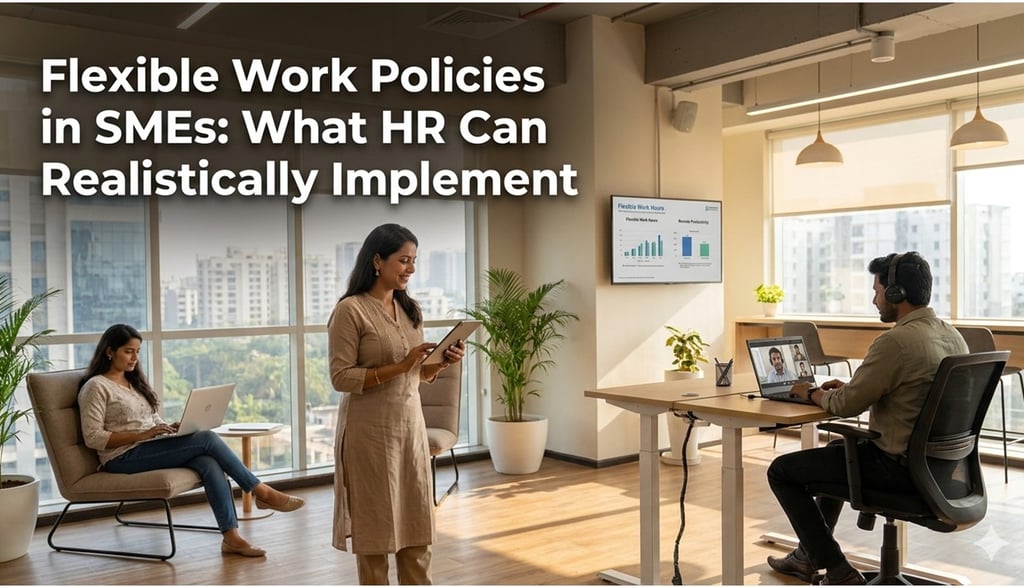
Flexible work has moved from being a “perk” to a practical necessity for many Indian SMEs. Employees increasingly expect flexibility in working hours, location, and time-off arrangements. At the same time, small organisations cannot afford policy complexity, operational chaos, or compliance risk.
This article explains how HR in SMEs can design realistic, enforceable, and fair flexible work policies — without copying large-corporate frameworks that don’t fit small teams.
What Flexible Work Means in an SME Context
In Indian SMEs, flexible work usually takes simple forms:
Adjusted work hours rather than reduced hours
Limited work-from-home days
Role-based flexibility instead of universal flexibility
Informal practices that need basic structure
HR’s role is to formalise flexibility without killing it.
Why SMEs Should Document Flexible Work Arrangements
Even small organisations need written clarity.
Documented flexibility helps:
Prevent employee disputes
Ensure consistency across teams
Protect managers from ad-hoc pressure
Support attendance, payroll, and compliance
A short policy is better than no policy.
Types of Flexible Work SMEs Can Actually Manage
SMEs should focus on low-complexity options that align with operations.
Common, workable options include:
Flexible start and end times
Fixed number of work-from-home days per month
Temporary flexibility for life events
Role-specific remote or hybrid eligibility
Avoid offering flexibility that cannot be tracked or enforced.
Manager Accountability and Approval Framework
Flexibility without control quickly becomes favoritism.
HR should ensure:
Clear eligibility criteria
Manager approval authority
Defined review or withdrawal conditions
Documentation of approvals
This keeps flexibility fair and defensible.
Compliance and Operational Guardrails
Flexible work does not dilute legal obligations.
HR must continue to manage:
Working hours and weekly off rules
Attendance and leave records
Overtime implications where applicable
POSH applicability for remote employees
Policies must explicitly state these guardrails.
Balancing Flexibility with Business Continuity
Flexibility should never disrupt customers or operations.
HR can balance this by:
Defining core working hours
Limiting flexibility during peak cycles
Allowing revocation during business exigencies
Reviewing flexibility effectiveness periodically
Flexibility works best when it is conditional, not absolute.
Conclusion
Flexible work policies in SMEs should be simple, selective, and structured. HR need not promise everything — only what the organisation can sustainably support. When implemented thoughtfully, flexibility improves retention and trust without compromising accountability.
Checklist: Practical Flexible Work Policy for SMEs
🗹 Define what flexibility means for your organisation
🗹 Limit flexibility to manageable formats
🗹 Specify eligibility and approval authority
🗹 Document conditions and review triggers
🗹 Track attendance and work hours
🗹 Protect compliance and POSH applicability
🗹 Communicate flexibility as conditional, not automatic
Realistic Flexible Work Options for Indian SMEs
Conclusion--
Effective labour law compliance depends on how well HR operations, payroll, and business processes work together. When compliance is embedded into everyday workflows, organisations reduce risk, improve accuracy, and build sustainable governance systems. HR teams that prioritise integration over isolation are better positioned to manage compliance confidently and consistently.
HireDesk India © 2026 | All Rights Reserved
"Thoughtful guidance for everyday HR"


Quick Links
Topics
Connect
_______________________________________________________________________________________________________________________________________________________________________________________
HireDesk is a free HR knowledge platform focused on practical, India-specific workplace guidance. We help HR professionals, managers, and learners navigate people practices with clarity, responsibility, and real-world relevance.