
Founders, HR, and Culture: Aligning People Practices in Growing Indian Companies
EMPLOYEE EXPERIENCE & CULTURE
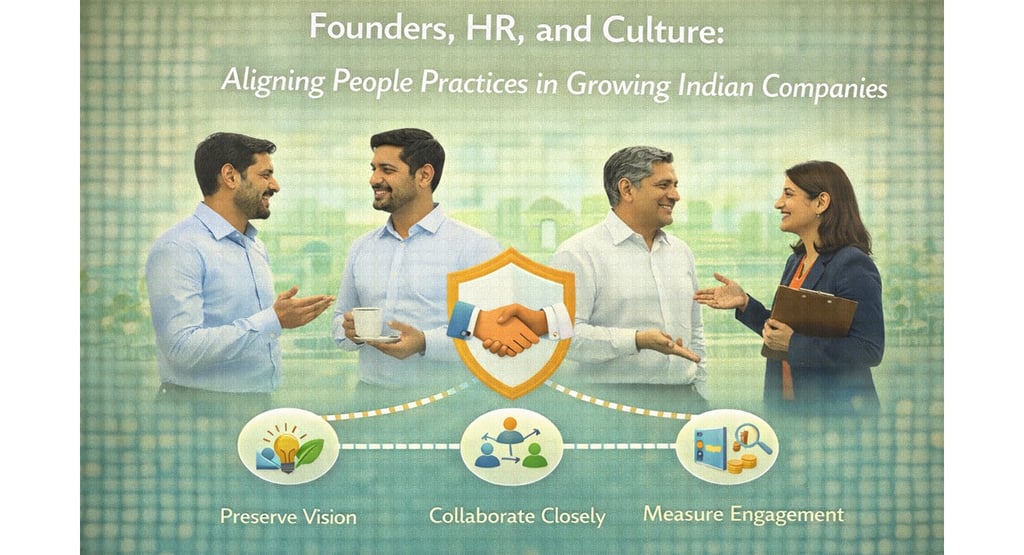
In many growing Indian companies, culture is strongly shaped by the founder’s personality, values, and working style. In the early stages, this works well. However, as the organisation grows, informal founder-led practices often clash with the need for consistency and fairness.
This article explains how founders and HR can work together to consciously shape culture as the organisation scales, without losing agility or trust.
Why Founder–HR Alignment Matters
In founder-led companies, employees closely observe:
How founders treat people during pressure situations
Whether HR has real authority or only administrative responsibility
Consistency between stated values and daily decisions
Misalignment between founders and HR creates confusion and weakens credibility.
Common Culture Challenges in Growing Indian Companies
As organisations scale, typical challenges include:
Founder-driven exceptions overriding HR processes
Inconsistent people decisions across teams
Informal communication replacing documented clarity
HR being perceived as a messenger, not a partner
These issues often surface during hiring spikes, performance cycles, or restructuring.
HR’s Role in Translating Founder Intent into Practice
HR acts as the bridge between founder intent and employee experience by:
Converting values into observable behaviours
Designing processes that support fairness without rigidity
Providing founders with ground-level employee insights
Flagging cultural risks early, even when uncomfortable
This requires trust, maturity, and mutual respect.
Founders’ Responsibility in Culture Building
Founders influence culture most through:
Day-to-day decisions, not vision statements
How they handle disagreement and failure
Whether they support HR judgement publicly
Their response to employee concerns
Culture solidifies when founders model the behaviours they expect others to follow.
Balancing Speed and Structure
Growing Indian companies must balance:
The need for speed and flexibility
The demand for clarity and consistency
Personal relationships with professional boundaries
Well-designed HR processes allow growth without eroding trust.
Conclusion
Culture in growing companies is neither accidental nor solely founder-owned. It is co-created by founders and HR through everyday decisions.
When founders and HR operate in alignment, employees experience stability, fairness, and clarity — even during rapid growth.
HR Checklist: Aligning Founders, HR, and Culture
🗹 Document core values as behaviours, not slogans
🗹 Clarify HR’s decision-making authority
🗹 Address founder-led exceptions transparently
🗹 Align people policies with business realities
🗹 Provide founders with honest employee insights
🗹 Ensure consistency across teams and levels
🗹 Train managers on applying culture fairly
🗹 Review cultural risks during growth phases
🗹 Reinforce values through leadership actions
Founder–HR Alignment Areas and Cultural Impact
Conclusion--
Effective labour law compliance depends on how well HR operations, payroll, and business processes work together. When compliance is embedded into everyday workflows, organisations reduce risk, improve accuracy, and build sustainable governance systems. HR teams that prioritise integration over isolation are better positioned to manage compliance confidently and consistently.
HireDesk India © 2026 | All Rights Reserved
"Thoughtful guidance for everyday HR"


Quick Links
Topics
Connect
_______________________________________________________________________________________________________________________________________________________________________________________
HireDesk is a free HR knowledge platform focused on practical, India-specific workplace guidance. We help HR professionals, managers, and learners navigate people practices with clarity, responsibility, and real-world relevance.