
From Policy to Practice: Building a Culture Employees Actually Experience in India
EMPLOYEE EXPERIENCE & CULTURE
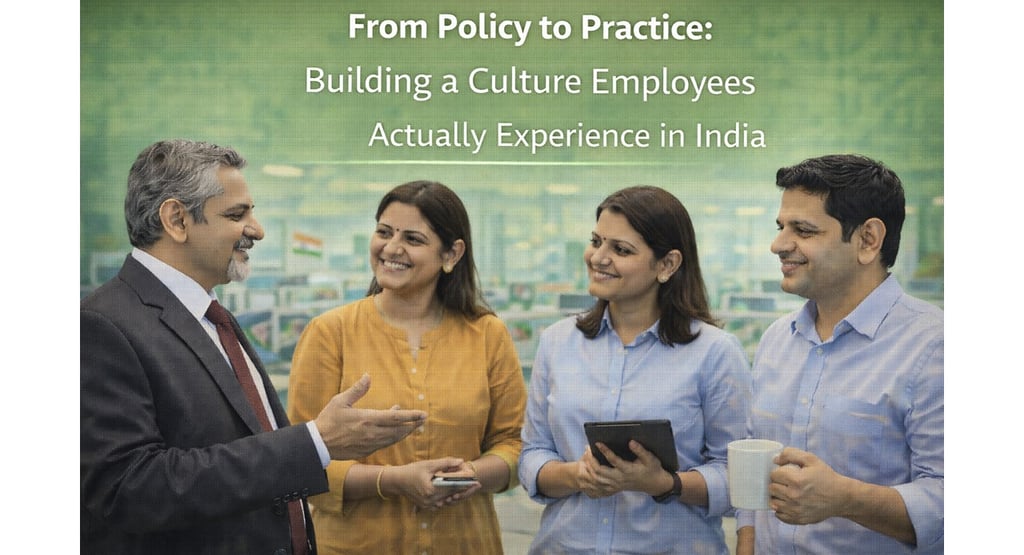
Most Indian organisations have well-written HR policies and value statements. Yet, employees often judge workplace culture not by what is written, but by what is practised. When policies say one thing and daily behaviour reflects another, trust erodes quickly.
In India, workplace culture is shaped far more by managers, informal practices, and exceptions than by handbooks. This article explains how HR can bridge the gap between policy intent and lived employee experience — and build a culture that employees actually recognise in their day-to-day work.
Why Policies Alone Do Not Create Culture
HR policies are necessary, but they are not culture by themselves. Policies define boundaries and intent; culture is formed by how consistently those boundaries are applied.
In Indian organisations, the gap between policy and practice often arises due to:
Strong hierarchies and personalised decision-making
Manager discretion overriding standard processes
Business urgency leading to “temporary” exceptions
Inconsistent handling across teams or locations
When exceptions become routine, employees start believing that policies exist only on paper.
How Employees Actually Experience Culture
Employees experience culture through everyday moments, such as:
How managers respond to leave requests or workload concerns
Whether rules apply equally to all employees
How mistakes are handled — with correction or blame
Whether HR intervenes when behaviour crosses the line
How transparent decisions feel, even when outcomes are unfavourable
Culture is reinforced not during town halls, but during routine interactions.
Moving from Policy Intent to Daily Practice
For HR, the challenge is not drafting better policies, but ensuring behavioural alignment. Three practical levers matter most.
1. Consistency Over Perfection
Employees value predictability more than generosity. A policy that is applied consistently builds more trust than a flexible policy applied selectively.
2. Manager Interpretation Matters
Managers translate policy into experience. HR must reduce ambiguity by clearly explaining:
What is non-negotiable
Where discretion is allowed
How to justify and document exceptions
3. Visible HR Judgement
When HR is seen as silent or passive during cultural breaches, policies lose credibility. Timely intervention signals seriousness, even if outcomes are balanced.
HR’s Practical Role in Closing the Gap
HR plays a critical role as the custodian of intent and fairness. This includes:
Simplifying policies so managers can actually use them
Training managers on why a policy exists, not just what it says
Tracking recurring exceptions and questioning patterns
Calling out behaviour that undermines stated values
Protecting employees from arbitrary or biased treatment
Culture improves when employees see HR applying judgement, not just administration.
Common Policy-to-Practice Gaps in Indian Workplaces
Some gaps are especially common across Indian organisations:
Leave and flexibility policies overridden by manager preference
Performance ratings influenced by relationships rather than outcomes
Code of conduct applied strictly to some, leniently to others
Escalations discouraged informally despite formal grievance channels
Addressing these gaps requires courage and consistency, not new frameworks.
Conclusion
A strong workplace culture is built when policies are lived, not just launched. In Indian organisations, employees watch closely how decisions are made, how exceptions are handled, and whether HR stands by its own principles.
By focusing on consistency, manager enablement, and visible judgement, HR can ensure that culture moves from policy documents into everyday employee experience — where it truly matters.
HR Checklist: Turning Policies into Lived Culture
🗹 Review whether key HR policies are applied consistently across teams
🗹 Identify common exceptions and assess their cultural impact
🗹 Clarify where managers have discretion and where they do not
🗹 Simplify policy language for easier manager understanding
🗹 Train managers on behavioural expectations, not just rules
🗹 Intervene early when behaviour contradicts stated values
🗹 Track patterns of complaints linked to policy misuse
🗹 Communicate the rationale behind difficult or unpopular decisions
🗹 Reinforce fairness even during business pressure situations
Policy vs Practice: How Culture Is Actually Experienced
Conclusion--
Effective labour law compliance depends on how well HR operations, payroll, and business processes work together. When compliance is embedded into everyday workflows, organisations reduce risk, improve accuracy, and build sustainable governance systems. HR teams that prioritise integration over isolation are better positioned to manage compliance confidently and consistently.
HireDesk India © 2026 | All Rights Reserved
"Thoughtful guidance for everyday HR"


Quick Links
Topics
Connect
_______________________________________________________________________________________________________________________________________________________________________________________
HireDesk is a free HR knowledge platform focused on practical, India-specific workplace guidance. We help HR professionals, managers, and learners navigate people practices with clarity, responsibility, and real-world relevance.