
Future Trends in HR Technology: What Indian HR Leaders Should Prepare For
HR TECH & ANALYTICS
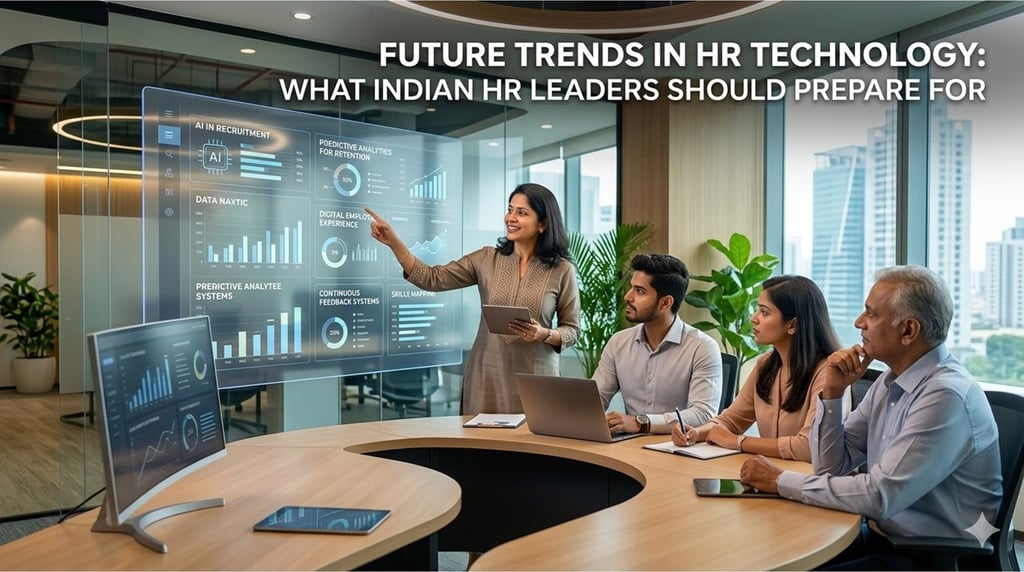
HR technology in India has evolved rapidly from basic payroll systems to integrated platforms supporting the entire employee lifecycle. As organisations deal with hybrid work, skill shortages, compliance complexity, and workforce diversity, HR technology is increasingly shaping how people are managed and developed.
This article outlines key HR technology trends relevant to Indian organisations and explains how HR leaders can prepare for these changes in a practical and measured manner.
The Shift from Transactional to Strategic HR Technology
Earlier HR systems focused primarily on transactions such as attendance, payroll, and statutory reporting. Modern HR technology increasingly supports:
Workforce planning and forecasting
Skill and capability assessment
Leadership development
Employee experience design
This shift requires HR professionals to understand both technology capabilities and business priorities.
Increased Use of Automation and AI (With Caution)
Automation is being used to:
Screen resumes
Schedule interviews
Trigger workflow approvals
Respond to employee queries through chatbots
In the Indian context, HR must apply automation judiciously. Over-automation can create distance between HR and employees, particularly in people-sensitive areas such as performance discussions or grievance handling.
AI should support decision-making, not replace human judgement.
Data-Driven HR and Predictive Analytics
Organisations are moving beyond historical reporting to predictive insights such as:
Attrition risk indicators
Skill demand forecasting
Workforce cost modelling
Training impact prediction
For many Indian organisations, this evolution will be gradual. Even simple trend analysis, when used consistently, can significantly improve decision quality.
Integrated Employee Experience Platforms
Employee experience platforms are consolidating multiple HR touchpoints into a single interface, covering:
Self-service
Learning access
Internal mobility
Communication and engagement
Integration improves usability and adoption, especially in large or geographically dispersed Indian workforces.
Mobile-First HR Technology
With widespread smartphone usage in India, mobile-first HR systems are becoming essential. Employees increasingly expect to:
Apply for leave
View payslips
Complete training
Receive notifications
Mobile accessibility improves participation, particularly for frontline and field employees.
Focus on Data Privacy and Ethical Use
As HR systems collect more personal and behavioural data, concerns around data privacy are growing. Indian organisations must:
Limit data access on a need-to-know basis
Communicate transparently about data usage
Align with emerging data protection regulations
Trust will become a key determinant of technology acceptance.
Customisation over One-Size-Fits-All Solutions
Indian organisations operate across varied industries, workforce profiles, and regulatory environments. Future HR technology adoption will favour:
Configurable platforms
Modular solutions
Scalable architectures
Flexibility will be more valuable than feature overload.
Preparing HR Teams for the Future
Technology readiness also depends on HR capability. HR professionals must develop:
Digital literacy
Data interpretation skills
Change management expertise
Vendor evaluation capability
HR’s role will increasingly involve translating technology outputs into people decisions.
Conclusion
The future of HR technology in India is not about adopting every new tool, but about selecting solutions that align with organisational maturity, workforce needs, and business objectives.
HR leaders who focus on practicality, ethical use, and continuous learning will be best positioned to leverage technology as a true enabler of people effectiveness.
Checklist: Preparing for Future HR Technology Trends
🗹 Shift focus from transactional efficiency to strategic impact.
🗹 Use automation and AI selectively, with human oversight.
🗹 Strengthen HR analytics capability gradually.
🗹 Invest in integrated employee experience platforms.
🗹 Ensure mobile accessibility for diverse workforce segments.
🗹 Establish strong data privacy and ethical guidelines.
🗹 Choose flexible and scalable HR technology solutions.
🗹 Build HR team capability in digital and data skills.
🗹 Review technology relevance periodically.
🗹 Align HR tech decisions with long-term business priorities.
Sample Table: Emerging HR Technology Trends and HR Focus
Conclusion--
Effective labour law compliance depends on how well HR operations, payroll, and business processes work together. When compliance is embedded into everyday workflows, organisations reduce risk, improve accuracy, and build sustainable governance systems. HR teams that prioritise integration over isolation are better positioned to manage compliance confidently and consistently.
HireDesk India © 2026 | All Rights Reserved
"Thoughtful guidance for everyday HR"


Quick Links
Topics
Connect
_______________________________________________________________________________________________________________________________________________________________________________________
HireDesk is a free HR knowledge platform focused on practical, India-specific workplace guidance. We help HR professionals, managers, and learners navigate people practices with clarity, responsibility, and real-world relevance.