
Gratuity Act: HR Responsibilities from Joining to Exit
COMPLIANCE & LABOUR LAWS
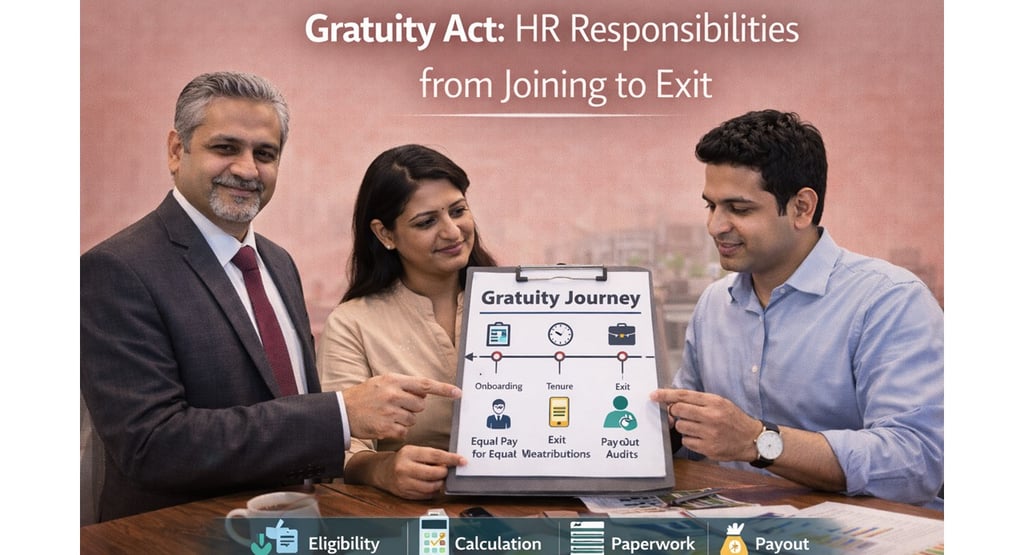
The Payment of Gratuity Act, 1972 is a long-term employee benefit law that often comes into focus only at the time of exit. However, most gratuity-related disputes arise because HR controls were weak much earlier—at joining, during service, or in record maintenance.
For HR teams, gratuity compliance is not a one-time settlement activity. It requires continuous discipline from onboarding to separation, covering eligibility tracking, wage definitions, nominations, and timely payment.
This article explains HR responsibilities under the Gratuity Act across the employee lifecycle.
Applicability of the Payment of Gratuity Act
The Act applies to:
Establishments employing 10 or more employees
Factories, shops, offices, and other notified establishments
Once applicable, the Act continues to apply permanently, even if employee strength falls below 10.
HR must track applicability at establishment level, not location-by-location assumptions.
HR Responsibilities at the Time of Joining
Eligibility Awareness
While gratuity becomes payable only after completion of five years of continuous service, HR should:
Communicate gratuity coverage clearly in appointment letters or policies
Avoid misrepresenting gratuity as discretionary
Gratuity is a statutory right, not an employer benefit choice.
Nomination Management
HR must ensure:
Gratuity nomination is obtained after completion of one year of service
Nominations are updated upon marriage or family changes
Missing or outdated nominations delay settlement and create disputes.
During Employment: Ongoing HR Controls
Continuous Service Tracking
HR must accurately track:
Breaks in service
Leave, lay-offs, and interruptions
Transfers within group entities
Incorrect service continuity data is a major compliance risk.
Wage Definition for Gratuity
Gratuity is calculated on:
Last drawn Basic + Dearness Allowance
HR should avoid:
Artificial restructuring of wages to suppress gratuity liability
Such practices are routinely challenged during disputes.
At the Time of Exit
Eligibility Triggers
Gratuity becomes payable on:
Resignation after five years
Retirement or superannuation
Death or disablement (no minimum service condition)
HR must not deny gratuity due to misunderstanding of eligibility triggers.
Payment Timelines
Gratuity must be:
Calculated promptly
Paid within 30 days from the date it becomes payable
Delays attract interest liability, even if the delay is unintentional.
HR Execution: What Prevents Disputes
Strong HR practices include:
Standard gratuity calculation templates
Clear exit checklists covering gratuity
Maker–checker review before payment
Proper documentation and acknowledgements
Most gratuity disputes arise due to delays or poor communication, not calculation errors.
Conclusion
The Gratuity Act demands lifecycle-based HR compliance, not end-stage firefighting. HR teams that manage nominations, service records, wage definitions, and timelines proactively can ensure smooth exits and avoid legal exposure.
Gratuity compliance reflects an organisation’s maturity and respect for statutory employee rights.
HR Compliance Action Checklist: Payment of Gratuity Act
🗹 Confirm establishment-level applicability of the Act
🗹 Communicate gratuity coverage clearly at joining
🗹 Obtain and update gratuity nominations
🗹 Track continuous service accurately
🗹 Apply correct wage components for calculation
🗹 Identify eligibility correctly at exit
🗹 Calculate gratuity using statutory formula
🗹 Pay gratuity within 30 days of eligibility
🗹 Issue payment acknowledgements
🗹 Maintain gratuity records and registers
Gratuity Act: HR Responsibilities Across the Employee Lifecycle
Conclusion--
Effective labour law compliance depends on how well HR operations, payroll, and business processes work together. When compliance is embedded into everyday workflows, organisations reduce risk, improve accuracy, and build sustainable governance systems. HR teams that prioritise integration over isolation are better positioned to manage compliance confidently and consistently.
HireDesk India © 2026 | All Rights Reserved
"Thoughtful guidance for everyday HR"


Quick Links
Topics
Connect
_______________________________________________________________________________________________________________________________________________________________________________________
HireDesk is a free HR knowledge platform focused on practical, India-specific workplace guidance. We help HR professionals, managers, and learners navigate people practices with clarity, responsibility, and real-world relevance.