
Handling Charter of Demands: A Practical HR Approach
INDUSTRIAL RELATIONS & FACTORY HR
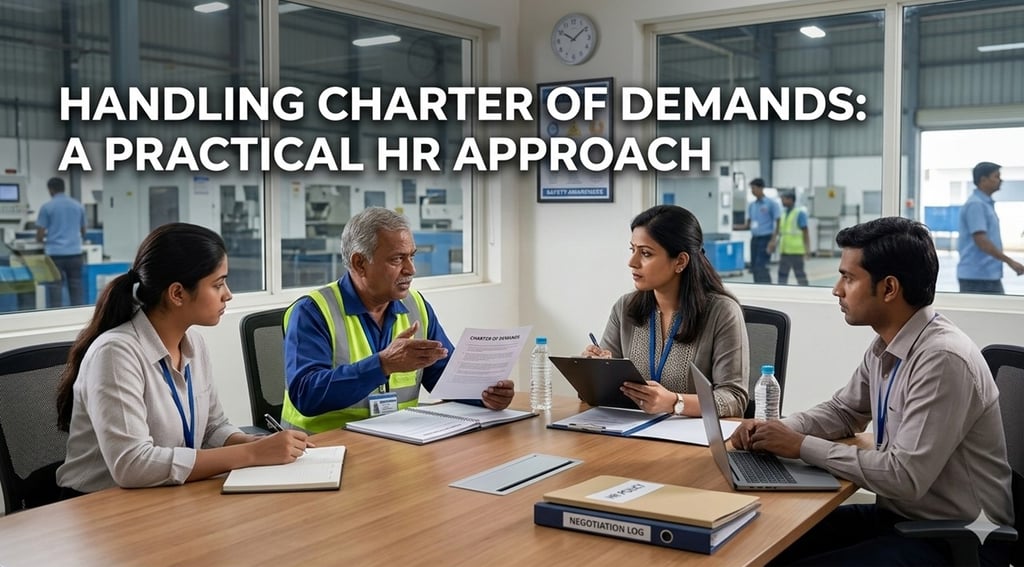
A Charter of Demands is one of the most important and sensitive documents factory HR teams deal with in industrial relations. It formally captures workers’ expectations on wages, benefits, working conditions, and welfare, and often sets the tone for collective bargaining and long-term industrial harmony.
For HR, mishandling a charter of demands can quickly escalate into disputes, strained union relations, or even strikes. At the same time, a structured, professional response can build trust, enable constructive negotiations, and align employee expectations with business realities.
This article explains what a charter of demands is, how HR should handle it in practice, and common pitfalls to avoid in Indian establishments.
What Is a Charter of Demands?
A Charter of Demands is a formal written submission by a recognised trade union or negotiating body listing demands related to employment conditions. It is usually submitted at the start of collective bargaining or before the expiry of an existing settlement.
Typical Areas Covered
Wage revisions and allowances
Incentives and productivity-linked pay
Working hours, shifts, and overtime norms
Leave, holidays, and benefits
Safety measures and welfare facilities
Contract labour and regularisation issues
Once submitted, the charter becomes the basis for structured negotiations.
Legal and Procedural Context in India
While labour laws do not prescribe a single standard format for a charter of demands, HR must align handling with established industrial relations principles:
Industrial Relations Code, 2020
Recognises negotiating unions/councils
Governs dispute resolution if negotiations fail
Collective Bargaining Practices
Charters are part of good-faith negotiation
Management is expected to acknowledge and respond
Standing Orders and Settlements
Existing Standing Orders and past settlements form the baseline
Demands cannot override statutory minimums
HR must ensure that responses and negotiations respect legal limits and documented practices.
How HR Should Handle a Charter of Demands
1. Formal Acknowledgement
Acknowledge receipt of the charter in writing
Record the date and submitting union/body
Share internally with management and legal teams
This signals seriousness and professionalism.
2. Detailed Analysis of Demands
HR should break down demands into clear categories:
Statutory-related demands: Minimum wages, safety, compliance
Financial demands: Wage hikes, allowances, bonuses
Operational demands: Shift changes, manpower norms
Policy-related demands: Leave, promotions, benefits
Each demand should be assessed for legality, cost impact, feasibility, and precedent.
3. Data and Cost Evaluation
Before negotiations begin, HR must prepare:
Cost-to-company impact of each demand
Productivity and performance data
Industry and regional benchmarks
Impact on competitiveness and sustainability
This preparation ensures negotiations are fact-based, not emotional.
4. Management Alignment
HR must align with leadership on:
Acceptable negotiation boundaries
Non-negotiable statutory and business constraints
Areas open for discussion or trade-offs
Without alignment, negotiations risk confusion and loss of credibility.
5. Structured Negotiation and Dialogue
Discuss demands item by item
Avoid blanket acceptance or rejection
Explain management position with data and rationale
Explore alternatives, phasing, or conditional agreements
HR’s role is to facilitate dialogue, not escalate positions.
Common Mistakes HR Must Avoid
Ignoring or delaying response to the charter
Entering talks without cost clarity
Making verbal commitments without approvals
Treating the charter as a confrontation tool
Overlooking historical settlements and precedents
Allowing supervisors to make informal assurances
These mistakes often lead to mistrust, escalation, and disputes.
HR’s Role in Managing Charter of Demands
Factory HR acts as the custodian of process and balance:
Ensure fairness, neutrality, and documentation
Guide management on legal and operational risks
Maintain continuous communication with unions
Record minutes and agreed positions
Link demands to productivity and sustainability
Practical Best Practices
Encourage realistic, phased demands
Use joint committees to discuss complex issues
Separate emotional issues from negotiable terms
Focus on long-term industrial stability
Conclusion
Handling a Charter of Demands is a defining moment for factory HR teams. A structured, data-driven, and transparent approach helps transform demands into constructive negotiations rather than conflict triggers.
By acknowledging concerns, preparing thoroughly, and engaging in good-faith dialogue, HR can balance employee expectations with organisational realities and preserve industrial harmony.
🗹 Charter of Demands – HR Action Checklist
🗹 Acknowledge receipt of the charter formally and promptly
🗹 Categorise demands into statutory, financial, operational, and policy areas
🗹 Assess legal compliance and feasibility of each demand
🗹 Prepare cost and productivity impact analysis
🗹 Align negotiation boundaries with management
🗹 Conduct structured, documented negotiations
🗹 Avoid informal or unauthorised commitments
🗹 Communicate outcomes clearly and consistently
Charter of Demands – HR Handling Framework - Sample Table
Conclusion--
Effective labour law compliance depends on how well HR operations, payroll, and business processes work together. When compliance is embedded into everyday workflows, organisations reduce risk, improve accuracy, and build sustainable governance systems. HR teams that prioritise integration over isolation are better positioned to manage compliance confidently and consistently.
HireDesk India © 2026 | All Rights Reserved
"Thoughtful guidance for everyday HR"


Quick Links
Topics
Connect
_______________________________________________________________________________________________________________________________________________________________________________________
HireDesk is a free HR knowledge platform focused on practical, India-specific workplace guidance. We help HR professionals, managers, and learners navigate people practices with clarity, responsibility, and real-world relevance.