
Handling Employee Complaints and Labour Notices: HR Playbook
COMPLIANCE & LABOUR LAWS
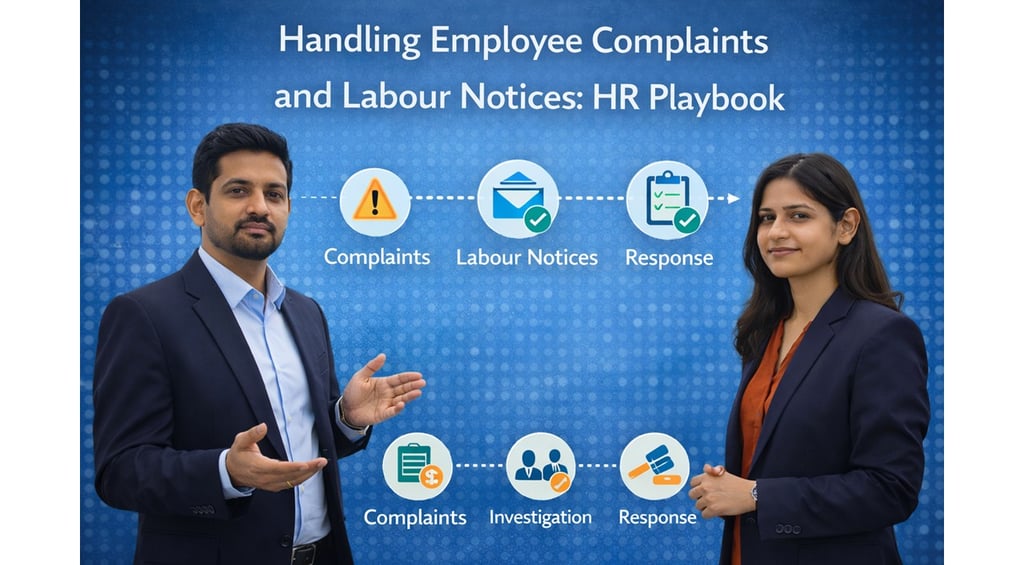
Employee complaints and labour notices are not exceptional events in Indian organisations—they are part of normal industrial relations reality. What differentiates mature HR functions is how calmly, systematically, and lawfully these situations are handled.
Most escalations to labour authorities happen not because the original issue was severe, but because complaints were ignored, handled informally, or poorly documented. Similarly, labour notices often become serious cases due to delayed or casual responses.
This article provides a practical HR playbook to manage employee complaints and labour notices in a compliant, disciplined manner.
Understanding the Nature of Employee Complaints
Employee complaints may relate to:
Wages, overtime, or statutory benefits
Leave, working hours, or weekly offs
Harassment, misconduct, or unfair treatment
Termination, transfers, or disciplinary actions
HR must distinguish between:
Internal grievances (to be resolved through company mechanisms)
Statutory complaints that may attract labour authority attention
Treating all complaints casually is a common HR mistake.
HR’s First Responsibility: Acknowledge and Record
When a complaint is received:
Acknowledge it formally
Record it with date, nature, and complainant details
Assign ownership for review
Verbal complaints without records often resurface later as formal labour disputes, putting HR on the defensive.
Internal Resolution: Where HR Has Maximum Control
HR should aim to:
Resolve complaints internally wherever possible
Follow principles of natural justice
Communicate decisions with reasons
Even if the complaint lacks merit, documented fairness protects the organisation during inspections or proceedings.
Receiving Labour Notices: HR Must Act, Not Panic
Labour notices may come from:
Labour Inspector
Assistant Labour Commissioner
Conciliation Officer
Court or Tribunal
Common HR errors include:
Ignoring notices
Missing response deadlines
Sending incomplete or informal replies
Every labour notice must be treated as a time-bound legal document, not routine correspondence.
Responding to Labour Authorities: HR Best Practices
HR should ensure:
Facts are verified before replying
Responses align with statutory records
Authorised representatives are nominated
Contradictory submissions or casual explanations often weaken the employer’s position during hearings.
Preparing for Inspections and Hearings
Before any inspection or conciliation:
Compile relevant registers, wage records, and policies
Brief management representatives
Maintain respectful and cooperative conduct
Most labour authorities value orderly documentation and transparency over aggressive defence.
Conclusion
Handling employee complaints and labour notices is a core HR governance responsibility, not an administrative burden. Timely acknowledgement, fair internal handling, and disciplined statutory responses can prevent minor issues from becoming long-running disputes.
Strong HR processes in this area signal organisational maturity and significantly reduce legal exposure.
HR Compliance Action Checklist: Complaints and Labour Notices
🗹 Acknowledge all employee complaints formally
🗹 Maintain written complaint and grievance records
🗹 Resolve issues internally wherever possible
🗹 Follow principles of natural justice
🗹 Track and diarise labour notice deadlines
🗹 Verify facts before responding to authorities
🗹 Send structured, timely replies to notices
🗹 Nominate authorised HR representatives
🗹 Prepare records before inspections or hearings
🗹 Document outcomes and follow-up actions
Employee Complaints and Labour Notices: HR Handling Framework
Conclusion--
Effective labour law compliance depends on how well HR operations, payroll, and business processes work together. When compliance is embedded into everyday workflows, organisations reduce risk, improve accuracy, and build sustainable governance systems. HR teams that prioritise integration over isolation are better positioned to manage compliance confidently and consistently.
HireDesk India © 2026 | All Rights Reserved
"Thoughtful guidance for everyday HR"


Quick Links
Topics
Connect
_______________________________________________________________________________________________________________________________________________________________________________________
HireDesk is a free HR knowledge platform focused on practical, India-specific workplace guidance. We help HR professionals, managers, and learners navigate people practices with clarity, responsibility, and real-world relevance.