
Handling Employee Misconduct in SMEs: Legal and Practical HR Steps
SME HR OPERATIONS
Introduction--
Once a candidate accepts an offer, the period between acceptance and joining becomes a critical phase in the recruitment lifecycle. This pre-joining window influences whether a candidate actually joins, how prepared they feel on Day One, and how quickly they settle into the organisation. For HR, effective pre-joining engagement and onboarding planning are essential to convert offers into confident, committed employees.
This article outlines practical approaches HR teams can adopt to manage pre-joining engagement and establish strong onboarding foundations—without overcomplicating the process.
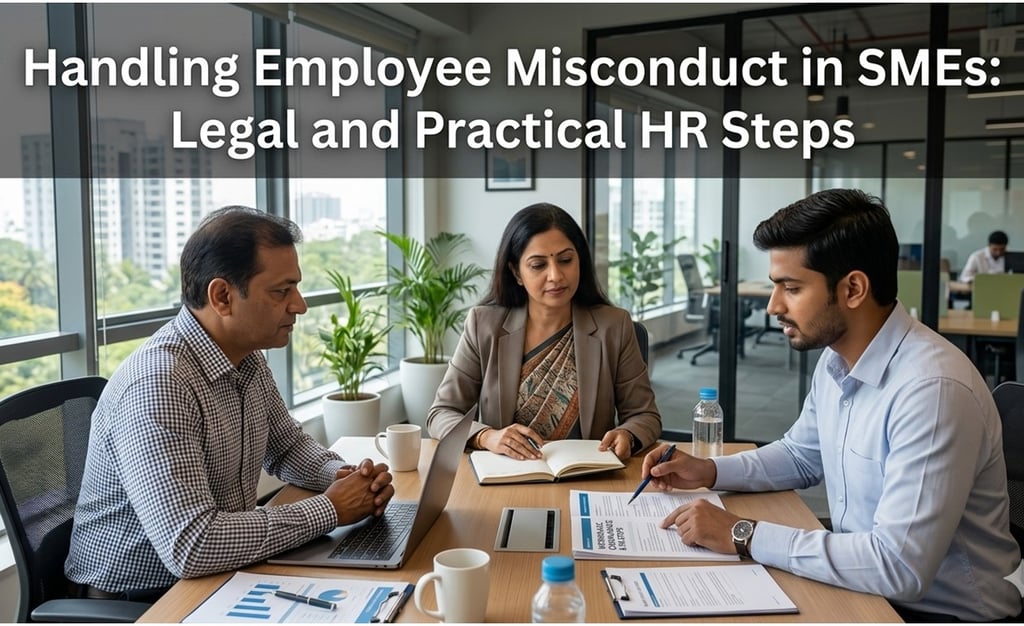
Employee misconduct is one of the most sensitive challenges for HR in Indian SMEs. Unlike large organisations, SMEs operate with smaller teams, closer relationships, and limited buffers. A single misconduct issue can disrupt operations, morale, and even founder confidence.
This article explains how HR in SMEs can handle employee misconduct lawfully, fairly, and practically — without over-legalising issues or acting impulsively.
Understanding Misconduct in an SME Context
Misconduct in SMEs typically falls into a few common categories:
Attendance and punctuality issues
Insubordination or refusal to follow instructions
Behavioural issues, disrespect, or conflicts
Misuse of company resources
Integrity-related concerns
HR must distinguish between performance issues and misconduct before acting.
Why SMEs Often Handle Misconduct Poorly
Common SME mistakes include:
Verbal warnings with no documentation
Sudden termination without due process
Emotional reactions by founders or managers
Treating similar cases inconsistently
These approaches expose SMEs to legal risk and damage trust.
Legal Framework Applicable to SMEs
Even small organisations are expected to follow principles of natural justice.
Key legal expectations include:
Fair opportunity to explain
Reasoned decision-making
Proportionate punishment
Basic documentation
Formal domestic enquiry may not be required for every case, but due process always applies.
Step-by-Step HR Approach to Handling Misconduct
A practical SME-friendly approach includes:
Fact finding – understand what actually happened
Classification – minor or serious misconduct
Show-cause notice – for non-trivial issues
Employee explanation – written response
Decision – warning, penalty, or escalation
Documentation – record the outcome
This approach balances fairness with speed.
Role of Managers vs HR in SMEs
Managers are closest to the issue, but HR must control the process.
HR should:
Guide managers on appropriate action
Prevent emotional or biased decisions
Ensure consistency across cases
Act as process custodian
Founders should be involved only in serious cases.
When Termination Becomes Necessary
Termination should be the last resort, not the first reaction.
Before terminating, HR should ensure:
Past warnings or corrective actions are documented
Misconduct severity justifies termination
Employee has been heard
Legal notice and dues are handled correctly
A rushed termination often costs more later.
Conclusion
Handling misconduct in SMEs requires calm judgement, basic legal awareness, and consistent processes. HR does not need heavy legal machinery — but must ensure fairness, documentation, and proportionality. Done right, misconduct handling strengthens discipline and credibility across the organisation.
Checklist: Handling Employee Misconduct in SMEs
🗹 Distinguish misconduct from performance issues
🗹 Document facts before taking action
🗹 Issue written communication for non-trivial cases
🗹 Give employees an opportunity to respond
🗹 Apply proportionate and consistent penalties
🗹 Maintain records of warnings and decisions
🗹 Involve founders only in serious matters
🗹 Close cases with clear communication
SME-Friendly Misconduct Handling Framework
Conclusion--
Effective labour law compliance depends on how well HR operations, payroll, and business processes work together. When compliance is embedded into everyday workflows, organisations reduce risk, improve accuracy, and build sustainable governance systems. HR teams that prioritise integration over isolation are better positioned to manage compliance confidently and consistently.
HireDesk India © 2026 | All Rights Reserved
"Thoughtful guidance for everyday HR"


Quick Links
Topics
Connect
_______________________________________________________________________________________________________________________________________________________________________________________
HireDesk is a free HR knowledge platform focused on practical, India-specific workplace guidance. We help HR professionals, managers, and learners navigate people practices with clarity, responsibility, and real-world relevance.