
HR Compliance Readiness Checklist for Indian Organisations
COMPLIANCE & LABOUR LAWS
Introduction--
Once a candidate accepts an offer, the period between acceptance and joining becomes a critical phase in the recruitment lifecycle. This pre-joining window influences whether a candidate actually joins, how prepared they feel on Day One, and how quickly they settle into the organisation. For HR, effective pre-joining engagement and onboarding planning are essential to convert offers into confident, committed employees.
This article outlines practical approaches HR teams can adopt to manage pre-joining engagement and establish strong onboarding foundations—without overcomplicating the process.

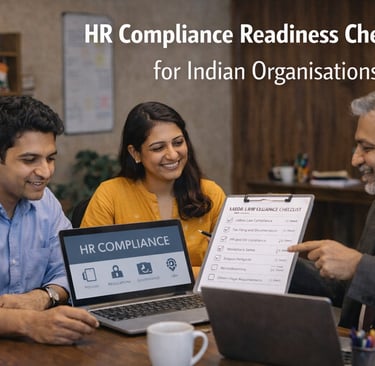
Most labour law failures do not occur because HR teams are unaware of the law. They occur because organisations are not inspection-ready on an everyday basis.
HR compliance readiness is about being able to demonstrate compliance confidently at any point in time — during inspections, audits, employee complaints, or legal proceedings. It requires discipline, ownership, and consistency across people, processes, and records.
This article brings together the entire Compliance & Labour Laws pillar into a practical readiness framework that HR teams in Indian organisations can realistically apply.
1. What “Compliance Readiness” Really Means
Compliance readiness is not:
Scrambling to collect files when an inspector arrives
Relying entirely on consultants or vendors
Assuming contractors are compliant without verification
Instead, it means:
Clear accountability within HR
Updated documentation aligned with practice
Routine checks rather than reactive fixes
An inspection should feel like a validation exercise, not a crisis.
2. Core Elements of HR Compliance Readiness
Across Indian organisations, compliance readiness rests on six pillars:
Applicability clarity (which laws apply)
Accurate registers and records
Timely statutory payments and filings
Contractor and vendor oversight
Workplace facilities and notices
Inspection and escalation preparedness
Weakness in any one area exposes HR and management to risk.
3. Applicability Mapping: The Starting Point
HR must clearly document:
Central vs state labour laws applicable
Threshold-based applicability (headcount, wages, nature of work)
Factory vs non-factory coverage
Contract labour applicability
Many compliance gaps arise because laws continue to apply even after headcount changes, but HR does not reassess applicability.
4. Documentation and Records Discipline
HR readiness requires:
Registers maintained in prescribed formats
Records updated regularly, not retrospectively
Alignment between payroll, attendance, and statutory filings
Easy retrievability of documents
Digital records are acceptable, but accessibility during inspections is critical.
5. Contractor and Vendor Compliance Readiness
From a legal standpoint, the principal employer is always visible first.
HR must ensure:
Contractor licences and registrations are valid
Wage and statutory compliance is verified monthly
Deployment numbers match licences
Welfare facilities exist for contract labour
Vendor non-compliance quickly becomes principal employer liability.
6. Inspection and Escalation Preparedness
HR should prepare for:
Unannounced inspections
Show-cause notices
Employee complaints escalating to authorities
This requires:
Identified inspection-handling SPOCs
Clear internal escalation paths
Controlled, factual responses
Unprepared responses often worsen legal exposure.
Conclusion
HR compliance readiness is a continuous state, not an annual exercise. When HR builds systems that are inspection-ready by default, compliance becomes predictable, defensible, and far less stressful.
This final checklist is intended to help HR teams pause, review, and reset their compliance posture with confidence.
🗹 HR Compliance Readiness Checklist (India)
🗹 Map all applicable central and state labour laws
🗹 Assign clear compliance ownership within HR
🗹 Maintain updated statutory registers and records
🗹 Ensure timely PF, ESI, wage, and welfare payments
🗹 Verify contractor and vendor compliance regularly
🗹 Display mandatory notices and abstracts at workplaces
🗹 Keep inspection-ready documentation accessible
🗹 Track and close inspection observations promptly
🗹 Review compliance status periodically, not annually
🗹 Escalate high-risk gaps to senior management
HR Compliance Readiness Framework
Conclusion--
Effective labour law compliance depends on how well HR operations, payroll, and business processes work together. When compliance is embedded into everyday workflows, organisations reduce risk, improve accuracy, and build sustainable governance systems. HR teams that prioritise integration over isolation are better positioned to manage compliance confidently and consistently.
HireDesk India © 2026 | All Rights Reserved
"Thoughtful guidance for everyday HR"


Quick Links
Topics
Connect
_______________________________________________________________________________________________________________________________________________________________________________________
HireDesk is a free HR knowledge platform focused on practical, India-specific workplace guidance. We help HR professionals, managers, and learners navigate people practices with clarity, responsibility, and real-world relevance.