
HR Documentation Essentials for SMEs: Records, Registers, and Discipline
SME HR OPERATIONS
Introduction--
Once a candidate accepts an offer, the period between acceptance and joining becomes a critical phase in the recruitment lifecycle. This pre-joining window influences whether a candidate actually joins, how prepared they feel on Day One, and how quickly they settle into the organisation. For HR, effective pre-joining engagement and onboarding planning are essential to convert offers into confident, committed employees.
This article outlines practical approaches HR teams can adopt to manage pre-joining engagement and establish strong onboarding foundations—without overcomplicating the process.

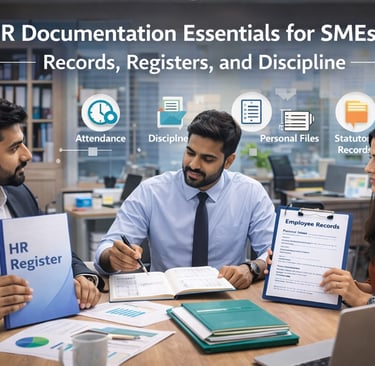
In many Indian SMEs, HR documentation is treated as an afterthought — papers are created only when a problem arises or when an inspector asks for them. This reactive approach exposes SMEs to compliance risk, employee disputes, and credibility issues.
HR documentation does not need to be bulky or legalistic. What SMEs need is the right documents, maintained consistently, and aligned to day-to-day operations. This article explains the essential HR records and registers Indian SMEs must maintain, and how documentation supports fair discipline and compliance.
Why HR Documentation Matters in SMEs
Good HR documentation helps SMEs:
Demonstrate legal compliance during inspections
Handle employee disputes objectively
Maintain consistency in HR decisions
Protect founders and managers from personal liability
Most SME issues arise not because actions were wrong, but because there was no written record.
Core Categories of HR Documentation
SME HR documentation can be grouped into three practical buckets:
Employee Records – individual employee-related documents
Statutory Registers – legally required records
Discipline and Process Records – fairness and consistency documentation
Keeping these buckets clear avoids confusion.
Essential Employee Records
Every SME should maintain a basic employee file (physical or digital) containing:
Appointment or employment letter
Compensation structure and revisions
Identity and statutory details
Policy acknowledgements
Performance or role change records
Incomplete employee files are a common audit red flag.
Statutory Registers and Compliance Records
Depending on applicability, SMEs may need to maintain registers under:
Shops and Establishments Act
Wages and attendance laws
EPF and ESI regulations
Gratuity and leave laws
While formats may vary by state, accuracy and regular updates matter more than format perfection.
Documentation in Disciplinary Matters
Discipline-related documentation protects both the employee and the employer. SMEs should document:
Misconduct complaints
Show-cause notices
Employee responses
Inquiry proceedings (where applicable)
Final actions taken
Avoid verbal warnings without records — they weaken the employer’s position.
Digital vs Physical Records in SMEs
SMEs may maintain records digitally, provided:
Documents are retrievable quickly
Access is controlled
Backups are maintained
Confidentiality is ensured
Digitisation improves efficiency, but discipline in record-keeping is essential.
HR’s Role in Documentation Discipline
HR acts as the custodian of records, responsible for:
Standardising document formats
Ensuring timely updates
Coordinating with payroll and compliance partners
Preparing records during audits or inspections
Documentation ownership should never be ambiguous.
Conclusion
HR documentation in Indian SMEs is about clarity, consistency, and discipline, not paperwork volume. By maintaining essential employee records, statutory registers, and fair disciplinary documentation, SMEs can reduce legal risk, improve HR credibility, and handle people issues with confidence.
Checklist: HR Documentation Essentials for SMEs
🗹 Maintain complete employee-wise records
🗹 Issue appointment letters and document role changes
🗹 Update statutory registers as per applicability
🗹 Track attendance, leave, and wage records
🗹 Document misconduct and disciplinary actions properly
🗹 Retain records for prescribed periods
🗹 Ensure confidentiality and controlled access
🗹 Review HR documentation periodically
Key HR Documents and Registers for SMEs
Conclusion--
Effective labour law compliance depends on how well HR operations, payroll, and business processes work together. When compliance is embedded into everyday workflows, organisations reduce risk, improve accuracy, and build sustainable governance systems. HR teams that prioritise integration over isolation are better positioned to manage compliance confidently and consistently.
HireDesk India © 2026 | All Rights Reserved
"Thoughtful guidance for everyday HR"


Quick Links
Topics
Connect
_______________________________________________________________________________________________________________________________________________________________________________________
HireDesk is a free HR knowledge platform focused on practical, India-specific workplace guidance. We help HR professionals, managers, and learners navigate people practices with clarity, responsibility, and real-world relevance.