
HR Operations in Small and Medium Enterprises in India: Concepts, Challenges and the Role of HR
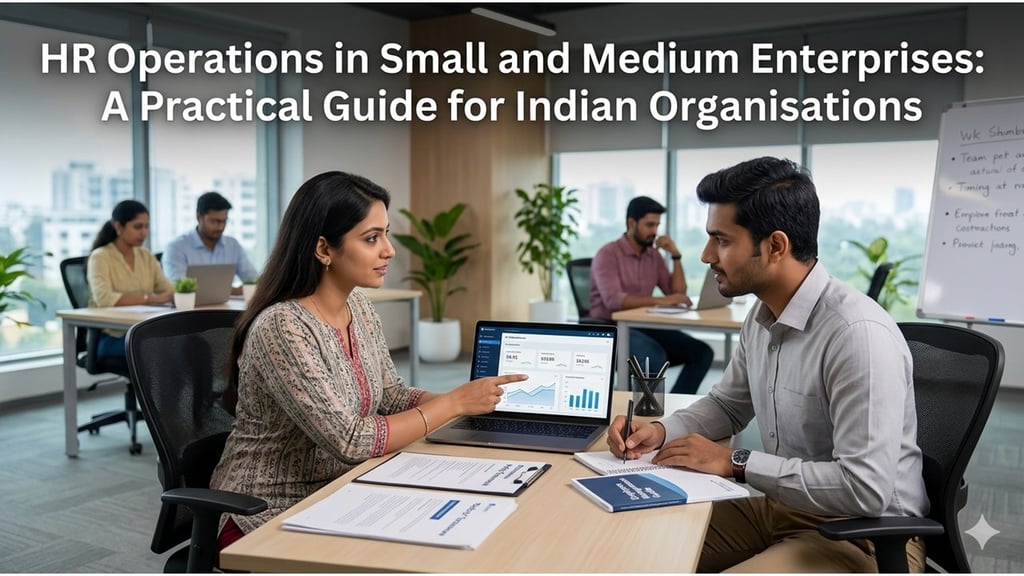
HR operations in SMEs are often handled by small teams or individual HR practitioners. Without clear processes, everyday HR activities can become reactive and difficult to scale.
SME HR OPERATIONS
Introduction
Small and Medium Enterprises (SMEs) play a significant role in India’s economy by contributing to employment generation, industrial growth, manufacturing activity, services expansion, and entrepreneurship development. Across industries, SMEs form an important part of the workforce ecosystem and often operate in highly competitive, resource-sensitive, and fast-changing business environments.
As SMEs grow, workforce management becomes increasingly important. Recruitment, attendance management, payroll administration, employee retention, compliance obligations, performance management, workforce communication, and organisational structure all begin to require greater consistency and coordination.
However, unlike large organisations, many SMEs operate with lean teams, limited budgets, evolving systems, and direct founder involvement in people-related decisions. HR responsibilities are often handled by business owners, administrators, finance teams, or small HR departments managing multiple responsibilities simultaneously.
As a result, SME HR operations often involve balancing practicality, compliance, workforce stability, operational efficiency, and business growth without creating unnecessary complexity.
This article provides a practical overview of HR operations in Indian SMEs — covering workforce management practices, common HR challenges, operational priorities, process development, compliance considerations, people management realities, and the role of HR in supporting sustainable business growth.
The objective is not to encourage large-corporate HR models for smaller businesses, but to help SMEs build practical, scalable, and people-focused HR systems suited to their operational realities.
Understanding HR Operations in SMEs
HR Operations refers to the day-to-day systems, processes, and workforce management activities that support employee administration and organisational functioning.
In SMEs, HR operations may include:
recruitment and hiring
employee onboarding
attendance management
payroll coordination
leave administration
statutory compliance
employee documentation
performance discussions
workforce communication
employee relations
employee retention support
Unlike larger organisations where specialised HR teams may manage separate functions, SME HR teams often handle multiple responsibilities simultaneously.
As organisations grow, structured HR operations help improve:
workforce stability
operational consistency
employee experience
compliance management
organisational discipline
__________________________________________________________________________________________________
Why HR Operations Matter in Growing SMEs
Many SMEs initially operate through informal systems, direct supervision, and founder-led decision-making.
While this may work during early stages, workforce growth often creates new challenges such as:
hiring difficulties
attendance inconsistencies
payroll errors
employee turnover
communication gaps
compliance risks
role confusion
managerial dependency
Research and industry observations consistently show that many SMEs operate with limited HR formalisation, leading to inconsistent workforce processes and operational inefficiencies as organisations expand.
Practical HR systems help organisations create greater clarity, consistency, accountability, and workforce stability.
__________________________________________________________________________________________________
Key Areas of SME HR Operations
HR operations in SMEs typically involve several interconnected workforce functions.
1. Recruitment and Workforce Planning
Many SMEs face challenges in attracting and retaining skilled employees due to:
limited employer visibility
budget constraints
competition from larger organisations
evolving workforce requirements
Talent acquisition remains one of the most common people-management challenges faced by SMEs in India.
Structured recruitment processes help organisations:
improve hiring quality
reduce hiring delays
strengthen workforce stability
improve employee fit
Even simple hiring systems often create significant long-term benefits.
__________________________________________________________________________________________________
2. Employee Onboarding and Documentation
Employee onboarding in SMEs is often handled informally.
However, structured onboarding helps employees understand:
organisational expectations
reporting structures
workplace policies
job responsibilities
attendance practices
compliance requirements
HR operations generally become more effective when employee documentation and onboarding processes are standardised.
__________________________________________________________________________________________________
3. Attendance, Leave and Workforce Administration
Attendance management is a critical operational area in many SMEs.
Workforce administration may include:
attendance tracking
leave management
shift coordination
overtime monitoring
employee record maintenance
As workforce size increases, manual administration often becomes more difficult and error-prone.
Structured workforce administration improves operational visibility and workforce discipline.
__________________________________________________________________________________________________
4. Payroll and Compliance Coordination
SMEs are required to manage multiple workforce-related obligations such as:
salary processing
statutory deductions
PF administration
ESI compliance
professional tax requirements
employee records
labour law obligations
Many growing businesses experience payroll and compliance challenges when systems remain overly dependent on manual processes or fragmented records.
Reliable payroll and compliance practices support both workforce trust and organisational stability.
__________________________________________________________________________________________________
5. Employee Communication and Workplace Relationships
In SMEs, workplace communication often has a direct impact on:
employee engagement
trust
retention
conflict resolution
organisational culture
Employees generally expect clarity regarding:
workplace expectations
salary matters
leave practices
performance discussions
organisational decisions
Even in smaller organisations, structured communication helps reduce misunderstandings and workplace friction.
__________________________________________________________________________________________________
6. Performance Management and Employee Development
Many SMEs focus heavily on operational execution and may not always establish structured performance systems during early growth stages.
However, employees increasingly value:
performance feedback
growth opportunities
skill development
recognition
career visibility
Development-focused workplaces often improve retention and workforce commitment.
__________________________________________________________________________________________________
7. Compliance and Risk Management
SMEs must often manage compliance relating to:
employment documentation
wage regulations
statutory benefits
labour law obligations
workplace policies
employee records
Compliance requirements may vary depending on:
workforce size
state applicability
industry
operational setup
As organisations scale, compliance discipline becomes increasingly important.
__________________________________________________________________________________________________
Common HR Challenges in Indian SMEs
Many SMEs face recurring workforce challenges such as:
difficulty attracting skilled talent
employee retention concerns
lack of formal HR systems
payroll and compliance complexity
limited HR expertise
inconsistent people practices
manager dependency
workforce communication gaps
resource constraints
role ambiguity
Industry studies and HR observations frequently highlight the lack of formal HR structures, limited HR resources, and growing compliance demands as major challenges within SMEs.
Growing businesses often reach a stage where informal systems become difficult to sustain effectively.
__________________________________________________________________________________________________
Founder-Led Organisations and HR Realities
Many Indian SMEs are:
founder-led
family-managed
entrepreneur-driven
In such environments, people decisions are often closely connected to business leadership.
This can create advantages such as:
faster decision-making
stronger workplace relationships
greater organisational flexibility
However, it may also create challenges relating to:
process consistency
role clarity
delegation
performance management
policy implementation
As organisations grow, balancing flexibility with structure becomes increasingly important.
__________________________________________________________________________________________________
HR Technology and Process Formalisation in SMEs
Many SMEs are gradually adopting:
HR software
attendance systems
payroll platforms
employee self-service tools
recruitment tracking systems
Technology can help reduce manual effort and improve operational visibility.
However, effective HR systems depend not only on software, but also on:
process discipline
accurate workforce data
manager accountability
employee adoption
Technology generally delivers greater value when aligned with practical business needs rather than implemented solely for automation.
__________________________________________________________________________________________________
The Role of HR in SME Environments
HR in SMEs often performs a broader and more integrated role than in larger organisations.
Responsibilities may include:
recruitment coordination
employee documentation
payroll support
compliance management
employee relations
workforce communication
onboarding
attendance administration
policy implementation
organisational support
In many SMEs, HR also acts as a bridge between:
business owners
managers
employees
operational teams
This requires both workforce understanding and practical business awareness.
__________________________________________________________________________________________________
Building Sustainable HR Operations in SMEs
Organisations benefit from:
clear workforce processes
standardised documentation
structured onboarding
attendance discipline
compliance monitoring
manager capability development
employee communication systems
practical HR technology adoption
workforce planning
employee retention efforts
Effective HR operations do not necessarily require large HR departments. They require consistency, ownership, and practical systems appropriate to organisational size and complexity.
__________________________________________________________________________________________________
HR Maturity in SMEs Develops Gradually
HR systems in SMEs often evolve alongside business growth.
Organisations typically move through stages involving:
informal workforce management
process standardisation
compliance strengthening
workforce planning
leadership development
organisational capability building
The objective is not to create bureaucracy, but to establish systems that support business continuity, workforce stability, and sustainable growth.
In Indian SMEs, HR practices generally become more effective when they remain:
practical
scalable
compliance-aware
people-focused
operationally aligned
suited to business realities
__________________________________________________________________________________________________
Explore Related Topics and Guides
Several related articles within the SME HR Operations section explore recruitment challenges, employee retention, payroll administration, compliance management, workforce planning, founder-led workplaces, HR technology adoption, employee communication, people processes, and organisational growth through more specific workplace situations and practical HR perspectives.
Together, these resources aim to help SME owners, HR professionals, managers, and growing organisations build HR systems that are structured, practical, scalable, and aligned with Indian business realities.
Conclusion
HR operations play an increasingly important role in supporting workforce stability, compliance management, employee experience, and organisational growth within Indian SMEs. As businesses expand, workforce management challenges often become more complex and require greater consistency, structure, and coordination.
In SME environments, HR is not limited to administrative activities alone. It supports recruitment, onboarding, payroll coordination, compliance management, employee communication, performance discussions, workforce planning, and everyday organisational functioning.
There is no single HR model suitable for every SME. However, organisations generally build stronger workforce systems when HR practices remain:
practical
scalable
people-focused
operationally realistic
compliance-conscious
aligned with business needs
As SMEs continue to grow and evolve, HR operations should increasingly be viewed not merely as a support function, but as an important contributor to organisational stability, workforce capability, and sustainable business growth.
Related Articles
HireDesk India © 2026 | All Rights Reserved
"Thoughtful guidance for everyday HR"


Quick Links
Topics
Connect
_______________________________________________________________________________________________________________________________________________________________________________________
HireDesk is a free HR knowledge platform focused on practical, India-specific workplace guidance. We help HR professionals, managers, and learners navigate people practices with clarity, responsibility, and real-world relevance.