HR Technology for SMEs: What to Automate and What to Keep Manual
SME HR OPERATIONS
Introduction--
Once a candidate accepts an offer, the period between acceptance and joining becomes a critical phase in the recruitment lifecycle. This pre-joining window influences whether a candidate actually joins, how prepared they feel on Day One, and how quickly they settle into the organisation. For HR, effective pre-joining engagement and onboarding planning are essential to convert offers into confident, committed employees.
This article outlines practical approaches HR teams can adopt to manage pre-joining engagement and establish strong onboarding foundations—without overcomplicating the process.
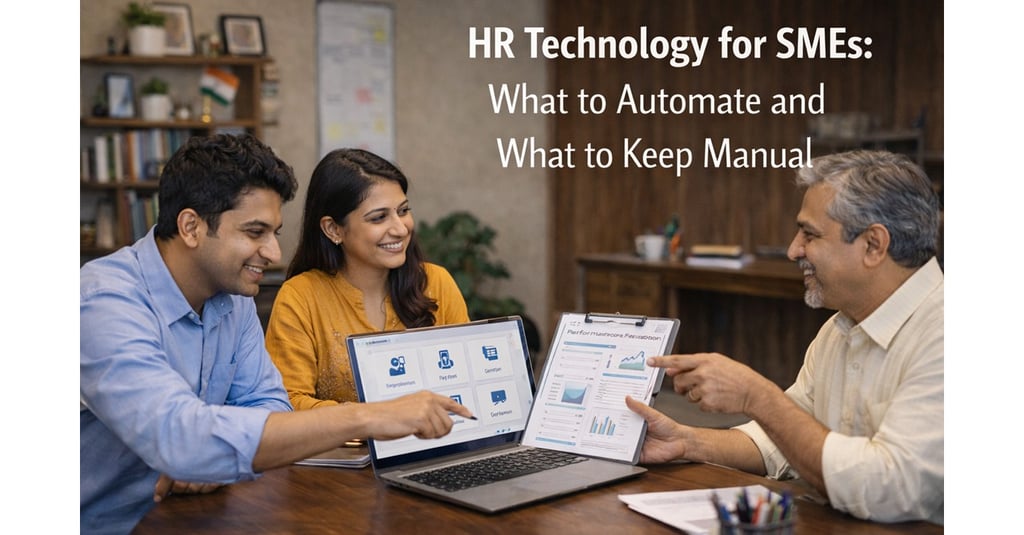
Indian SMEs are increasingly adopting HR technology — attendance apps, payroll software, HRMS tools, and employee portals. While technology can improve efficiency, many SMEs either delay adoption entirely or over-automate without readiness.
HR technology works best for SMEs when it supports discipline and consistency, not when it replaces judgement. This article helps SMEs decide what HR activities to automate and what to keep manual, based on scale, risk, and practicality.
Why HR Tech Decisions Matter for SMEs
Poor HR tech decisions can lead to:
High costs without proportional value
Data inaccuracies and employee frustration
Compliance gaps masked by automation
Over-dependence on tools without process clarity
For SMEs, the goal is appropriate automation, not full digitisation.
Core Principles for HR Automation in SMEs
Before adopting any HR technology, SMEs should ensure:
Processes are defined before being automated
Data ownership and accuracy are clear
Users (HR and managers) are trained
Manual controls exist for exceptions
Automation amplifies existing discipline — or the lack of it.
HR Areas Suitable for Automation
Certain HR activities are transaction-heavy and repetitive, making them ideal for automation in SMEs:
Attendance tracking
Leave applications and balances
Payroll processing
Statutory contribution calculations
Employee master data maintenance
Automation here reduces errors and saves time.
HR Areas Better Kept Manual (or Semi-Manual)
Some HR activities require context, judgement, and discretion, especially in SMEs:
Hiring decisions and interviews
Performance discussions
Disciplinary actions
Grievance handling
Exit conversations
Technology can support documentation, but not decision-making.
Common HR Tech Mistakes SMEs Make
SMEs often struggle when they:
Buy tools without defining processes
Assume software ensures compliance automatically
Over-customise systems early
Ignore data quality and audits
Leave adoption entirely to vendors
Technology cannot compensate for weak HR governance.
HR’s Role in HR Tech Adoption
HR must act as the process owner, not just system user. This includes:
Defining workflows before automation
Validating data and reports
Ensuring compliance alignment
Training managers and employees
Reviewing effectiveness periodically
Tools should serve HR objectives, not dictate them.
Scaling HR Tech with Business Growth
SMEs should adopt HR tech in phases:
Start with payroll and attendance
Add leave and employee records
Introduce performance or learning modules later
Integrate systems only when scale demands
Gradual adoption reduces disruption and cost.
Conclusion
For Indian SMEs, HR technology is a support system, not a solution by itself. Automating transactional processes improves efficiency, while keeping judgement-driven HR activities manual ensures fairness and flexibility. The most effective SMEs use technology selectively and responsibly, aligned with their maturity and scale.
Checklist: Using HR Technology Effectively in SMEs
🗹 Define HR processes clearly before automation
🗹 Automate high-volume, repetitive activities first
🗹 Retain human judgement for people decisions
🗹 Ensure data accuracy and ownership
🗹 Train HR, managers, and employees on systems
🗹 Avoid over-customisation in early stages
🗹 Review compliance impact of HR tech regularly
🗹 Scale HR technology gradually with growth
What to Automate vs Keep Manual in SME HR
Conclusion--
Effective labour law compliance depends on how well HR operations, payroll, and business processes work together. When compliance is embedded into everyday workflows, organisations reduce risk, improve accuracy, and build sustainable governance systems. HR teams that prioritise integration over isolation are better positioned to manage compliance confidently and consistently.
HireDesk India © 2026 | All Rights Reserved
"Thoughtful guidance for everyday HR"


Quick Links
Topics
Connect
_______________________________________________________________________________________________________________________________________________________________________________________
HireDesk is a free HR knowledge platform focused on practical, India-specific workplace guidance. We help HR professionals, managers, and learners navigate people practices with clarity, responsibility, and real-world relevance.