
HR’s Accountability and Decision-Making in Recruitment
RECRUITMENT AND HIRING
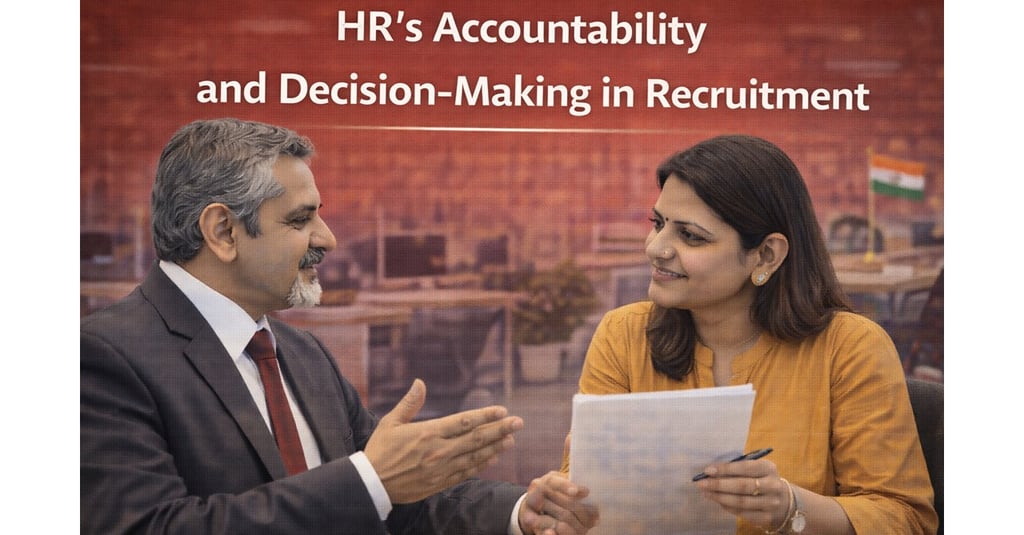
HR plays a central role in recruitment, yet accountability is often diluted in Indian organisations. Decisions are sometimes influenced by line managers, external agencies, or operational urgency, leaving HR in a transactional position. Strong HR accountability ensures recruitment aligns with business goals, legal compliance, and long-term workforce quality.
For Indian HR teams, structured decision-making and ownership are essential to prevent hiring errors, bias, and process failures.
Understanding HR Accountability in Recruitment
HR accountability involves:
Ensuring hiring aligns with organisational needs and strategy
Owning recruitment processes end-to-end
Making informed decisions based on data, policy, and judgement
Monitoring outcomes, including retention and quality
Accountability is both procedural and ethical.
Common Gaps in HR Decision-Making
Over-Reliance on Managers
When HR defers hiring decisions entirely to line managers:
Role clarity may be compromised
Screening and assessment standards can vary
HR loses oversight of compliance and fairness
Weak Ownership of Process
Without end-to-end ownership, HR may:
Miss incomplete documentation
Allow unstructured interviews
Fail to track candidate experience
Process gaps undermine recruitment credibility.
Insufficient Data-Driven Decisions
HR often relies on intuition rather than:
Metrics on hiring source effectiveness
Assessment performance correlations
Early attrition patterns
Data-driven decisions improve predictability and quality.
Strengthening HR Decision-Making
Structured Policies and Approval Frameworks
HR must define:
Clear delegation of authority
Standardised interview and selection criteria
Budget and headcount approvals
Policy clarity strengthens accountability.
Active Oversight of Recruiters and Agencies
HR should monitor:
Agency compliance
Recruiter adherence to process
Candidate interactions and feedback
Oversight prevents errors and bias.
Leveraging Metrics and Feedback
HR should track:
Time-to-hire, cost-per-hire, and quality-of-hire
Early attrition and joining dropouts
Candidate experience scores
Regular review of metrics informs better decisions.
Decision-Making Principles for HR
Consistency: Apply rules uniformly across roles and locations.
Fairness: Avoid bias in screening, interviews, and offers.
Transparency: Communicate clearly with managers, candidates, and stakeholders.
Responsiveness: Balance speed with thorough evaluation.
Accountability: Take ownership of process outcomes, not just execution.
Conclusion
HR accountability in recruitment is critical for consistent quality, fairness, and organisational credibility in India. Structured decision-making, process ownership, and active monitoring empower HR to be a strategic partner rather than a passive administrator. When HR leads recruitment responsibly, hiring outcomes improve and organisational risk decreases.
🗹 HR Accountability and Decision-Making Checklist
🗹 Own the recruitment process end-to-end
🗹 Define clear roles, responsibilities, and approval frameworks
🗹 Standardise screening, interview, and assessment criteria
🗹 Monitor recruiter and agency compliance
🗹 Use data and metrics to guide decisions
🗹 Ensure consistency and fairness across all roles
🗹 Communicate transparently with managers and candidates
🗹 Review outcomes and iterate processes
HR Accountability Controls in Recruitment
Conclusion--
Effective labour law compliance depends on how well HR operations, payroll, and business processes work together. When compliance is embedded into everyday workflows, organisations reduce risk, improve accuracy, and build sustainable governance systems. HR teams that prioritise integration over isolation are better positioned to manage compliance confidently and consistently.
HireDesk India © 2026 | All Rights Reserved
"Thoughtful guidance for everyday HR"


Quick Links
Topics
Connect
_______________________________________________________________________________________________________________________________________________________________________________________
HireDesk is a free HR knowledge platform focused on practical, India-specific workplace guidance. We help HR professionals, managers, and learners navigate people practices with clarity, responsibility, and real-world relevance.